
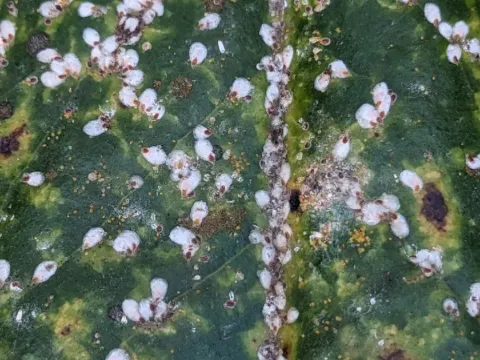
Natal phenacaspis
Phenacaspis natalensis
Natal phenacaspis (Phenacaspis natalensis) is a small insect species belonging to the order Hemiptera and the family Diaspididae (armored scale insects). It is characterized by a cryptic lifestyle and a protective waxy scale covering.
What the section contains
Natal phenacaspis
Adult females have a pear-shaped or elongated body shielded by a white or greyish wax cover. Males are significantly smaller than females, winged, and mobile, allowing them to locate mates during the reproductive phase.
Precise species identification requires microscopic analysis of the female pygidium — the terminal segment of the abdomen. These morphological traits are essential for distinguishing Phenacaspis species from other diaspidid scales.
The life cycle involves a crawler stage (first instar larva). This is the only mobile phase of the insect, during which it disperses across the host plant or to adjacent plants.
Once a suitable feeding site is selected, the crawler attaches itself, loses mobility, and initiates the formation of its protective cover. From this point on, it remains sedentary and focuses on continuous feeding.
This pest primarily attacks woody ornamental plants and shrubs. It poses a significant threat to evergreen species, especially in subtropical and tropical environments where growing conditions are optimal.
The insect feeds by inserting its mouthparts into plant tissues and extracting sap from leaves, shoots, and thin branches. This mechanical and physiological stress severely depletes the host plant.
Infested plants, often used for urban landscaping, lose their aesthetic value and decorative properties. Heavy infestations can result in partial dieback of branches or the death of younger, less established plants.
Wounds caused by feeding facilitate the entry of secondary pathogens. Fungal infections frequently colonize these damaged sites, further compromising the overall health of the plant.
The extent of damage depends on the population density. High numbers of scale insects lead to rapid loss of turgor, leaf yellowing, and premature defoliation.
The phenology of Natal phenacaspis is highly dependent on temperature and humidity. In warm regions, the pest can develop continuously, producing multiple generations throughout the year.
The period of peak crawler activity coincides with warmer seasonal temperatures. This is the most critical window for monitoring populations and initiating management interventions.
The species typically overwinters as fertilized females or older nymphs. They find shelter in bark crevices or near bud scales, where environmental conditions are slightly more buffered.
In greenhouse settings or indoor garden environments, generations can overlap, leading to a constant presence of all life stages of the pest.
Adverse climatic conditions, such as heavy rain or extreme temperatures, may temporarily suppress reproduction, but they are rarely sufficient to eradicate an established population.
The primary symptom is the presence of white or grey scale covers, resembling tiny flakes, on the underside of leaves and along branches. Often, these colonies appear in dense clusters.
Feeding damage typically manifests as chlorotic (yellow) spots on leaves. Over time, these leaves turn brown, wither, and drop prematurely, causing the canopy to become sparse.
The overall appearance of the host becomes stunted. Shoot growth is significantly delayed, and stems may become misshapen or brittle, which is particularly evident in young transplants.
In cases of heavy infestation, the surface of branches is coated in a thick layer of scale wax, which interferes with normal gas exchange and transpiration processes.
Thorough inspections of the plant, especially the interior of the canopy and leaf undersides, are necessary to detect the pest before visible signs of decline appear.
Effective management requires an integrated approach. Early detection allows for physical removal of minor infestations using soft brushes soaked in soapy oil solutions.
Systemic insecticides are considered the most effective control measures. These chemicals are absorbed by the plant, providing residual protection against sucking insects for an extended period.
Application timing is crucial; treatments are most effective during the crawler stage, as these young larvae lack the protective wax shield that makes adults highly resistant to contact pesticides.
Biological control strategies involve the release or preservation of natural enemies, including predatory coccinellids (ladybugs) and parasitic wasps, which can regulate scale populations.
Strict phytosanitary practices are essential when importing new plant material to prevent the introduction and spread of this pest into clean landscapes and nurseries.