
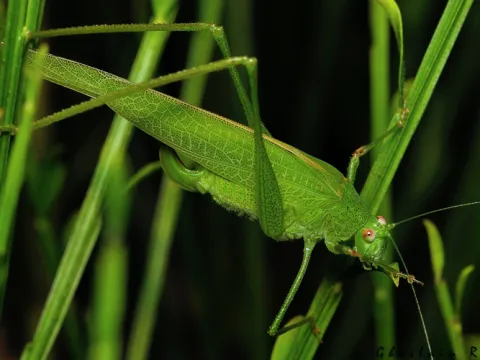
Four-spotted grasshopper
Phaneroptera quadripunctata
The four-spotted grasshopper (Phaneroptera quadripunctata) is a member of the Tettigoniidae family within the order Orthoptera. It is a slender, green insect with long, thread-like antennae.
What the section contains
Four-spotted grasshopper
A distinctive trait of this species is the presence of four dark spots on its wings, arranged in pairs, which distinguishes it from other similar grasshoppers. Adults typically measure 15–20 mm in length.
The wings extend well beyond the abdomen, giving the insect a streamlined appearance. Its hind legs are powerful and adapted for leaping, while its coloration provides excellent camouflage in foliage.
The biology of this species is tied to warm, temperate climates. Adults are primarily active during the evening and night, although they may be encountered during the day in dense vegetation.
The life cycle includes an egg stage, which usually overwinters in plant tissues, and several nymphal stages where the insect gradually matures into its adult form.
This species is a polyphage, meaning it feeds on a wide range of plants. It causes significant damage to vegetable crops, fruit trees, and ornamental plants.
The grasshoppers consume leaves, young shoots, and developing fruit, leaving behind ragged, irregular holes. Young, actively growing plants are the most susceptible to attack.
Damage to flowers and buds is common, which significantly lowers crop yields and ruins the aesthetic quality of ornamental plants due to tissue deformation.
High populations of this pest can lead to severe defoliation, which weakens the host plants and makes them more susceptible to environmental stress and secondary infections.
Wounds caused by feeding provide entry points for various pathogens, including fungi and bacteria, which can cause rotting and further loss of agricultural productivity.
The primary sign of infestation is the presence of irregular, ragged holes in the foliage. Unlike some pests that leave clean edges, grasshoppers leave uneven bite marks.
Small dark granules of excrement can often be found on the leaves below feeding sites. In the evening, their presence is often announced by characteristic stridulation (chirping sounds).
Feeding damage on buds and fruit often appears as deep gouges or depressions, which may dry out or rot, frequently leading to the premature drop of the fruit or flower.
In severe cases, you may notice yellowing of the leaves and premature leaf drop, resulting from sustained feeding pressure throughout the growing season.
Careful inspection of the undersides of leaves and shaded areas of the plant canopy in the early morning can reveal the presence of nymphs hiding from direct sunlight.
Control measures begin with good cultural practices, such as clearing weeds and debris around cultivation areas where grasshoppers hide or lay eggs.
When pest populations exceed economic thresholds, authorized insecticides should be applied according to the manufacturer's instructions for specific crops.
Biological control involves promoting natural predators, including insectivorous birds, parasitic wasps, spiders, and predatory beetles that naturally feed on grasshopper nymphs.
Regular monitoring of plants, particularly during the flowering and fruit-setting stages, is crucial to detecting early colonization and preventing population spikes.
For smaller gardens or protected structures, mechanical removal of the insects in the early morning, when they are less mobile due to cooler temperatures, can be an effective non-chemical solution.