
Gymnocheta
Gymnocheta
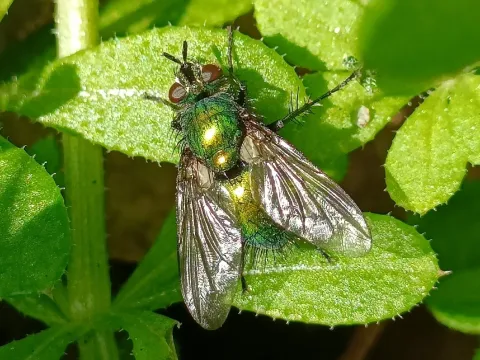
Gymnocheta is a genus of tachinid flies belonging to the family Tachinidae. Adult individuals are characterized by their metallic green or bluish body coloration, making them easily distinguishable from other fly species.
What the section contains
Gymnocheta
The morphology is typical for parasitoid flies: prominent bristles covering the thorax and abdomen. They possess transparent wings with well-defined venation, allowing for highly agile and rapid flight patterns.
They have a large head with well-developed compound eyes, providing a wide field of vision. Their mouthparts are specialized for nectar feeding, making them frequent visitors to meadow and agricultural landscapes.
The larval stages undergo several instars, changing significantly in size and shape. Unlike the adults, larvae require specific host insects to complete their development and pupation.
Precise species identification within the genus often requires microscopic examination of key features, such as antennal structure and the specific arrangement of thoracic bristles.
It is important to emphasize that many Gymnocheta species function as beneficial entomophages, playing a vital role in regulating populations of various moth caterpillars.
However, within certain agroecosystems, an imbalance can occur. While they are usually beneficial, high numbers may influence the local entomofauna, competing with other natural enemies for hosts.
They do not cause direct damage to plants by feeding on leaves or stems, as they are not herbivores. Their impact on crops is indirect and tied to the population dynamics of their hosts.
Crops suffer if the natural regulation of primary pests is disrupted. In such cases, the absence of parasitoids like Gymnocheta leads to a rapid increase in caterpillar damage.
Agronomists view these insects primarily as indicators of the presence of hidden pests, rather than as primary targets for chemical extermination.
Adult activity is most pronounced during the spring and summer months, coinciding with the flowering period of early nectar-producing plants.
The life cycle is closely synchronized with the phenology of their hosts — caterpillars of various noctuid and geometer moths that infest vegetables and row crops.
Throughout the warmer season, the population can go through several generations, depending on regional climatic conditions and the availability of suitable hosts.
As autumn approaches, activity levels drop, and the insects transition into dormancy or pupate within the soil to survive the winter season.
Environmental factors, such as ambient humidity and temperature fluctuations, significantly influence larval survival rates and the overall success of each generation.
The most visible sign of their presence is the swarm of metallic-green flies in areas where caterpillar populations are known to reside on foliage.
Occasionally, one may observe tiny eggs attached to the bodies of caterpillars, usually located near the head or thoracic segments, indicating successful oviposition.
Affected caterpillars gradually lose vitality and eventually perish, often leading to a noticeable decline in pest numbers without human intervention.
After the adult flies emerge, empty puparia may be found in the soil or among organic debris, serving as physical evidence of a completed lifecycle.
A sudden decrease in caterpillar populations despite previously high numbers is a strong diagnostic indicator of successful parasitism by tachinid flies.
Given the beneficial role of many tachinid species, specific control measures are rarely needed and are generally discouraged to avoid disrupting biological pest regulation.
If population control becomes necessary, for instance in greenhouses, standard fly management methods such as adhesive traps should be employed.
Reducing the usage of broad-spectrum insecticides is a critical strategy for maintaining a healthy population of these beneficial natural enemies in the field.
Agrotechnical practices, such as deep tillage, must be managed carefully as they can negatively impact the soil-dwelling overwintering stages of these beneficial flies.
Establishing nectar-rich buffer strips around crop perimeters ensures a steady food source for adult flies, supporting a stable and effective population of parasitoids.