
Anisopteromalus calandrae
Anisopteromalus calandrae
Description
How to identify
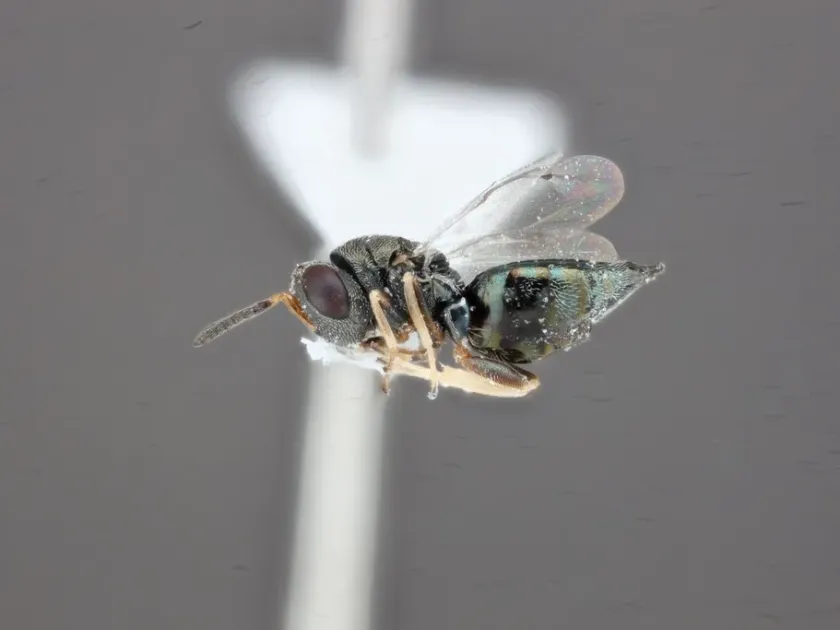
Anisopteromalus calandrae is a small hymenopteran insect belonging to the family Pteromalidae. Adults are typically 2–4 mm long and exhibit a metallic green or bronze coloration, which is characteristic of many pteromalids.
The female is equipped with a functional ovipositor, allowing her to penetrate grain kernels or search through packed storage materials to locate host larvae. They have characteristic elbowed antennae and delicate, clear wings.
This species is globally distributed and commonly found in granaries, mills, and warehouses. Its high mobility allows it to locate isolated pockets of pest infestations within large storage environments.
As a parasitoid, its morphology is adapted for exploring narrow crevices where grain pests like weevils hide. It is highly valued for its ability to track down hosts that are otherwise difficult to reach with chemical sprays.
Identification often requires careful inspection under a microscope, focusing on wing venation and abdominal structure. It is a highly specialized natural enemy within its ecological niche.
What it damages
It is crucial to classify Anisopteromalus calandrae not as a pest, but as a highly beneficial biological control agent. Its primary role in agricultural ecosystems is the regulation of stored grain pest populations.
The wasp targets the larvae and pupae of several major stored-product pests, including the rice weevil (Sitophilus oryzae) and the maize weevil (Sitophilus zeamais). It effectively reduces their numbers, preventing widespread crop loss.
By paralyzing the host larva before laying an egg, the wasp ensures the death of the pest, protecting the internal structure of the grain kernel. This biological suppression is vital for reducing food waste during storage.
Using this parasitoid allows for an integrated pest management approach that minimizes dependence on dangerous synthetic fumigants. It is a preferred method for organic grain storage and long-term commodity protection.
The impact of this insect is most significant when pest density is moderate, as it can keep the host population below the economic threshold without human intervention.
When it appears
The life cycle and activity of Anisopteromalus calandrae are strictly governed by temperature conditions inside storage facilities. The wasp performs best in warm environments, typically between 25°C and 30°C.
Below 15°C, metabolic activity and reproduction rates drop significantly, often leading to a cessation of effective control. Therefore, its utility is most pronounced in temperature-controlled or summer-season environments.
The generation time from egg to adult is remarkably short, often taking about 15 to 20 days under optimal conditions. This rapid turnover allows for quick population surges when prey is abundant.
Adult wasps are active searchers, spending weeks hunting for pest larvae by detecting chemical signals produced by their hosts. They are highly responsive to kairomones emitted by developing weevils.
The population peak usually aligns with the period when host infestation reaches its height, generally following the harvest and storage period in warmer climates.
Control measures
Control efforts regarding Anisopteromalus calandrae focus on conservation and augmentation rather than eradication. Because they are beneficial, any chemical interference must be carefully managed or avoided entirely.
Broad-spectrum insecticides are extremely detrimental to wasp populations and should be avoided in facilities where biological control programs are in place. Selective, targeted applications are preferred if necessary.
Maintaining a stable microclimate is essential for sustaining the presence of these wasps. Excessive dryness or extreme cooling should be avoided to ensure the survival of adult populations.
Integrated programs should emphasize sanitation to reduce the initial pest population, followed by the introduction or protection of the wasp to handle the remaining larvae.
- Avoid broad-spectrum chemical fumigants
- Maintain storage temperatures around 25-30°C
- Monitor pest density to assess the wasp's effectiveness
- Minimize storage disturbances that disrupt wasp foraging
- Implement a sanitation program to complement biological control
Taxonomy
- Latin name
- Anisopteromalus calandrae
- Order
- Hymenoptera
- Family
- Pteromalidae
- EPPO code
- ANIMCA
Discussion
No discussions yet — be the first.