
Cerocephala
Cerocephala
Description
How to identify
Cerocephala belongs to the Hymenoptera order and the Pteromalidae family. These are tiny parasitic wasps frequently found in areas where grain and grain products are stored.
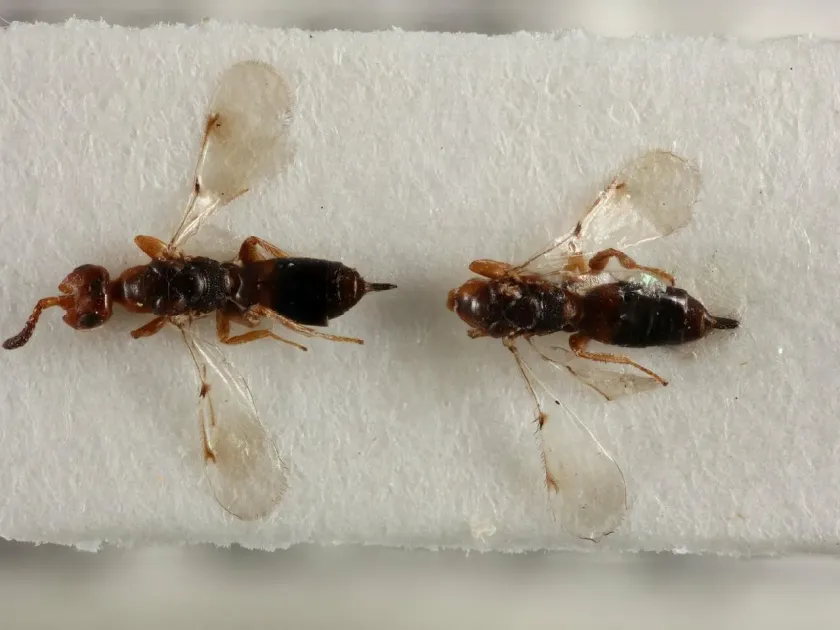
Visually, the adults are minute insects with a characteristic metallic sheen. The head and thorax are usually dark, often displaying a greenish or bronze reflection, which distinguishes them from other parasitoids.
Females possess a well-developed ovipositor, allowing them to penetrate the hard husks of seeds or reach host larvae hidden deep within the grain substrate.
The wings of the adults are transparent with specific venation typical of pteromalids. Studying their morphology is essential for precise species identification, as the genus includes several biologically similar representatives.
In agronomy, this genus is viewed from two perspectives: as a primary parasite of stored-grain pests, which helps limit their population, and as a pest itself that requires management in storage facilities.
What it damages
Cerocephala are specialized parasitoids that develop by feeding on the larvae of various seed-boring beetles that infest stored grain.
Their primary targets are larvae of granary weevils and various species of bruchids (Bruchidae). By parasitizing these pests, Cerocephala indirectly reduces the population of dangerous storage insects.
The insect does not cause direct damage to the grain itself, as adults feed on nectar or host hemolymph. However, their presence in storage requires strict sanitation monitoring.
Their economic value lies in the potential for using these entomophages for biological control in closed environments, reducing the need for chemical fumigation.
Nevertheless, in cases of mass infestation, any parasitic Hymenoptera can contaminate products, which negatively affects the commercial quality of grain intended for export.
When it appears
The activity of Cerocephala is directly dependent on temperature and humidity conditions within the storage facilities where grain stocks are kept.
The most favorable period for population growth is the warm season, when the air temperature inside grain silos rises above +20...+25 degrees Celsius.
The life cycle consists of several stages: egg, larva, pupa, and adult. Given sufficient host availability, the pest can produce several generations within a single season.
In unheated warehouses, development slows down during winter, but with stable temperatures inside the grain bulk, the insects are capable of continuing development throughout the year.
Monitoring is conducted using sticky traps or by taking grain samples to identify traces of host beetle activity.
Signs of infestation
The main sign of Cerocephala presence is observing the adults on the surface of the grain pile or on the inner walls of storage containers.
An indirect sign is the presence of "windows" or small holes in grains left by the host beetle larvae, which serve as access points for the parasites.
When damaged grains are opened, one can find Cerocephala larvae or pupae, which pupate inside the chamber prepared by the host larva.
The presence of the parasitoid indicates that the grain is already heavily infested with beetles, which is a clear signal that immediate treatment of the batch is required.
Visual inspection of grain samples under a magnifying glass reveals characteristic exit holes of the adults, which differ slightly in shape from those of the host beetles.
Control measures
The primary method of control is strict adherence to sanitary standards and hygiene in grain storage, including regular cleaning of equipment to remove dust and product residues.
Applying grain fumigation helps eliminate both the primary pests and the parasitic Hymenoptera, ensuring the preservation of product quality.
Maintaining low temperatures (below +10...+12 degrees Celsius) in storage facilities significantly reduces the activity of Cerocephala and the development of its hosts.
- Cleaning warehouses before receiving a new harvest.
- Regular monitoring of grain infestation using pheromone traps.
- Usage of biological insecticides when necessary.
In some cases, under ecologically oriented storage systems, Cerocephala is not eradicated if its population effectively keeps primary pest numbers below economic injury levels.
Taxonomy
- Latin name
- Cerocephala
- Order
- Hymenoptera
- Family
- Pteromalidae
- EPPO code
- KRKESP
Discussion
No discussions yet — be the first.