
Alfalfa seed chalcid
Bruchophagus platypterus
Description
How to identify
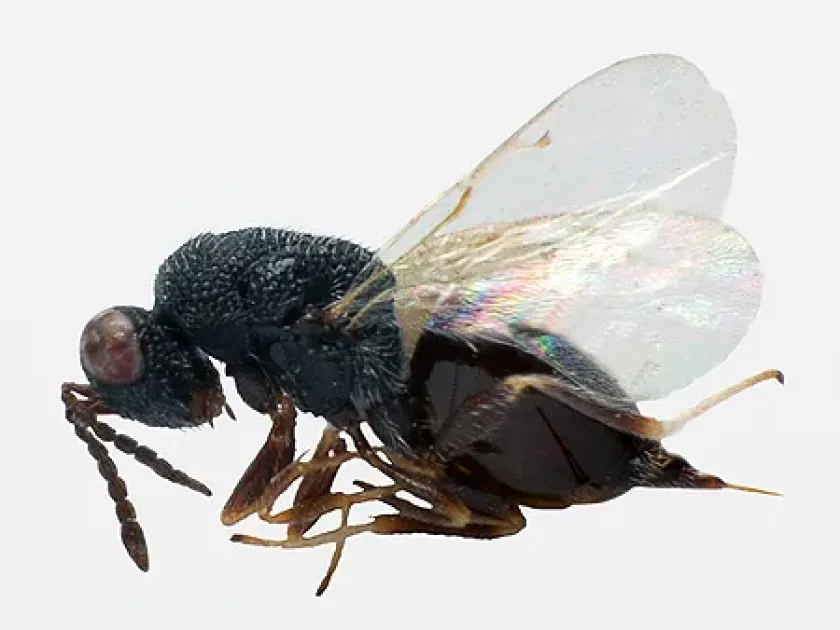
The alfalfa seed chalcid (Bruchophagus platypterus) is a small hymenopteran insect belonging to the Eurytomidae family. Adult insects are black with a slight metallic sheen, measuring about 1.5–2 mm in length.
The species is named for its distinctive morphological feature: the hind femora (thighs) are significantly thickened. They have transparent wings with minimal venation, making them quite difficult to spot during flight.
The larvae are legless, white to yellowish in color, and have a curved body shape with a well-developed head. The entire larval stage is spent inside the seed, consuming its nutrients.
This pest is widespread in regions where alfalfa is cultivated. It thrives in warm, dry weather conditions, which often coincide with the flowering period of the host plants.
The insects overwinter as larvae inside infested seeds left on the ground, in crop residues, or within unharvested flower heads, serving as a primary source for re-infestation.
What it damages
The alfalfa seed chalcid primarily infests the seeds of alfalfa (Medicago sativa). It can also occasionally infest seeds of clover and other leguminous plants.
The damage is caused by the larvae, which hollow out the developing seeds. This consumption destroys the embryo, rendering the seed entirely non-viable for future planting.
Infested seeds are often empty, light, and brittle. Under heavy infestation, losses can reach 50–80% of the potential seed yield, significantly impacting profitability.
Because the larvae are concealed inside the seed coat for most of their life cycle, they are well-protected from environmental stress and most chemical insecticidal treatments.
Beyond quantity, the quality of the seed batch is degraded, as the presence of hollowed seeds creates a high percentage of waste during cleaning and processing.
When it appears
Adult emergence typically begins in late spring or early summer, coinciding with the bud and initial flowering stage of the alfalfa crop.
The peak flight of adults occurs during full bloom. Females use their ovipositors to insert eggs directly into the developing seed within the alfalfa pod.
The lifecycle from egg to adult takes approximately 3 to 5 weeks. Depending on climate, the pest can complete two or sometimes three generations in a single season.
The second generation is usually the most damaging, as it targets the seeds of the second cutting, which are often the ones intended for seed production.
As temperatures drop in the autumn, the final generation of larvae enters diapause inside the seeds, where they remain until the following spring.
Signs of infestation
Early infestation is extremely difficult to detect. The presence of the pest is usually noticed by sweeping flowering fields with an insect net to capture flying adults.
A definitive sign of infestation is the presence of small, circular exit holes on the pods. These holes indicate that the adult chalcid has completed its development and emerged.
Infested pods may appear prematurely yellow or shriveled compared to healthy pods. When squeezed, these pods are often found to contain no healthy seeds.
Growers should monitor fields frequently during the flowering stage, using the threshold of 3–5 adults per 10 sweeps of a net as a trigger for intervention.
In laboratory settings, infested seeds are identified by dissecting them, which reveals the presence of white larvae or pupae inside the hollowed-out seed coat.
Control measures
Maintaining proper distance between alfalfa fields of different ages is a critical cultural practice to limit the migration of the pest from older, infested sites.
Harvesting seed crops as early as possible can help remove the infested seeds from the field before the insects emerge and spread to new areas.
Deep plowing in the autumn (burying crop residues) is an effective mechanical method to destroy overwintering larvae residing in fallen seeds or plant debris.
Chemical control must be applied strategically during the peak emergence of adults, but prior to egg-laying, using systemic or contact insecticides.
- Monitor fields during the initial flowering stages.
- Use professional seed cleaning equipment to remove lightweight infested seeds.
- Eliminate volunteer alfalfa and weeds around field borders.
- Encourage natural biological control by protecting beneficial insect populations.
Taxonomy
- Latin name
- Bruchophagus platypterus
- Order
- Hymenoptera
- Family
- Eurytomidae
- EPPO code
- BRPHPL
Discussion
No discussions yet — be the first.