
Alfalfa seed chalcid
Bruchophagus mellipes
Description
How to identify
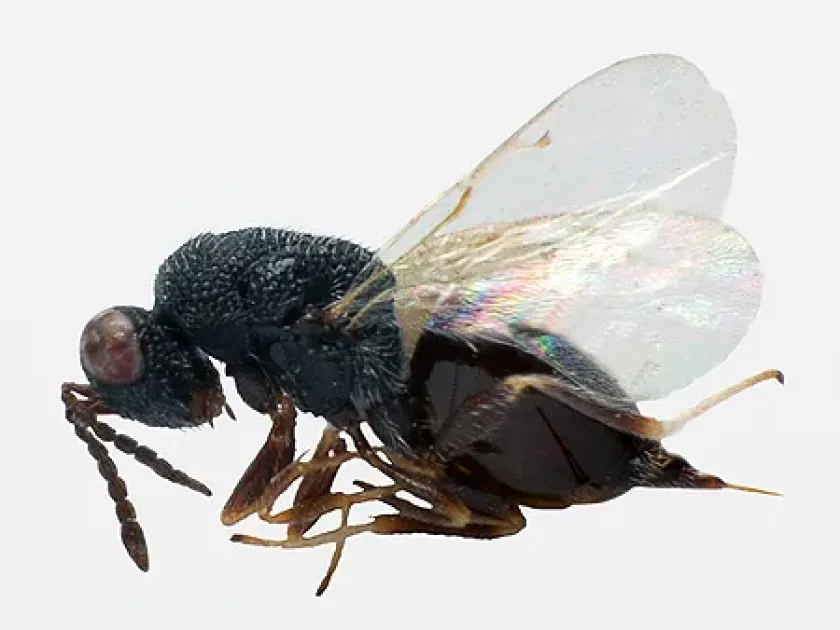
The alfalfa seed chalcid (Bruchophagus mellipes) is a tiny hymenopteran insect belonging to the family Eurytomidae. Adult wasps are approximately 1.5 to 2 mm long and have a predominantly black, robust body.
The adult female is equipped with an ovipositor, which is used to pierce the tender pods and developing seeds of alfalfa. The visual identification of adults in the field requires close inspection due to their small size and rapid movement.
Larvae are legless, white, and fleshy, specifically adapted to live within the confined space of a single seed. Their entire development occurs inside the seed, effectively masking their presence until the adult emerges.
These wasps are capable of flying long distances when temperatures are warm, making them highly efficient at colonizing new alfalfa fields during the flowering and seed-set stages.
The biology of this species is perfectly synchronized with the phenology of its host plant, ensuring that larvae always have a sufficient food supply during the critical stages of seed maturation.
What it damages
The primary economic damage is caused by the larvae feeding on the contents of the alfalfa seeds. A single larva consumes the entire inner part of a seed, leaving only the empty hull behind.
The alfalfa seed chalcid infests various legume species, causing significant reductions in seed yield and viability. Crops left for seed production are particularly vulnerable to infestation if left unmanaged.
Infested seeds become non-viable, failing to germinate, which significantly diminishes the overall quality and commercial value of the harvested seed lot.
Under favorable environmental conditions, the chalcid population can explode, causing up to 50% or more crop loss in highly infested areas, leading to significant financial losses for farmers.
Because the damage is hidden within the seed coat, it is often not realized until the final cleaning process, when the empty, lightweight seeds are removed from the bulk.
When it appears
The life cycle begins in spring when overwintering adults emerge from infested seeds left in the field or in storage facilities. This timing usually coincides with the flowering of the first alfalfa cut.
Adult activity peaks during the mid-summer months when seeds are actively developing. Females seek out green, succulent pods to lay their eggs, repeating the cycle as more pods become available.
Depending on the climatic zone, the chalcid can complete one to two generations per year. The insects pupate within the seeds they have consumed, emerging as adults to start the next generation.
The pest overwinters as a full-grown larva inside dry seeds that remain in the field or are stored in improperly cleaned seed lots.
Warm, dry weather conditions significantly accelerate the development of the larvae and increase the frequency of adult emergence, leading to higher infestation rates throughout the season.
Signs of infestation
The most distinctive sign of infestation is the appearance of tiny, perfectly round exit holes on the surface of mature seeds, created by emerging adult wasps.
During the harvest, seeds may appear lighter or duller than healthy ones. A simple water test can reveal infested seeds, as they tend to be hollow and will float on the surface.
While the exterior of the pods may look relatively normal, a closer inspection of individual seeds extracted from the pods will reveal the presence of larvae or empty cavities.
A reduction in the total weight of the harvested seed lot compared to previous years is a major red flag for chalcid infestation levels in the field.
Early yellowing or drying of seed pods, occurring prematurely compared to the rest of the field, can also indicate that chalcid larvae are developing within those pods.
Control measures
Effective control starts with cultural practices, such as early cutting of alfalfa for hay, which can eliminate infested pods before the larvae have a chance to complete their development.
Maintaining spatial separation between hay fields and seed production areas is critical to prevent the migration of adult wasps into highly valuable seed-producing blocks.
- Utilizing advanced seed cleaning equipment to separate and remove lightweight, infested seeds from the commercial product.
- Sanitation of fields by burying crop residues through deep plowing to destroy overwintering larvae.
- Weed control, particularly of wild legumes that serve as alternative hosts for the chalcid population.
- Strategic application of insecticides during the adult flight period to reduce egg-laying opportunities.
- Harvesting seed crops as early as possible to minimize the time available for chalcid infestations.
Chemical control must be applied with caution, choosing products that are safe for pollinators, as alfalfa seed production relies heavily on the presence of bees during the bloom period.
Taxonomy
- Latin name
- Bruchophagus mellipes
- Order
- Hymenoptera
- Family
- Eurytomidae
- EPPO code
- BRPHME
Discussion
No discussions yet — be the first.