
Citrus gall wasp
Bruchophagus fellis
Description
How to identify
The citrus gall wasp (Bruchophagus fellis) is a small hymenopteran insect belonging to the Eurytomidae family. Unlike many other insects, this species is specialized to live within the plant tissue, which provides it with protection.
The adult insect is a tiny black wasp, approximately 2–3 mm in length. The female has a specialized ovipositor that allows her to penetrate deep into young citrus shoots to lay eggs.
The larvae are cream-colored, legless, and mostly sedentary. It is the larval stage that is primarily responsible for the physiological damage to the host plant.
The development of this pest is strictly synchronized with the citrus tree's growing cycle. Because the entire life cycle occurs inside the woody tissue, the insect is difficult to detect during early stages.
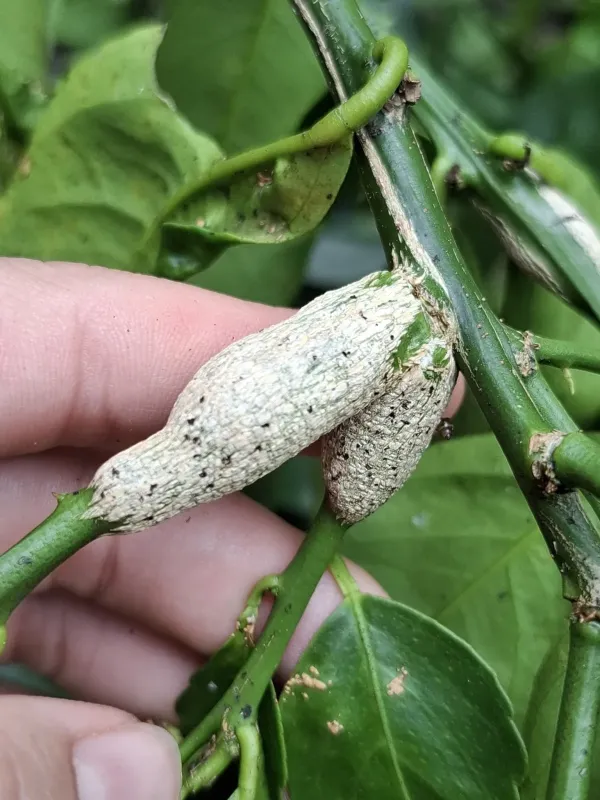
The key diagnostic feature is the formation of galls—pathological growths on the branches caused by the plant's response to the presence of feeding larvae.
What it damages
This pest affects various citrus species, including lemons, oranges, and grapefruits. It poses a significant threat to both commercial orchards and backyard citrus trees.
The most severe damage is inflicted on young, vigorous spring growth. Feeding larvae inside the stem stimulate abnormal cell division, resulting in the formation of woody, tumor-like galls.
Infested branches become brittle and distorted. This causes a disruption in sap flow, which severely hinders the tree's development and can lead to a significant decline in fruit production.
Heavy infestations often lead to premature leaf drop and the dieback of infected branches. Stressed trees are also more susceptible to secondary fungal or bacterial infections.
A high population density of the wasp can result in major economic losses, affecting both the health of the orchard and the quality of the harvest.
When it appears
The emergence of adult wasps generally coincides with the active spring growth phase, when the tree produces the succulent young stems favored for egg-laying.
In subtropical regions, the peak flight period usually occurs in spring when temperatures become consistently warm. During this window, adults mate and search for fresh shoots.
After egg-laying, the larvae develop inside the stems for several months. During this period, the galls grow gradually, becoming increasingly visible as they swell.
The insect overwinters inside the galls as a larva or pupa. This stage provides excellent protection against cold temperatures and other environmental stresses.
The cycle concludes in the following season when the new generation of adults emerges from the galls, perpetuating the infestation in the orchard.
Signs of infestation
The most obvious symptom is the presence of swellings or galls on the surface of young branches. These growths can vary in size and significantly distort the stem's appearance.
If you inspect the surface of a gall closely, you may see tiny exit holes. These indicate that the adult wasps have completed their metamorphosis and have already emerged.
Infested branches appear crooked and unhealthy. In early stages, before galls are fully formed, one might notice stunted shoot growth and slight yellowing of the foliage.
In neglected cases, branches may split, exposing the inner wood. This creates entry points for pathogens, potentially leading to wood rot and branch failure.
For definitive confirmation, one can cut a suspected branch open. Finding larval chambers within the wood confirms the presence of the citrus gall wasp.
Control measures
Sanitation is the most effective control method. All infested branches should be pruned and destroyed (burned) before adult wasps emerge to prevent the next generation from spreading.
Regular monitoring of the orchard during the spring growth phase is crucial. Early detection allows for the removal of galls before the pest population can expand.
Chemical control is only effective during the short adult flight window. Insecticides must be applied before the wasps lay their eggs deep inside the plant tissue.
Biological control, including the use of parasitic wasps that prey on the gall wasp larvae, can help keep populations at manageable levels in natural environments.
Maintaining optimal tree health through proper fertilization and irrigation is essential, as healthy trees possess a stronger immune response to pest attacks.
Taxonomy
- Latin name
- Bruchophagus fellis
- Order
- Hymenoptera
- Family
- Eurytomidae
- EPPO code
- EURTFE
Discussion
No discussions yet — be the first.