
Seed chalcid
Bruchophagus
Description
How to identify
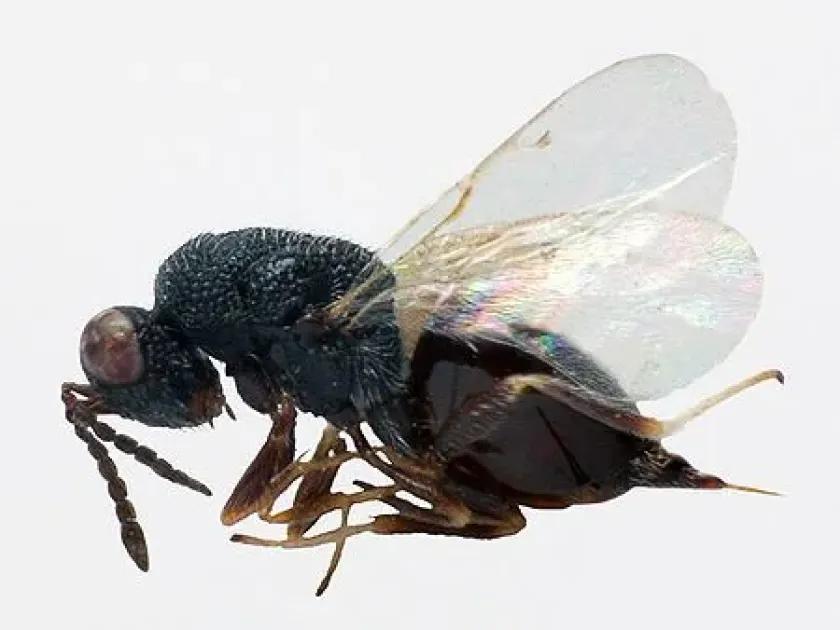
The seed chalcid (genus Bruchophagus) belongs to the Eurytomidae family within the order Hymenoptera. These are tiny insects, typically measuring 2–3 mm in length, with a predominantly black or dark brown appearance.
A distinctive morphological feature is the swollen hind femur, which is characteristic of the genus and serves as a key identifier. Their wings are transparent with minimal venation, making them difficult to spot in the field.
The larva is legless, white, and possesses a small, poorly developed head. Since it spends its entire developmental cycle inside the seed, it remains hidden from view throughout most of the growing season.
The female is equipped with a robust ovipositor, which allows her to pierce the shell of developing legume seeds and deposit an egg inside. This specialized adaptation makes them a significant agricultural pest.
Correct species identification within the Bruchophagus genus often requires laboratory examination, as many species are morphologically similar and difficult to differentiate in the field.
What it damages
Seed chalcids primarily infest the seeds of perennial legumes, such as alfalfa, clover, and sainfoin. The larva feeds on the internal tissues of the seed, specifically the embryo and endosperm.
During heavy infestations, the pest can destroy 50% to 80% of the potential seed yield. The larva consumes the contents, leaving behind an empty hull that is completely non-viable.
Infected seeds often appear normal externally until the adult emerges. The emergence process creates a tiny, circular hole in the seed coat, which is the most visible sign of infestation after harvest.
The presence of seed chalcids significantly impacts seed quality, rendering the material unsuitable for planting. This leads to severe economic losses for seed growers and farmers.
Secondary impacts include the costs associated with specialized cleaning and processing, as well as the risk of spreading the pest to previously unaffected fields through contaminated seed batches.
When it appears
The pest overwinters primarily in the larval stage, protected inside infested seeds that have fallen to the ground or remained in the field after harvest. Pupation begins in the spring as soil temperatures rise.
The emergence of the first generation of adults typically coincides with the bud formation and early flowering stages of legumes. This is the critical window when females search for suitable seeds to lay their eggs.
Depending on the climatic zone, the seed chalcid can complete one to three generations per year. Warm and dry weather conditions accelerate the developmental cycle, leading to higher population numbers.
Adult activity is highest during warm, sunny periods of the day. In contrast, overcast or cool weather significantly reduces their movement and reproductive success in the field.
As autumn approaches and temperatures drop, the final generation of larvae enters diapause, remaining safely tucked inside seeds until the following spring, when the cycle begins anew.
Signs of infestation
The primary diagnostic sign is the presence of small, round exit holes in the seeds during sorting and cleaning. These holes confirm that an adult insect has already completed its development.
Visual monitoring during the flowering stage may reveal the mass flight of tiny Hymenopterans above the crop canopy. This indicates that egg-laying is currently in progress.
A reduction in the weight of a thousand seeds during quality assessment is a strong indicator of an internal infestation, as the contents have been hollowed out by the larvae.
Dissecting suspected seeds is the most reliable method for confirmation. If a white, legless larva or a pupa is found inside, it confirms that the seed lot is compromised.
Low germination rates observed in laboratory tests, especially when coupled with visible exit holes, are clear evidence that the seed batch has been heavily damaged by the seed chalcid.
Control measures
Integrated Pest Management begins with sound agronomic practices, such as maintaining spatial isolation between seed production fields and commercial or wild legume stands.
Deep plowing in the autumn is a highly effective cultural control method, as it buries infested seeds deep in the soil, preventing adults from emerging the following spring.
- Harvesting crops as early as possible to minimize seed shattering.
- Using only certified, clean seed lots that have been verified as pest-free.
- Managing weeds and volunteer host plants in the field margins to remove reservoirs.
When economic thresholds are exceeded, targeted insecticide applications may be necessary during the bud stage. It is crucial to use bee-safe products and apply them when pollinators are inactive.
Biological control efforts focus on the conservation of natural parasitoids, which are small wasps that hunt and kill seed chalcid larvae within the seeds, helping to keep populations in check.
Taxonomy
- Latin name
- Bruchophagus
- Order
- Hymenoptera
- Family
- Eurytomidae
- EPPO code
- BRPHSP
Discussion
No discussions yet — be the first.