
Annona seed borer
Bephratelloides cubensis
Description
How to identify
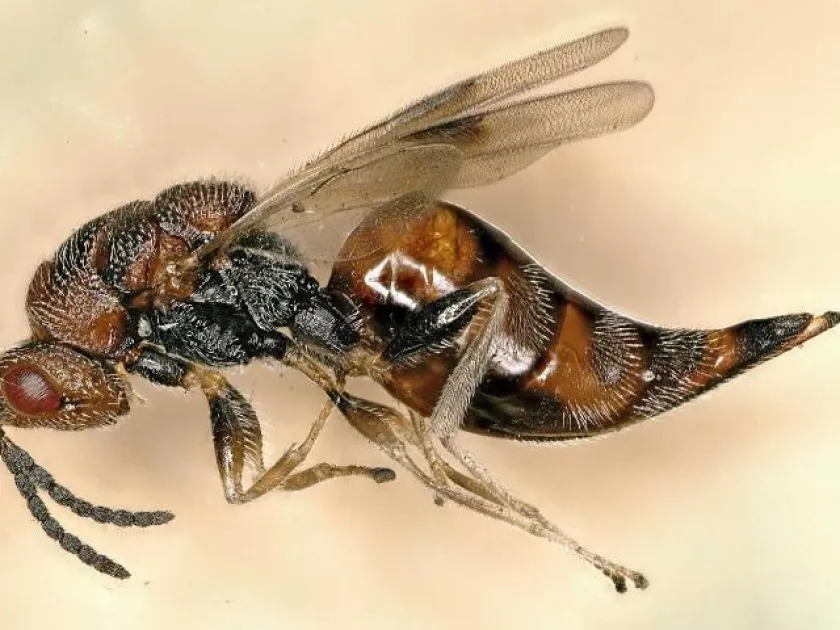
The Annona seed borer (Bephratelloides cubensis) is a small parasitic wasp belonging to the Eurytomidae family (Hymenoptera). The adults are typically dark, brownish-black insects with a metallic sheen, measuring about 3 to 5 millimeters in length.
They are characterized by a slender body and a well-developed ovipositor in females, which is specialized for piercing the fruit skin and depositing eggs directly into the developing seeds of Annona species.
The larvae are legless, white, and possess a distinct head capsule. They reside exclusively inside the seeds, completing their entire life cycle within the fruit until they emerge as adults through small, perfectly round exit holes.
Due to their secretive nature and small size, identifying these insects in an orchard is challenging. Their presence is usually confirmed by finding the characteristic exit holes or observing the damage to the harvested fruit.
Monitoring efforts should focus on the fruit development stage, as this is when the adult females are most active and searching for suitable hosts to oviposit their eggs.
What it damages
The primary hosts of this pest include various species of the Annonaceae family, most notably cherimoya, soursop, and custard apple. These fruits are high-value crops in many tropical and subtropical regions.
The larvae destroy the seeds entirely, causing premature fruit drop and significant economic loss. When a fruit is infested, the nutritional value and marketability are drastically reduced or completely eliminated.
The exit holes created by the emerging adults facilitate the entry of secondary pathogens, leading to fruit rot and further decreasing the quality of the harvest. This makes it impossible to store or transport the infested fruits.
In cases of severe infestation, up to 90 percent of the fruit crop can be lost if proper pest management practices are not implemented. This creates a significant threat to the profitability of commercial Annona plantations.
The pest is difficult to eradicate because the larvae are well-protected within the hard seed coats, making contact insecticides ineffective once the fruit has been penetrated.
Signs of infestation
The most visible sign of infestation is the presence of small, round exit holes on the surface of mature or ripening fruits. These holes are the result of adult wasps boring their way out after completing development.
Premature yellowing and dropping of young, undeveloped fruit is another major indicator. Upon inspecting these fallen fruits, one will often find the internal seeds hollowed out and filled with larval frass.
Fine particulate matter resembling sawdust often accumulates near the exit holes, signaling recent emergence activity. Infested trees may appear stunted or show signs of stress due to the massive loss of reproductive potential.
Surface blemishes on the fruit skin, which may appear as tiny punctures or scars, mark the spots where female wasps laid their eggs. Detecting these early signs is crucial for effective intervention.
Internal damage is characterized by hollow, empty seed coats that crumble upon touch, contrasting sharply with healthy, firm seeds of non-infested fruits.
Control measures
Strict orchard sanitation is the most effective management strategy. All fallen fruits must be collected and removed from the plantation daily to prevent the completion of the life cycle and the emergence of the next generation.
Integrated Pest Management (IPM) programs should incorporate the use of pheromone traps or sticky yellow traps for monitoring adult wasp activity to time potential insecticide applications accurately.
- Removing and destroying all infested or dropped fruit.
- Wrapping young fruits in paper bags to prevent oviposition.
- Implementing regular pruning for better canopy aeration.
- Encouraging natural biological control agents in the orchard.
- Avoiding the movement of infested fruit to prevent spread to new areas.
For small-scale farmers, individual fruit bagging is a highly effective mechanical control method. By covering the young fruits, the female wasp is physically prevented from reaching the skin with her ovipositor.
Biological control using parasitic wasps that target the seed borer is a promising area of research, providing a sustainable way to keep populations below economic injury levels without heavy reliance on chemicals.
Taxonomy
- Latin name
- Bephratelloides cubensis
- Order
- Hymenoptera
- Family
- Eurytomidae
- EPPO code
- BEPHCU
Discussion
No discussions yet — be the first.