
Varroa underwoodi
Varroa underwoodi
Description
How to identify
Varroa underwoodi is a parasitic mite belonging to the family Varroidae, order Mesostigmata. It is a specialized ectoparasite that feeds on the hemolymph of honeybees, causing significant stress to the host colonies.
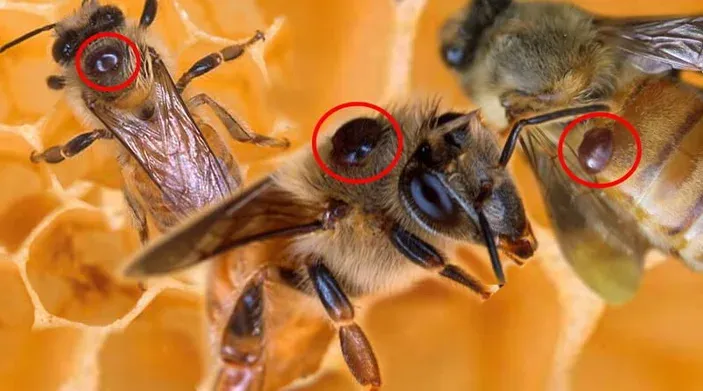
The adult female mite has a flattened, oval-shaped body and a dark brown, sclerotized exoskeleton. It measures approximately 1.0–1.2 mm in length, making it easily distinguishable by size and shape when using a magnifying lens.
Males are smaller, lighter in color, and have softer cuticles compared to females. They have a short lifespan and are primarily found within brood cells, where they mate with newly emerged females before dying.
The mite is morphologically adapted to latch onto honeybees and reside within brood cells. Its flat shape allows it to navigate between the overlapping abdominal segments of bees and hide effectively inside sealed brood cells.
Taxonomically, it is classified within the genus Varroa. Accurate identification requires microscopic analysis of the dorsal plates and the structure of the gnathosoma to differentiate it from the more common Varroa destructor.
What it damages
The damage caused by Varroa underwoodi stems from the mite feeding on the hemolymph of both adult bees and developing larvae. This causes nutritional deficiencies and developmental stunting in young bees.
Feeding by the mite weakens the immune system of the host bee, making it significantly more susceptible to various viral, bacterial, and fungal infections that often occur concurrently with mite infestations.
The mechanical injury to the bee's cuticle during the feeding process can lead to secondary infections. Furthermore, mites are known vectors that facilitate the transmission of pathogenic viruses within the hive.
Severe infestations lead to a reduction in the lifespan of worker bees, deformities in wings and legs, and a general decline in the colony's vitality, which can lead to rapid population collapse.
The impact is cumulative; as the number of mites increases, the efficiency of the colony decreases, leading to lower honey production and increased winter mortality rates due to the weakened state of the bees.
When it appears
The lifecycle of Varroa underwoodi is highly dependent on the availability of bee brood, which acts as the primary site for the mite's reproduction during the warmer months of the year.
In early spring, when the queen starts laying eggs, the over-wintering female mites migrate from the adult bees into the brood cells to initiate the reproductive cycle. This marks the beginning of the seasonal population growth.
Throughout the summer, the population grows exponentially as multiple generations of mites complete their development within the capped brood. The cycle is optimized to match the developmental timing of the honeybee.
As the autumn season arrives and brood production naturally declines, the mites move back to the adult bees. They enter a phoretic phase, attaching themselves to the bees to survive throughout the winter.
Winter survival is dependent on the mite's ability to remain on the cluster of bees. During this time, the mite's metabolism slows down, and reproduction ceases until the colony resumes brood rearing the following season.
Signs of infestation
Visible signs of infestation include the presence of adult bees with stunted, deformed wings or crippled legs crawling at the hive entrance, which is a classic indicator of severe parasitic pressure.
Patchy brood patterns, where sealed cells are interspersed with empty ones, often suggest that the colony is struggling to deal with the mite load, leading to the removal of diseased larvae by worker bees.
Direct observation of adult mites on the bodies of bees, especially on the thorax or the abdomen near the wing bases, confirms the presence of the parasite within the hive population.
A general decrease in colony strength, slow development in the spring, and high winter losses without other apparent causes are strong indicators of a chronic mite problem.
Beekeepers use standard diagnostic tests, such as alcohol washes, ether rolls, or powdered sugar shakes, to quantify the mite population and determine if control measures are necessary.
Control measures
Effective control of Varroa underwoodi requires an integrated pest management (IPM) approach that combines mechanical, biological, and chemical methods to keep mite levels below the economic threshold.
Chemical treatments using acaricide strips or organic acids, such as formic or oxalic acid, are common. These should be applied at specific times of the year, particularly after the honey flow, to avoid contamination.
Mechanical control methods involve the use of drone brood traps. Since mites prefer drone brood, removing these frames regularly can significantly reduce the total number of mites in the hive without chemicals.
Rotation of treatment agents is crucial to prevent the development of acaricide resistance. Reliance on a single chemical substance often leads to diminished efficacy over time, requiring periodic strategy adjustments.
Good apiary hygiene, including the use of screened bottom boards to allow falling mites to exit, and maintaining strong, healthy colonies, provides a robust foundation for preventing excessive mite infestations.
Taxonomy
- Latin name
- Varroa underwoodi
- Order
- Mites
- Family
- Varroidae
- EPPO code
- VARRUN
Discussion
No discussions yet — be the first.