
Varroa
Varroa jacobsoni
Description
How to identify
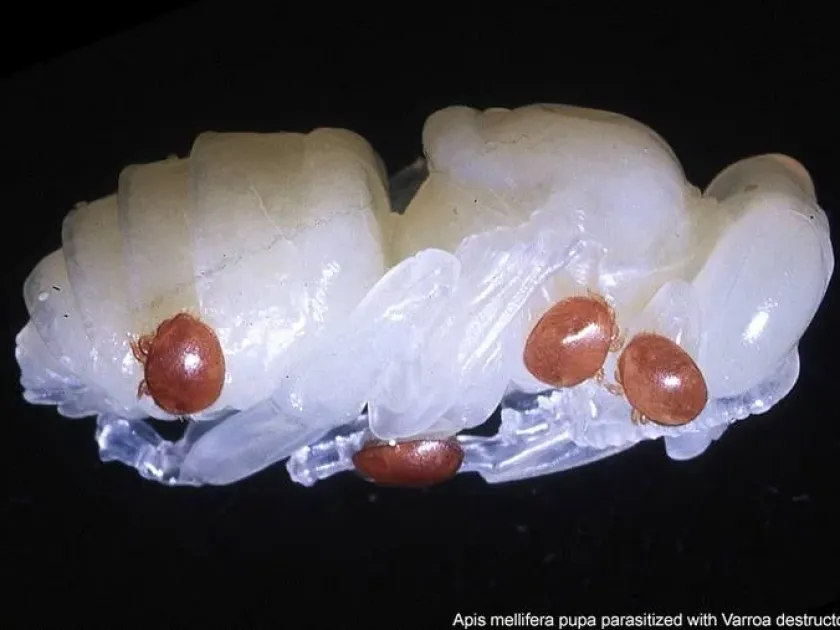
Varroa (Varroa jacobsoni) is an ectoparasitic mite that infests honey bee colonies. Adult females have a flattened, reddish-brown oval body, measuring approximately 1.1 mm in length and 1.6 mm in width.
The mite possesses a highly sclerotized exoskeleton, providing protection while it navigates within the hive environment and hitches rides on its host.
The mouthparts are specially adapted for piercing the honey bee's exoskeleton and accessing the haemolymph, which serves as the primary food source.
Males are significantly smaller than females and rarely emerge from the brood cells, focusing their life cycle on reproduction within the cell.
These parasites use chemosensory organs to detect suitable hosts and brood cells, ensuring they successfully reproduce within the bee nest.
What it damages
The primary hosts of Varroa are honey bees (Apis mellifera). Mites feed on the haemolymph of both developing larvae and adult bees, causing significant physiological stress.
Infestation of larvae often leads to malformed wings, legs, and abdomens, resulting in shorter lifespans and impaired foraging capabilities for the emerging bees.
The mite acts as a potent vector for various viruses, including the Deformed Wing Virus (DWV), which can devastate the health of an entire colony.
Persistent feeding reduces the overall protein and fat content in the bees' bodies, leading to weakened immunity and increased susceptibility to other pathogens.
Uncontrolled infestations result in colony collapse, as the parasitic load becomes too high for the bees to maintain their internal hive functions and winter survival.
When it appears
The population growth of Varroa mites is tightly synchronized with the presence of brood in the colony, typically peaking during the active spring and summer months.
Females invade brood cells just before they are sealed, where they lay eggs that develop into adult mites at the same rate as the bee host.
As brood rearing declines in late autumn, the mites transition to phoretic behavior, attaching themselves to adult bees to survive the winter period.
During winter, the mites remain attached to the winter cluster of bees, feeding sporadically while waiting for the resumption of brood rearing in the spring.
Environmental conditions, such as temperature and humidity, play a secondary role compared to the availability of host brood, which is the main driver of the mite's reproductive cycle.
Signs of infestation
Visual identification involves spotting mites on the thorax or abdomen of adult bees during routine hive inspections, though this can be difficult in low infestations.
Inspecting the bottom board or using mite counts via sugar rolls or alcohol washes are essential diagnostic tools to assess the severity of the infestation.
The presence of bees with stunted or deformed wings crawling near the hive entrance is a severe indicator of high mite prevalence and associated viral infections.
Visible mite damage on capped drone brood or the eviction of dead, malformed larvae are clear warnings that the parasite population is reaching dangerous levels.
- Mites visible on adult bees.
- Deformed bee wings and body parts.
- Sudden decline in colony population.
- Increased mortality of brood.
Control measures
Integrated Pest Management (IPM) is crucial, involving the use of acaricides, organic acids like formic and oxalic acid, and essential oils to lower mite counts.
Physical control methods, such as drone brood removal and screened bottom boards, help reduce the total number of mites within the colony naturally.
Regular monitoring through established sampling methods ensures that beekeepers treat their hives only when necessary, minimizing the use of synthetic chemicals.
Rotating treatments with different modes of action is vital to prevent the development of resistance within the Varroa population.
Maintaining strong, well-nourished colonies helps the bees' natural defense mechanisms cope better with the stress caused by parasitic mites.
Taxonomy
- Latin name
- Varroa jacobsoni
- Order
- Mites
- Family
- Varroidae
- EPPO code
- VARRJA
Discussion
No discussions yet — be the first.