
Varroa
Varroa destructor
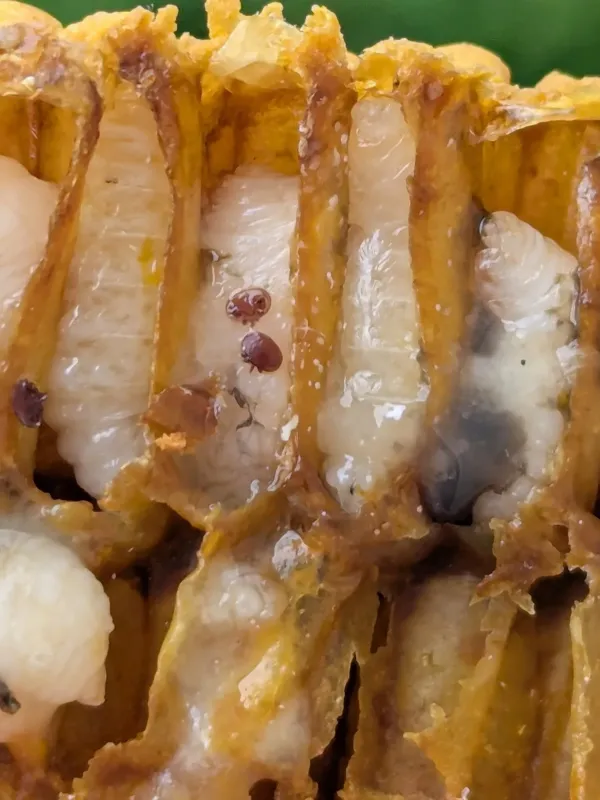
Description
How to identify
The Varroa mite (Varroa destructor) is an ectoparasitic mite belonging to the order Mesostigmata and the family Varroidae. The adult female is reddish-brown, oval, and flattened in shape.
Adult females measure approximately 1.1–1.2 mm in length and 1.5–1.9 mm in width. The male is significantly smaller, lighter in color, and lives for a very short duration, primarily for reproductive purposes.
Equipped with specialized suction pads and piercing-sucking mouthparts, the mite is perfectly adapted for puncturing the bee’s cuticle and feeding on the host's hemolymph.
The mite's body is covered in short, stiff hairs that provide grip, allowing it to remain securely attached to the bee's abdomen between the sclerites.
Reproduction takes place exclusively within sealed brood cells. The female enters the cell before it is capped, lays her eggs, and the offspring develop by feeding on the larva or pupa inside.
What it damages
The Varroa destructor mite exclusively targets honey bees (Apis mellifera) throughout their lifecycle. Both adult bees and developing brood suffer significantly from infestation.
Infested adult bees experience reduced vitality, shorter lifespans, and a diminished ability to forage and perform necessary hive tasks, leading to a general decline in the colony.
The brood is severely harmed as mites consume their hemolymph, often resulting in bees emerging with physical deformities, such as malformed wings or stunted abdomens.
Mites act as vectors for various deadly viruses, most notably the Deformed Wing Virus (DWV), which often proves fatal to the colony when infestation levels are high.
Without adequate intervention, mite populations grow exponentially, inevitably causing the collapse and death of the honey bee colony, particularly during the winter months.
When it appears
The mite's life cycle is intrinsically linked to the presence of bee brood; therefore, they remain active throughout the beekeeping season from spring to late autumn.
Population peaks typically occur in late summer and early autumn when the amount of capped brood is at its highest, providing optimal conditions for rapid mite reproduction.
During the spring, as soon as the first brood appears, overwintered female mites migrate into cells to begin the reproductive cycle for the new season.
Throughout the winter, reproduction ceases due to the absence of brood, but adult mites survive by clinging to the adult bees and feeding on their hemolymph.
Climatic factors and colony strength influence the rate at which mite populations expand, requiring beekeepers to remain vigilant throughout the entire active year.
Signs of infestation
Visual inspection of the colony often reveals the presence of mites on the bodies of adult bees, especially on young bees or drones, which the mites tend to prefer.
Checking the bottom board or using screened inserts allows beekeepers to observe fallen mites, providing a quantitative assessment of the infestation level within the hive.
Signs of severe infestation include crawling bees near the hive entrance with crippled, deformed wings or physical abnormalities preventing them from flying.
A general decline in colony strength, poor winter survival, and a lack of brood development are common indirect indicators of a heavy mite burden.
- Visible mites on adult bees.
- Bees with deformed wings or appendages.
- Mites found on hive floor inserts.
- Weakened colony productivity and unexplained adult bee mortality.
Control measures
Effective management of Varroa destructor requires an integrated pest management (IPM) approach that combines chemical treatments and mechanical methods.
Chemical control typically involves the use of acaricide strips or the application of organic acids, such as oxalic or formic acid, during periods when little or no brood is present.
Mechanical methods include drone brood removal; since mites prefer drone cells, extracting these frames allows beekeepers to physically remove a large portion of the mite population.
It is essential to rotate different classes of chemical treatments to prevent the development of resistance within the mite population to commonly used acaricides.
Consistent monitoring of infestation levels throughout the season is the most critical step in determining when and how to apply necessary control measures to protect the colony.
Taxonomy
- Latin name
- Varroa destructor
- Order
- Mites
- Family
- Varroidae
- EPPO code
- VARRDE
Discussion
No discussions yet — be the first.