
Varroa
Varroa
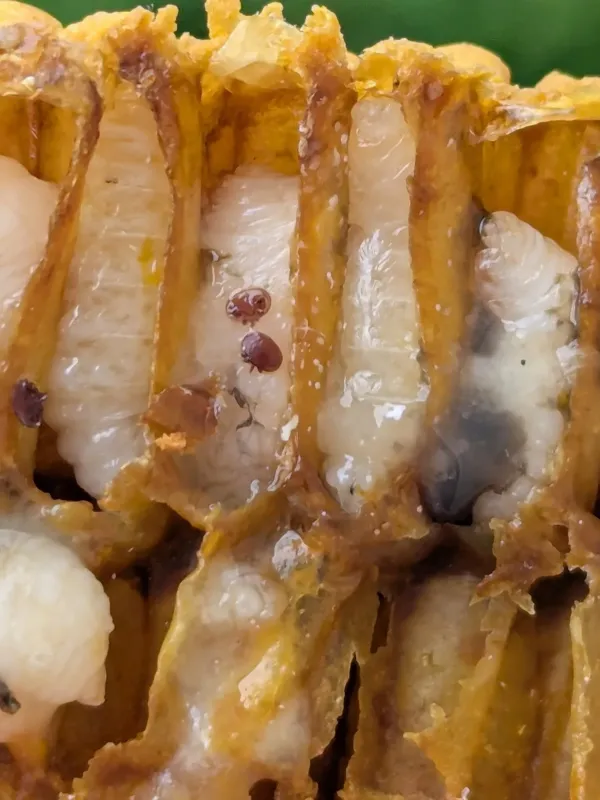
Description
How to identify
The Varroa destructor is an external parasitic mite that exclusively attacks honey bees (Apis mellifera) and their brood.
Adult female mites are reddish-brown, oval-shaped, and flattened, measuring approximately 1.1 mm in length and 1.6 mm in width.
They are members of the family Varroidae, equipped with specialized suckers on their legs that allow them to attach securely to the bee's cuticle.
The male mite is significantly smaller and pale, living its entire life within the sealed brood cells without feeding independently.
Mites use their mouthparts to pierce the bee's exoskeleton and feed on the fat body and hemolymph, which is vital for the bee's immune system.
What it damages
The primary damage caused by Varroa is the significant weakening of individual bees, leading to colony collapse if left untreated.
Infested brood often results in the birth of bees with malformed wings, stunted legs, or reduced body weight, shortening their lifespan.
Mites act as vectors for several harmful viruses, most notably the Deformed Wing Virus (DWV), which is fatal to bee colonies.
By consuming hemolymph, the mite drastically reduces the colony's overall productivity and ability to store food for the winter.
Heavy infestation levels can lead to a decrease in the number of foraging bees, causing the colony to dwindle rapidly during the active season.
When it appears
The reproduction cycle of Varroa is synchronized with the availability of bee brood, peaking during the late summer months.
In spring, the mite population starts to grow as the queen bee increases her egg-laying rate and brood becomes abundant.
During summer, mites have the optimal conditions to multiply, often doubling their population every 3–4 weeks within the colony.
As the season progresses toward autumn, the mite population reaches its peak, often resulting in a high parasite load on worker bees.
During the winter, mites survive by hitching rides on adult bees, continuing to feed on them while the colony is clustered.
Signs of infestation
Visible signs of infestation include the physical presence of dark brown mites on the backs or abdomens of adult honey bees.
Beekeepers may observe bees crawling near the entrance with crumpled or deformed wings, indicating a viral outbreak linked to Varroa.
- Mites visible on debris collected on the hive's bottom board.
- Uncapped or chewed brood cells in the hive frames.
- Unexplained sudden loss of adult bees or dwindling colony size.
A high mite count can be detected through monitoring methods such as alcohol washes, ether rolls, or sugar shake tests.
If not checked regularly, advanced infestations are often followed by the sudden disappearance of the colony, known as Colony Collapse Disorder symptoms.
Control measures
Managing Varroa requires an Integrated Pest Management (IPM) approach to maintain mite levels below the economic threshold.
Chemical treatments using synthetic acaricides in strip form are effective but must be rotated to prevent the development of resistance.
Organic acids like formic or oxalic acid are widely used to treat colonies with minimal risk of chemical residue in honey or wax.
Cultural practices, such as drone brood removal and the use of screen bottom boards, help to physically reduce the mite load naturally.
Regular monitoring of mite levels is essential to determine the timing and efficacy of interventions throughout the beekeeping season.
Taxonomy
- Latin name
- Varroa
- Order
- Mites
- Family
- Varroidae
- EPPO code
- VARRSP
Discussion
No discussions yet — be the first.