
Long-legged mite
Linopodes motatorius
Description
How to identify
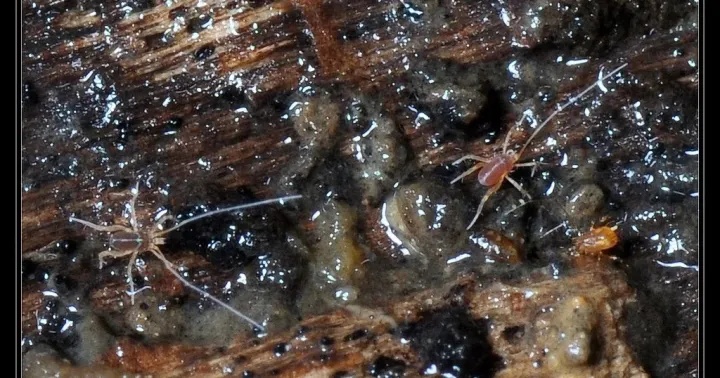
The long-legged mite (Linopodes motatorius) belongs to the Eupodidae family. It is a tiny, highly mobile pest distinguished by its remarkably long front legs, which it uses as sensory organs rather than for locomotion.
Adult mites are usually pear-shaped or oval, with a color ranging from pale yellow to light brown. Measuring about 0.5 mm in length, they are nearly invisible to the naked eye and require magnification for proper identification.
Their behavior is unique; the long front pair of legs is constantly raised and tapping the surface. This rapid, jerky movement makes them quite easy to spot once they have been magnified.
The life cycle progresses through several stages: egg, larva, nymph, and adult. Each stage is adapted to humid environments, and the mites are primarily found in moist substrates or on the underside of foliage.
Unlike many other plant-feeding mites, they prefer high-humidity conditions and are highly sensitive to desiccation, which dictates their habitat choice within greenhouses.
What it damages
Linopodes motatorius primarily affects greenhouse vegetables, such as cucumbers and tomatoes, as well as various ornamental potted plants. They feed by puncturing plant cells and extracting sap, which weakens the host.
High populations lead to stunted growth and leaf discoloration. The damage to the epidermal tissue also facilitates the entry of pathogenic fungi and bacteria, leading to secondary plant diseases.
Beyond direct feeding, these mites act as vectors for fungal spores by moving them across plant surfaces. This behavior is particularly dangerous in moist greenhouse environments where diseases spread rapidly.
Young seedlings are most susceptible to damage, often suffering from leaf distortion and restricted development. If the population density is high, they may also target the lower stem areas near the soil.
The indirect impact of the mite is often as significant as the direct feeding, as the resulting weakened plant tissue becomes highly prone to wilting and rotting under humid conditions.
When it appears
In indoor environments and greenhouses, this mite is active year-round as long as the temperature remains favorable (typically above +20°C) and the soil remains moist.
Outdoor activity is limited to warm, wet months. They are most abundant during spring and autumn when soil moisture is high and evaporation rates are relatively low.
The reproductive cycle is rapid; under optimal conditions, a generation can develop in less than two weeks. This allows populations to explode in greenhouses with poor ventilation and over-irrigation.
Winter survival is achieved by adults sheltering in plant debris, structural cracks in greenhouse frames, or the top layer of moist soil where temperatures remain stable.
Drought is the natural enemy of this pest. Extended periods of dryness lead to a significant decline in population density, which is a key factor in natural control.
Signs of infestation
Early signs of infestation include small, light-colored stippling or spotting on the underside of leaves. As the infestation progresses, these spots may merge, and the leaves may turn yellow.
Careful inspection of the soil surface or the base of the plant often reveals the mites moving quickly across the substrate. A hand lens is essential to distinguish them from soil-dwelling organisms.
The presence of fine, dusty-looking excrement on the leaf undersides, combined with the lack of webbing (unlike spider mites), is a strong indicator of a long-legged mite colony.
Plant wilting and loss of turgor, despite adequate watering, indicate that the mites have caused enough damage to the root zone or stem base to disrupt water uptake.
Identifying the pest requires checking the undersides of leaves and the moist surface of the soil near the stems, especially in shaded, humid corners of the growing area.
Control measures
The primary control measure is the management of environmental humidity. Improving air circulation and avoiding over-watering the soil surface will drastically reduce the suitability of the habitat.
Rigorous sanitation practices, such as the removal of plant debris and weeds, prevent the mites from establishing reservoirs for future generations. Keep the greenhouse floor clean and dry.
Chemical control involves the use of acaricides. When applying pesticides, ensure thorough coverage of the stems and the soil surface, as this is where the majority of the population gathers.
- Utilize biological control agents like predatory phytoseiid mites.
- Apply entomopathogenic fungi as a preventative biological treatment.
- Use sticky traps for population monitoring.
- Implement strict disinfection protocols between growing cycles.
To avoid resistance, rotate acaricides from different chemical classes. Repeated applications may be necessary to target consecutive generations as they hatch from eggs.
Taxonomy
- Latin name
- Linopodes motatorius
- Order
- Mites
- Family
- Eupodidae
- EPPO code
- LINPMO
Discussion
No discussions yet — be the first.