
Sugar beet root maggot
Tetanops
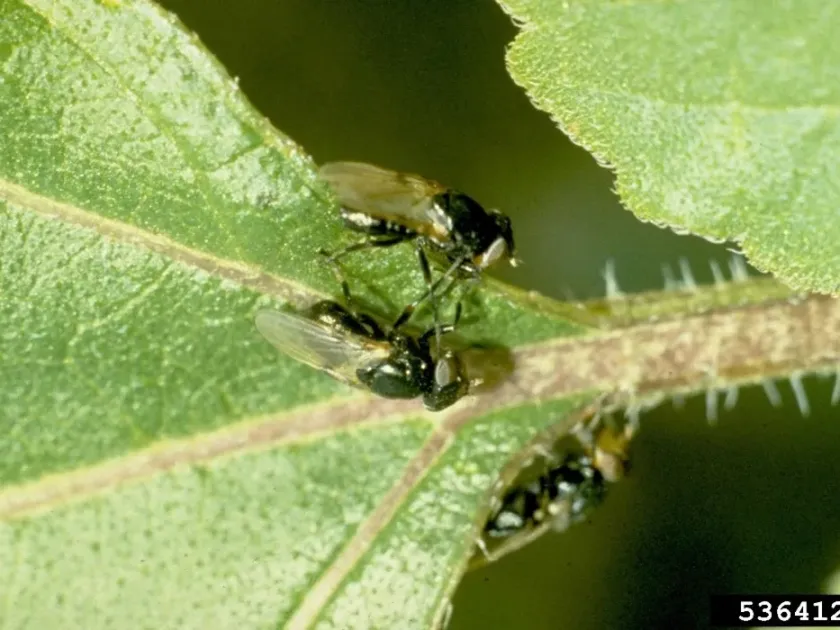
Description
How to identify
The sugar beet root maggot (Tetanops myopaeformis) belongs to the Diptera order and the Ulidiidae family. Adult flies are approximately 5–7 mm long with shiny black bodies and distinct banded wings.
Larvae are cylindrical, reaching 10–12 mm in length, and vary in color from white to creamy yellow. They lack legs and possess specific spiracles on the posterior end, which are essential for morphological identification.
The life cycle involves eggs, three larval stages, pupae, and adults. These pests overwinter in the soil as pupae at depths of up to 20 cm, allowing them to withstand harsh winter conditions.
Adults typically emerge in spring when soil temperatures reach 10–12°C. Their emergence often coincides with the germination and early seedling stages of sugar beets.
Females deposit eggs in the soil near the base of the host plants. A single female can lay over 100 eggs, creating significant localized pest pressure in the field.
What it damages
The larvae primarily attack sugar, fodder, and garden beets. Their feeding activity is focused on the root system, causing severe physiological stress and potentially fatal damage to young seedlings.
Larvae tunnel into the main root, destroying vascular tissue. This impairs the plant's ability to uptake water and nutrients, leading to wilting and stunted growth.
Heavy infestations lead to the mass death of seedlings, often requiring costly field reseeding. This causes significant economic losses for farmers due to reduced plant populations.
Surviving plants often exhibit deformed roots with excessive side-rooting, which drastically reduces the commercial quality and sugar content of the harvested crop.
Root injuries caused by the larvae act as entry points for secondary pathogens, such as soft rot bacteria and fungi, which can further decay the taproot.
When it appears
The peak activity period occurs between May and early June. During this time, the beet crop is in the cotyledon or early leaf stages, making it highly susceptible to damage.
Temperature and soil moisture are critical factors for larval development. Warm, moist springs are generally conducive to high pest pressure and successful egg hatching.
Drought conditions may delay adult emergence but do not necessarily prevent larval survival if adequate soil moisture exists near the root zone.
Typically, there is one generation per year, although climate variations can lead to staggered emergence of adult flies throughout the season.
Monitoring the flight of adult flies using sticky traps is a standard practice to determine the optimal timing for protective intervention.
Signs of infestation
The earliest symptom is the wilting of seedlings during the day. Affected plants can be easily pulled from the soil due to the destruction of their root system.
Inspection of the root reveals characteristic feeding scars and tunnels. Larvae can often be found in the immediate vicinity of the damaged roots within the soil.
Foliage becomes chlorotic (yellowish), and overall growth stalls. Visually, infected fields show patchy areas of poor establishment or missing rows.
Severe infestations leave the main root hollowed out or severed, effectively removing the plant's primary growth point and leading to permanent wilting.
A foul odor of decaying plant matter, which may attract other secondary pests, is a strong indicator of significant root damage caused by maggot activity.
Control measures
Cultural management starts with strict crop rotation, ensuring that beets are not planted on the same field for at least 3–4 years to interrupt the life cycle.
Deep fall tillage is an effective mechanical measure that brings pupae to the surface, exposing them to predators and freezing temperatures during winter.
Seed treatment with systemic insecticides is the most effective proactive defense, providing protection to seedlings during the most vulnerable developmental phase.
- Adjusting planting dates to avoid the peak emergence window of adult flies.
- Applying foliar insecticides when trap counts indicate high pest thresholds.
- Managing host weeds, particularly those in the Amaranthaceae family, to reduce alternative food sources.
Chemical control should be applied based on the economic injury level (EIL) and consistent field monitoring to ensure both yield protection and cost efficiency.
Taxonomy
- Latin name
- Tetanops
- Order
- Diptera (flies)
- Family
- Otitidae
- EPPO code
- TETASP
Discussion
No discussions yet — be the first.