
Corn silk fly
Euxesta schineri
Description
How to identify
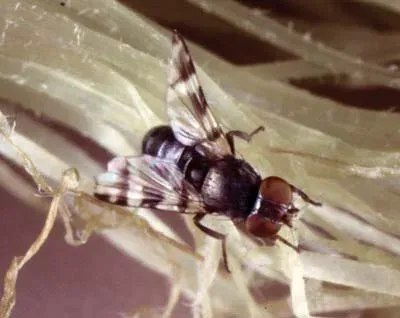
The corn silk fly (Euxesta schineri) is a member of the Ulidiidae family, belonging to the order Diptera. These flies are small insects easily recognized by the distinct dark banding patterns on their wings.
Adult flies typically exhibit a metallic appearance, often with bronze or greenish iridescence. Their eyes are frequently bright reddish-brown, which is a useful field identification marker.
Larvae are small, cylindrical, and white or cream-colored. They possess specialized mouth hooks that allow them to rasp and consume soft plant tissues within the developing corn ear.
The life cycle undergoes complete metamorphosis, including the egg, larva, pupa, and adult stages. Depending on temperature and moisture, they can complete multiple generations within one season.
These flies are highly adaptable to agricultural environments, often thriving in fields where the local microclimate provides protection and continuous food sources for their larvae.
What it damages
Euxesta schineri is a primary pest of corn (Zea mays). The adult females are attracted to the fresh silks of the corn ear, where they deposit their eggs in large numbers.
Once hatched, the larvae feed on the silks, hindering the pollination process. They subsequently tunnel into the ear to feed on the developing kernels, causing significant yield losses.
The feeding damage creates entry points for various pathogens, leading to ear rots and fungal infections, such as those caused by Fusarium species, which further degrade grain quality.
Significant infestations can result in deformed ears, missing kernels, and an overall reduction in the marketability of the harvested corn crop for both human and animal consumption.
The economic impact is twofold: quantitative loss of grain mass and qualitative degradation, which often leads to rejection of the product during grading at grain elevators.
Signs of infestation
The most prominent sign of infestation is the presence of small entry holes in the husks of the ears. These holes are created by emerging larvae as they move from the silks into the kernels.
Upon opening a damaged ear, one can observe larval feeding galleries and frass. The kernels may appear shriveled, discolored, or partially consumed, often covered in mold.
Infected ears frequently exhibit abnormal silk development, appearing brown or decayed long before natural maturity, which is a clear signal of larval interference with fertilization.
Adult flies can be spotted resting in the leaf axils or actively flying around the ear zone of the corn plant during the early reproductive stages of the crop.
A foul odor emitting from the ear, combined with damp, decaying silk and husk tissue, is a strong indicator that larval activity has opened the way for secondary bacterial or fungal decay.
Control measures
Effective management of the corn silk fly requires an integrated approach. Cultural practices, such as deep tillage after harvest, help disrupt the pupation sites in the soil.
Chemical control can be implemented using labeled insecticides, but timing is crucial. Applications must coincide with the peak adult flight and egg-laying period to be effective.
Selection of corn hybrids with tight husk coverage is a recommended preventive measure, as it provides a mechanical barrier that prevents flies from easily reaching the silk and kernels.
Timely harvest is essential to minimize the period during which the ears are susceptible to late-season infestation and to reduce the potential for mold development.
- Utilize pheromone traps for regular scouting and to time insecticide applications accurately.
- Practice crop rotation to minimize the build-up of local pest populations.
- Maintain field hygiene by removing crop debris that may harbor pupae.
Taxonomy
- Latin name
- Euxesta schineri
- Order
- Diptera (flies)
- Family
- Otitidae
- EPPO code
- EUXESC
Discussion
No discussions yet — be the first.