
Corn silk fly
Euxesta macquarti
Description
How to identify
Euxesta macquarti belongs to the family Ulidiidae, order Diptera. It is a small fly characterized by distinctive dark patterns on its wings, typical for the Ulidiidae family.
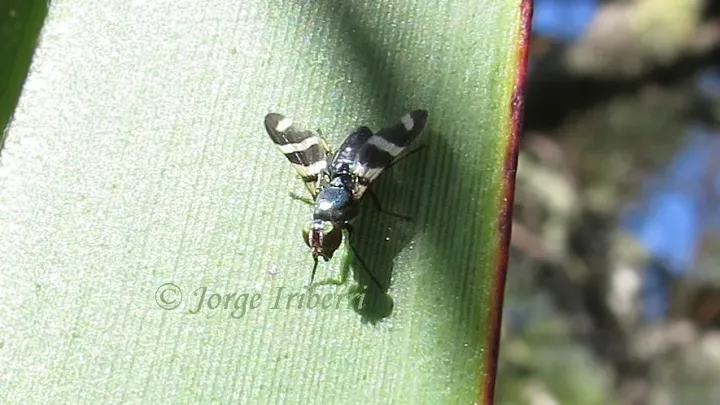
Adult flies measure between 3 and 5 millimeters in length and possess a dark, shiny body often exhibiting a metallic greenish or bronze sheen.
The eyes of the adult insect are usually reddish or brownish in color, which helps distinguish them from other species present in agricultural environments.
Larvae are cream-colored, legless, and cylindrical in shape, typical of fly larvae that develop within plant tissues or decaying organic matter.
The life cycle consists of four distinct stages: egg, larva (three instars), pupa, and adult, allowing the pest to adapt efficiently to corn cultivation cycles.
What it damages
The primary host for Euxesta macquarti is maize (corn), particularly the ears during the silk and milk stages of development.
The flies lay their eggs on the silk, and the emerging larvae migrate into the ear, causing direct damage to the kernels by feeding on them.
While corn is the primary target, these flies may affect other grain crops or related botanical families when their preferred host is unavailable.
Feeding damage significantly reduces crop yield, as the tunnels created by larvae promote kernel rot and facilitate the entry of fungal pathogens.
In sweet corn production, the pest is especially detrimental because even minor ear damage leads to the total rejection of the crop for market sale.
When it appears
Adult flies are active from spring until autumn, with populations peaking during the pollination and early grain-filling stages of corn development.
Multiple generations can occur throughout a single growing season, leading to rapid population expansion under favorable warm and humid weather conditions.
Pupae overwinter in the soil or within crop residues, emerging as adults when conditions are suitable for mating and egg-laying in the following spring.
The presence of the pest is highly correlated with the availability of fresh corn silk, which serves as a preferred site for oviposition.
Temperature fluctuations directly affect the speed of development; warmer temperatures typically lead to faster life-cycle completion for this species.
Signs of infestation
The most evident sign is the presence of adult flies on the corn silk, where they feed on pollen and plant fluids before laying eggs.
Visible damage to the silk, such as discoloration or premature wilting, often indicates where eggs have been deposited or larval entry has occurred.
Opening an ear at the milky stage may reveal tunnels and the presence of creamy-white larvae actively feeding on the developing kernels.
Secondary infections, including various molds and bacterial rots, often manifest as dark patches or decayed areas on the ear tips following larval feeding.
- Premature drying of the corn silk.
- Hollowed-out or missing kernels at the ear tip.
- Presence of larvae and larval frass within the ear husk.
Control measures
Cultural management, including deep tillage after harvest, is essential to bury pupae and reduce the success rate of overwintering populations.
Effective crop rotation practices help disrupt the pest's cycle by moving susceptible hosts away from areas with historical infestation levels.
Chemical control must be timed precisely with the period of peak adult flight, as applications are less effective once larvae have entered the ear.
Planting corn hybrids with tight, well-fitting husks acts as a physical barrier, making it much harder for flies to reach the kernels for oviposition.
Integrated Pest Management (IPM) using yellow sticky traps allows farmers to monitor population dynamics and apply interventions only when necessary.
Taxonomy
- Latin name
- Euxesta macquarti
- Order
- Diptera (flies)
- Family
- Otitidae
- EPPO code
- EUXEMA
Discussion
No discussions yet — be the first.