
Argentine corn fly
Euxesta argentina
Description
How to identify
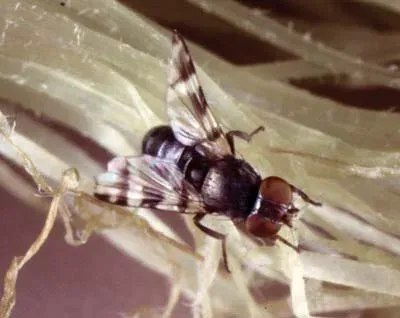
The Argentine corn fly (Euxesta argentina) is a member of the Ulidiidae family. Adult flies are approximately 5–6 mm long and are distinguished by a metallic, iridescent body appearance.
The wings of the adult possess clear dark transverse bands or patches, serving as a primary diagnostic feature for the species. The head and thorax are generally dark with a greenish or bronze shimmer.
Larvae are cylindrical and legless, characteristic of fly maggots. They range in color from white to cream and can reach a length of 7–8 mm during their final development stage.
Eggs are tiny and elongated, deposited by females primarily within the silk tissues or under the husk of the corn ear. Their cryptic placement makes them difficult to spot during routine field scouting.
The development of this pest is strongly influenced by climate. High humidity and moderate temperatures provide optimal conditions for the fly to progress through its life cycle rapidly.
What it damages
Maize (Zea mays) is the primary host for this pest. The fly causes significant economic damage by targeting the plant's reproductive structures during the critical ear-filling stages.
Larvae feed directly on developing corn kernels during the milk and dough stages. Damaged areas become highly susceptible to secondary infections, including fungal molds and bacterial rots.
While corn is the main target, the species can also infest other cereals if they are at the flowering or grain-filling stage. The insect demonstrates notable trophic plasticity among grass species.
The damage extends beyond mere grain loss; it significantly degrades grain quality and marketability. Affected ears are often unsuitable for storage due to internal decay and deformity.
Yield losses are directly proportional to the pest population density during the silking phase. Under severe infestation, losses can reach 20–30% or more of the total harvest.
When it appears
Adult activity begins when maize crops reach the silking stage. Flies are attracted to the fields to feed on pollen and lay their eggs near the fresh silks of the ears.
The life cycle from egg to adult is relatively short. During a typical warm summer, multiple generations can occur within a single growing season, increasing the pressure on the crop.
Peak populations are usually observed in the second half of the summer, coinciding with the kernel development process. The moist environment within the husk is ideal for larval growth.
The pest overwinters primarily as pupae or larvae within the soil or in crop debris left behind after harvest, facilitating rapid population rebound the following spring.
Migration of adults into new fields is common, especially from adjacent areas where maize has reached the flowering stage earlier, creating staggered infestation windows.
Signs of infestation
The first visual indication is the presence of withered, discolored silks. Upon peeling back the husk, larvae are typically found colonizing the silk and grain areas.
Larval excrement within the ear is a classic sign, which often triggers mold development. Kernels in affected areas show distinct deformation and discoloration, often turning dark.
Severe infestations often result in tip necrosis of the ear. Husks may appear glued together by larval secretions, which prevents the ear from developing properly and accelerates rotting.
Adult presence can be monitored using yellow sticky traps placed near the ears. During dusk, flies are easily observed resting on the silks at the tip of the ear.
Secondary signs include a pungent, decaying odor emanating from the ears, which attracts additional scavengers and secondary insect pests to the already damaged crop.
Control measures
Agrotechnical measures such as deep autumn plowing are essential to destroy overwintering pupae. Removing crop residues immediately after harvest reduces the overwintering population.
Utilizing maize hybrids with a tight husk coverage is a key preventive strategy, as it makes it significantly harder for females to reach the developing kernels for oviposition.
Chemical control involves applying insecticides during the silking stage. It is critical to strictly adhere to pre-harvest intervals to ensure the grain remains safe for consumption.
Biological control methods involve the use of entomopathogenic organisms or specific bacterial formulations targeting dipteran larvae, which are gaining interest in organic production systems.
- Implementing diverse crop rotation to break the pest's cycle.
- Continuous monitoring of adult activity using pheromone-based traps.
- Optimizing planting dates to avoid the peak flight periods of the fly.
Taxonomy
- Latin name
- Euxesta argentina
- Order
- Diptera (flies)
- Family
- Otitidae
- EPPO code
- EUXEAR
Discussion
No discussions yet — be the first.