
Picture-winged fly
Euxesta
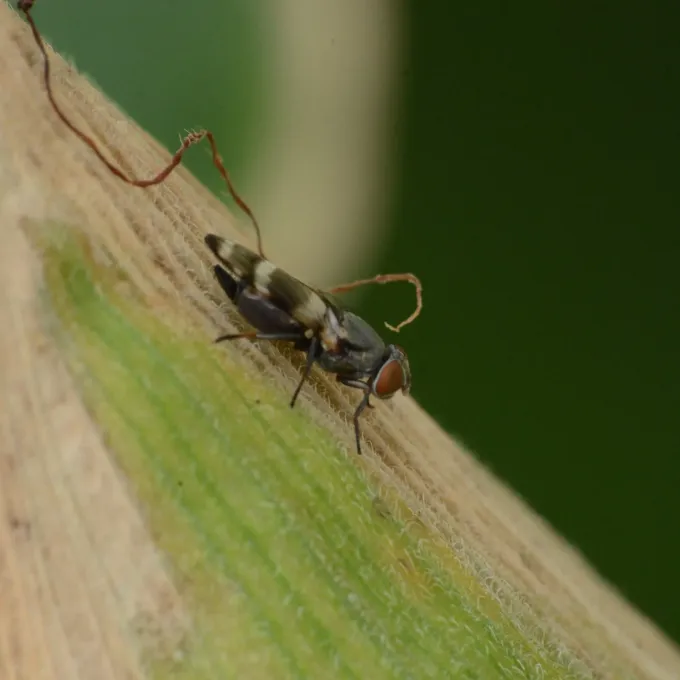
Description
How to identify
The picture-winged fly (genus Euxesta) belongs to the family Ulidiidae, order Diptera. Adults are easily recognized by their distinctively patterned wings and bright, metallic green compound eyes, which are a hallmark of the genus.
Adult flies measure between 5 to 7 millimeters in length and have a dark, often shiny, body appearance. Larvae are typically legless, cream-colored maggots that remain hidden inside plant tissues throughout their development.
The life cycle consists of complete metamorphosis: egg, larval stages, puparium, and adult. They are prolific breeders, capable of producing multiple generations per season in warm, humid environments.
Larvae develop rapidly and are protected by the plant tissue they consume, making them difficult to detect during the early stages of infestation. This hidden lifecycle is a major challenge for integrated pest management.
The presence of Euxesta is often determined by adult activity patterns and the subsequent discovery of larval damage inside reproductive plant structures, as the flies themselves are highly mobile.
What it damages
Corn is the primary host for Euxesta larvae. They infest the ear by entering through the silk or the tip, feeding directly on the developing kernels during the milk and dough stages.
Feeding damage leads to substantial yield losses, as destroyed kernels fail to develop properly. Furthermore, the tunnels created by larvae provide entry points for various pathogens, including fungi and bacteria.
This secondary infection often leads to ear rot, which significantly degrades both the quantity and the quality of the harvested grain, making it unsuitable for processing or storage.
In high-pressure years, if left unmanaged, these flies can cause severe economic damage to commercial corn production, necessitating targeted intervention strategies.
Besides corn, the genus is known to affect various other crops and weeds, allowing the population to persist in an agro-ecosystem even when the primary host is not available.
Signs of infestation
The first signs of infestation include the presence of larval frass (excrement) at the tip of the corn ear, hidden beneath the protective husks, often accompanied by silk discoloration.
Opening the ear reveals irregular feeding patterns, damaged kernels, and the presence of larvae. The tissue often exhibits signs of rot due to the introduction of moisture and microorganisms.
A foul, fermented smell may emanate from the infested ears, which is a classic indicator of advanced larval feeding and subsequent secondary microbial decay.
Birds or other wildlife feeding on the tips of corn ears can be a visual cue of infestation, as they are often attracted by the smell and the exposed, decaying kernels.
Discoloration of the silk and premature wilting of the ear tip are often visible long before the ear is fully matured, providing a signal for closer field inspection.
Control measures
Effective control starts with cultural practices. Proper crop rotation and maintaining adequate spatial isolation between early-planted and late-planted corn fields help break the fly's lifecycle.
Deep fall tillage is recommended to destroy overwintering puparia in the soil, effectively reducing the number of emerging adults for the next growing season.
Selecting corn hybrids with tight husk coverage is a highly effective preventative measure, as it physically restricts the ability of female flies to access the silks for egg-laying.
Chemical control must be timed precisely to coincide with the flight of adults before they lay eggs. Monitoring using pheromone or sticky traps is essential to determine the correct application window.
Harvesting corn as early as possible after maturity can prevent late-season infestation spikes, as the flies are less likely to attack fully dry and hardened kernels compared to soft, developing ears.
Taxonomy
- Latin name
- Euxesta
- Order
- Diptera (flies)
- Family
- Otitidae
- EPPO code
- EUXESP
Discussion
No discussions yet — be the first.