
Barley miner fly
Hydrellia griseola
Description
How to identify
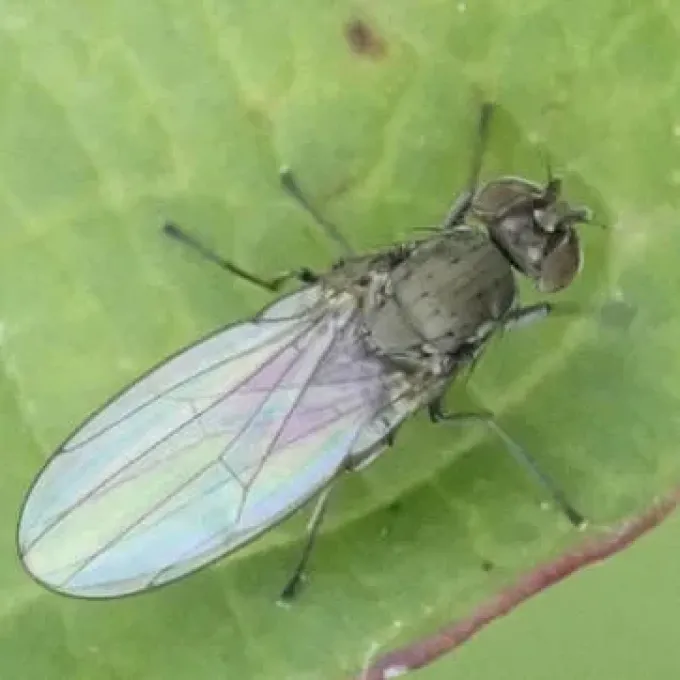
The barley miner fly (Hydrellia griseola) belongs to the order Diptera, family Ephydridae. It is a small insect, typically measuring about 2 to 2.5 millimeters in length.
The adult fly has a dark gray or greenish-gray body with a metallic sheen. Its wings are clear but feature distinct dark veins, which serves as a key characteristic for field identification.
The larvae are legless, cylindrical, and pale yellow or cream-colored, reaching up to 4 mm in length. They are specialized for life within the leaf tissue, which protects them from predators.
The development cycle is heavily influenced by temperature and moisture. Warm and humid springs provide ideal conditions for rapid multiplication, leading to multiple generations during the growing season.
The insects overwinter as adults or pupae in plant debris, soil, or even on winter cereal crops, allowing them to emerge and start infesting early-spring crops immediately.
What it damages
The primary hosts for this pest are barley, wheat, oats, and rye. In addition to commercial cereals, the miner fly also attacks corn and various wild grass species.
Larvae cause damage by mining between the upper and lower epidermis of the leaves. This feeding behavior destroys the parenchyma, which is crucial for the plant's photosynthesis.
Young plants at the seedling and tillering stages are most vulnerable. Severe infestations can cause significant stunting, reduced biomass, and in extreme cases, the death of young tillers.
High population densities lead to a decrease in the overall vigor of the crop, making the plants susceptible to secondary fungal pathogens that enter through the damaged leaf epidermis.
Economic damage is most pronounced when infestations occur early in the season, as the plant cannot compensate for the loss of photosynthetic area during the critical stages of development.
Signs of infestation
The most visible symptom of an infestation is the presence of pale, longitudinal mines on the leaves. These mines appear as transparent or white streaks where the leaf interior has been consumed.
Over time, the mined areas turn brown and dry out. If the infestation is widespread, the field may appear as if it has suffered from frost or drought, with yellowing and withered leaves.
By holding the leaf against a light source, one can often see the larvae moving inside the mines or detect their dark-colored excrement accumulated within the tunnels.
Adult flies may also leave small, pin-prick feeding marks on the leaves, which can lead to localized necrosis, though this is less destructive than the larval feeding.
- Transparent longitudinal streaks (mines) on leaves.
- Yellowing and browning of leaf tips and margins.
- Reduced plant growth and leaf area index.
- Presence of larvae or puparia inside the leaf tunnels.
Control measures
Effective management begins with cultural practices, including deep plowing to bury crop residues where the flies overwinter and the elimination of wild grass hosts around fields.
Optimizing planting dates is crucial; sowing early or at the recommended time helps the crop reach a stage where it can withstand minor infestations before the peak fly activity.
Chemical control should be implemented only when scouting confirms that pest populations exceed the economic threshold, using systemic insecticides to reach the larvae within the leaves.
Monitoring the adult population using yellow sticky traps can provide an early warning, allowing farmers to apply treatments during the egg-laying stage for maximum efficacy.
Integrated pest management (IPM) should prioritize the use of selective insecticides that minimize harm to beneficial insects, ensuring long-term sustainability of the agroecosystem.
Taxonomy
- Latin name
- Hydrellia griseola
- Order
- Diptera (flies)
- Family
- Ephydridae
- EPPO code
- HYDRGR
Discussion
No discussions yet — be the first.