
Pyralid moth
Pyralis
Description
How to identify
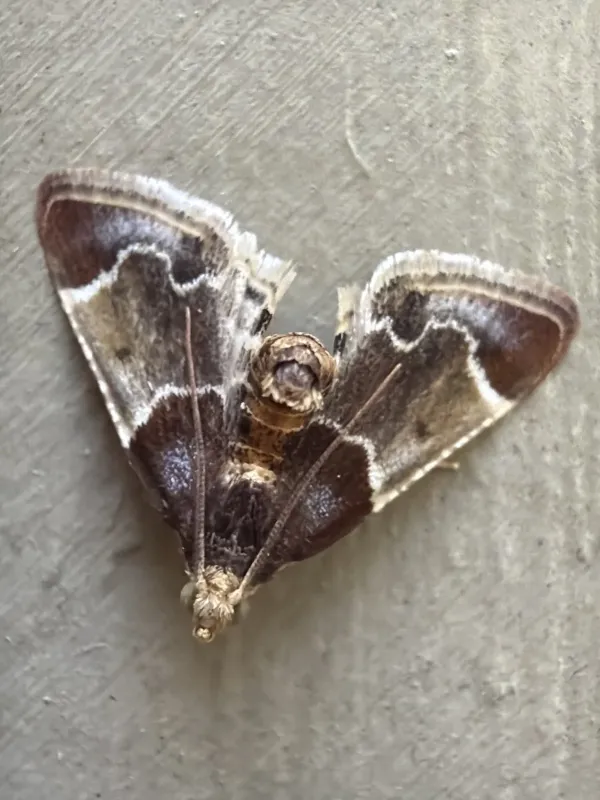
Pyralid moths (family Pyralidae) are a diverse group of moths containing thousands of species worldwide. Adult moths are characterized by a slender body and a tendency to fold their wings into a triangular or elongated shape when at rest.
The wings typically feature camouflage patterns in shades of brown, gray, and yellow, often adorned with distinct transverse lines. While sizes vary, most agricultural Pyralid pests have a wingspan between 15 and 30 millimeters.
The larval stage, known as caterpillars, are highly active and possess strong mandibles. They often appear pale, green, or brownish, sometimes displaying longitudinal stripes that help them blend into the foliage of their host plants.
Taxonomically, they belong to the order Lepidoptera. The family includes both significant field crop pests and notorious storage pests that infest grain, flour, and dried fruits, making them a major subject in entomology and crop science.
Positive identification of a specific species often requires professional inspection of the larvae or adult genitalia, as many species within the family exhibit similar morphological traits during the larval stages.
What it damages
Pyralid moths affect a wide variety of plants, including cereals, legumes, sunflower, and various vegetables. Their host range is extensive, with some species being highly specialized while others are generalist feeders.
Stored product pests within this family can cause severe economic losses in elevators and food facilities by infesting stored grains, flour, and dried products. They weave silken webs through these products, rendering them unsalable.
In fields, larvae cause damage by skeletonizing leaves, boring into stems, or feeding on developing seeds within floral structures. This leads to weakened plant structures, poor crop yield, and susceptibility to environmental stress.
Fruit-infesting species penetrate the skin of stone and pome fruits, tunneling deep into the flesh. This feeding behavior ruins the marketable quality of the fruit and facilitates the entry of decay-causing microorganisms.
Secondary infections are a common consequence of Pyralid infestations. Fungal diseases and rot often thrive in the damaged tissues and waste left behind by the feeding larvae, multiplying the impact of the initial pest infestation.
When it appears
The life cycle of a Pyralid moth comprises the egg, larva (caterpillar), pupa, and adult stages. Depending on the geographical region and climate, these insects can complete one to several generations per growing season.
Most species overwinter as mature larvae or pupae, protected within cocoons hidden in the soil, plant debris, or structural cracks in buildings, allowing them to withstand harsh environmental conditions.
Adult moths emerge in late spring or early summer, depending on temperature thresholds. They are primarily nocturnal or crepuscular, meaning they are most active and engage in egg-laying during twilight and nighttime hours.
After hatching, the larvae begin an intense feeding phase. The speed of their development is highly temperature-dependent; warmer conditions generally accelerate the transition from larva to pupa, leading to faster population cycles.
Pupation typically occurs within a silk cocoon. Once the larval development is complete, the insect settles into a sedentary state to undergo metamorphosis before emerging as a new generation of adult moths to continue the cycle.
Signs of infestation
The presence of silken webbing is one of the most reliable indicators of a Pyralid infestation. You may find this webbing between leaves, within flower heads, or inside bulk grain storage bins.
Leaf damage often manifests as irregular feeding patterns or "windowing," where the green tissue is consumed but the tough veins remain. Stems may show small entry holes surrounded by frass (larval excrement).
Wilting of plant parts is a common symptom in cases of stem-boring species. The internal damage disrupts the vascular system, preventing nutrients and water from reaching the upper parts of the plant.
In stored products, infestation is signaled by clumping of grain kernels due to silk strands, and the presence of small pellets of frass. The affected grain may appear dull and contain hollowed-out seeds.
- Silken webs on leaves, stems, or within storage bins.
- Small entry holes and visible larval frass.
- Sudden wilting or stunted growth of the plant.
- Detection of adult moths using light traps or pheromone lures.
Control measures
Cultural control practices, such as deep autumn plowing, help disrupt the life cycle by burying and killing overwintering pupae. Removing weeds and crop residues eliminates potential breeding sites for the next generation.
In storage facilities, strict sanitation, humidity management, and the use of aeration systems are vital to preventing massive outbreaks. Regular inspections and sealing of structures can keep these pests at bay.
Biological control involves the use of natural enemies, such as Trichogramma wasps, which are parasitoids that lay eggs inside the moth's eggs, effectively reducing the population before the larvae can cause damage.
Chemical control should be applied during the window of egg-hatching, before larvae enter the plant tissues. Once the larvae are inside the stem or fruit, they become significantly harder to reach with conventional insecticides.
Integrated Pest Management (IPM) strategies, including pheromone trapping for monitoring, allow growers to time their interventions perfectly. This ensures high efficacy while minimizing the overuse of broad-spectrum pesticides.
Taxonomy
- Latin name
- Pyralis
- Order
- Lepidoptera (butterflies)
- Family
- Pyralidae
- EPPO code
- PYRASP
Discussion
No discussions yet — be the first.