
Hammond's leafminer
Psorosina hammondi
Description
How to identify
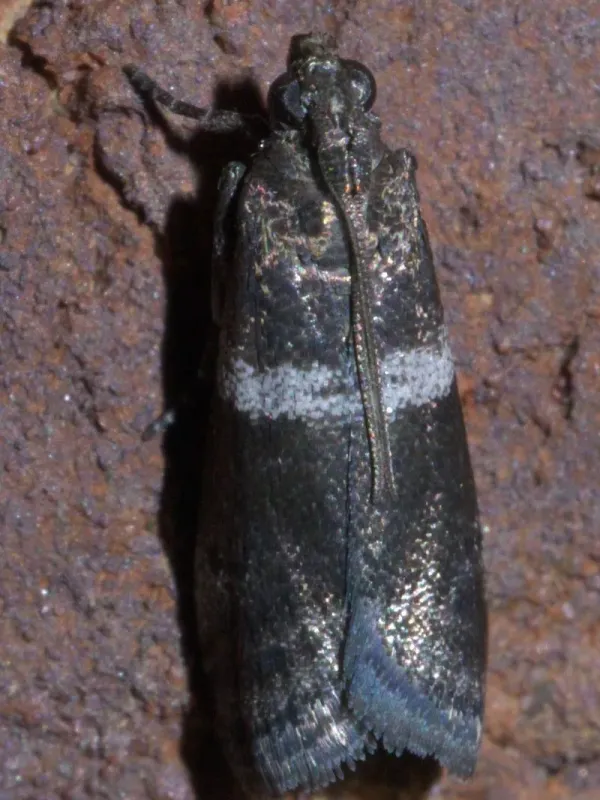
Hammond's leafminer (Psorosina hammondi) is a member of the Pyralidae family. The adult moth is small, typically measuring 12–15 mm in wingspan, with a brownish-grey appearance marked by darker transverse bands across its forewings.
The larvae progress through several developmental stages. Initially, they are leaf miners, living inside the foliage, but as they grow, they shift their behavior to become leaf tiers and skeletonizers, living in protected webbing.
The life cycle involves complete metamorphosis (egg, larva, pupa, adult). The species typically overwinters in the pupal stage, encased in a silken cocoon hidden in bark crevices or among plant debris under the tree canopy.
Recognizing the adult moth can be difficult due to its cryptic coloration, which blends in with tree bark. Monitoring programs rely on pheromone traps or visual inspection of foliage during the spring.
This pest is a specialist that primarily targets plants within the Rosaceae family, making apple and quince orchards the most frequent sites for infestation outbreaks.
##damage##The primary hosts for Hammond's leafminer are apple trees. The larvae cause damage by consuming the internal tissue of the leaf during the mining stage and skeletonizing the exterior surfaces later in their development.
The initial mining phase creates blotchy, brown patches on the leaves. As the larvae mature, they weave silk to pull leaf edges together, creating shelters where they feed extensively on the leaf tissue.
This feeding behavior severely impairs the photosynthetic capacity of the leaves. Heavily infested trees show early leaf browning, curling, and eventually premature defoliation, which stresses the tree.
In cases of high infestation levels, the overall vigor of the apple tree is compromised. This reduced vitality can lead to stunted shoot growth, poor fruit quality, and lower yield in the following season.
Young nursery trees are particularly vulnerable, as the loss of foliage during critical growth phases can result in lasting damage to the tree's structure and overall health.
##season##The adult moths emerge in late spring, usually corresponding with the apple tree blossoming period. This is when the cycle begins with eggs being laid on the underside of fresh, young leaves.
Larval activity peaks in early summer, typically throughout June. This period is the most important for scouting, as the larvae are highly active and the initial leaf mines become clearly visible.
Depending on the climatic zone and temperature, the insect may complete two generations per year, with the second generation of larvae appearing in late summer, causing additional late-season stress to the trees.
Warm, dry weather conditions tend to accelerate the development of the larvae, potentially leading to larger population spikes in favorable years compared to cooler, wetter seasons.
As autumn approaches, the larvae seek out overwintering sites. They spin their cocoons in protected areas, entering dormancy to survive the winter temperatures until the cycle repeats the following spring.
##signs##The most immediate sign of an infestation is the presence of small, pale blotch mines on the leaf surfaces, which eventually turn brown and necrotic as the internal tissues are consumed.
As the larvae grow, they create noticeable webs that tie leaves together. These shelters are often filled with frass, providing a clear indication that a caterpillar is residing within the folded leaf.
- Light-colored blotch mines on the foliage.
- Leaves skeletonized to the main veins.
- Visible silk webbing between adjacent leaves.
- Curled, deformed, or rolled leaf tips.
- Premature yellowing and leaf drop in the mid-to-late summer.
Observing these signs, particularly the combination of leaf rolling and skeletonization, is a strong indicator of Psorosina hammondi presence compared to other leaf-feeding insects.
##control##Cultural control is a primary defense. This includes regular pruning to remove infested branches and the meticulous collection and destruction of fallen leaves, which harbor the overwintering pupae.
Fall soil cultivation under the tree canopy helps disrupt the pupal stages located in the ground or surface debris, reducing the initial population density for the following spring.
Biological controls, such as the release of parasitic wasps (e.g., Trichogramma species) or the use of microbial insecticides, are effective options for integrated pest management programs.
Chemical control should be applied based on economic thresholds determined by pheromone monitoring. Targeting the larvae when they are in their early mining stage is generally the most effective strategy.
Always rotate insecticide modes of action to prevent the development of resistance within the leafminer population, and ensure applications align with local orchard safety guidelines.
Taxonomy
- Latin name
- Psorosina hammondi
- Order
- Lepidoptera (butterflies)
- Family
- Pyralidae
- EPPO code
- PSOOHA
Discussion
No discussions yet — be the first.