
Indian meal moth
Plodia
Description
How to identify
The Indian meal moth, scientifically known as Plodia interpunctella, is a common member of the Pyralidae family in the order Lepidoptera. It is a major pest for global grain and food storage systems.
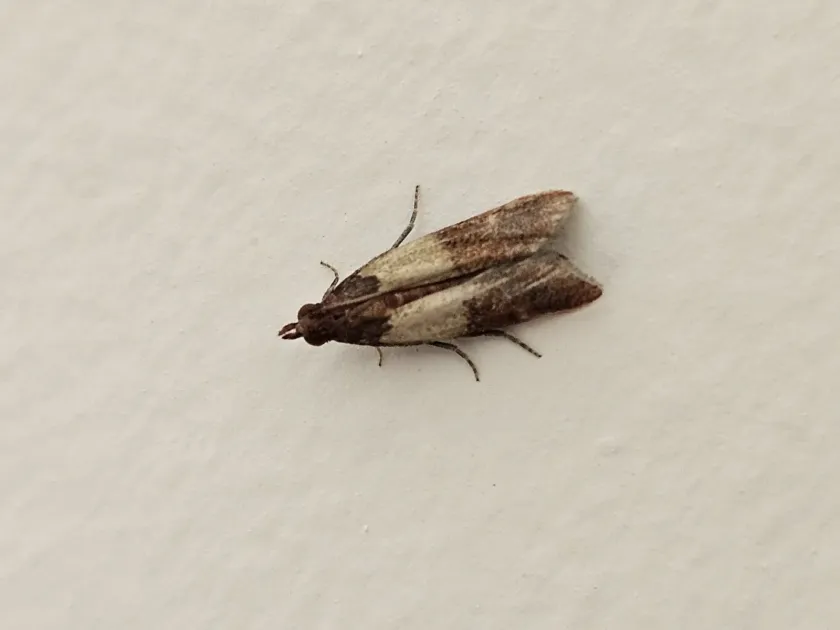
The adult moth has a wingspan of approximately 15 to 20 mm. The most distinct feature is the pattern on its forewings: the inner portion is yellowish-gray, while the outer portion is a reddish-bronze color.
In a resting position, the moth is easily overlooked due to its dull coloring and habit of hiding in dark crevices of warehouses, mills, and residential pantries.
The larvae, which cause the primary damage, grow up to 15 mm in length. They are typically off-white, yellowish, or slightly pinkish, with a brown head capsule.
The lifecycle duration is highly dependent on environmental factors. In climate-controlled environments, the insect can complete its development from egg to adult in less than 30 days.
What it damages
Plodia interpunctella is a highly polyphagous species. It consumes a vast variety of dried food products, including cereal grains, flour, dried fruits, nuts, and even spices and pet food.
The larvae are responsible for the damage. They bite through food containers and feed inside the product, destroying the embryo and the endosperm of the seeds or grains.
Beyond direct consumption, the larvae create messy, webbed masses in the food supply. These silken threads connect food particles, which leads to the formation of dense clumps.
The accumulation of waste products, such as frass (excrement) and larval skins, makes the infected food repulsive and unsuitable for human consumption or processing.
Large-scale infestations can cause severe economic losses, as entire batches of food products become contaminated and must be discarded to prevent the spread of the population.
Signs of infestation
The first indication of an infestation is often the observation of adult moths flying erratically near ceilings or food storage shelves, especially during evening hours.
A secondary sign is the presence of fine, silk-like webbing on the surface of grain, flour, or dried fruits. This webbing is often the most reliable way to identify an active infestation.
Consumers may notice small, clumped-together particles of flour or cereal that appear stuck together by thin, sticky threads that are clearly visible upon inspection.
The discovery of small larvae or empty pupal cases inside or on the exterior of food packaging is a definitive sign that the population has established itself in the area.
In severe cases, you might smell an unusual, musty odor emanating from the stored products, which is a result of the insect's waste combined with potential secondary fungal decay.
Control measures
Sanitation is the most crucial step in managing the Indian meal moth. All spilled grains or food debris must be removed, as these provide an ideal environment for egg-laying.
Storing susceptible products in airtight glass, metal, or hard plastic containers helps prevent adult moths from entering and laying eggs in the food supply.
Pheromone traps are highly effective tools for both monitoring the presence of moths and reducing their population by attracting and capturing the male adults.
For larger facilities, fumigation is the standard industry method. It ensures that the gas reaches all crevices and cracks where larvae or pupae might be hidden.
- Frequent rotation of stored goods to prevent long-term exposure.
- Freezing small quantities of suspected products to kill all life stages.
- Inspecting new shipments before they are placed in general storage.
- Using vacuum cleaning to remove debris from warehouse cracks.
Taxonomy
- Latin name
- Plodia
- Order
- Lepidoptera (butterflies)
- Family
- Pyralidae
- EPPO code
- PLODSP
Discussion
No discussions yet — be the first.