
Oak knot-horn
Phycita roborella
Description
How to identify
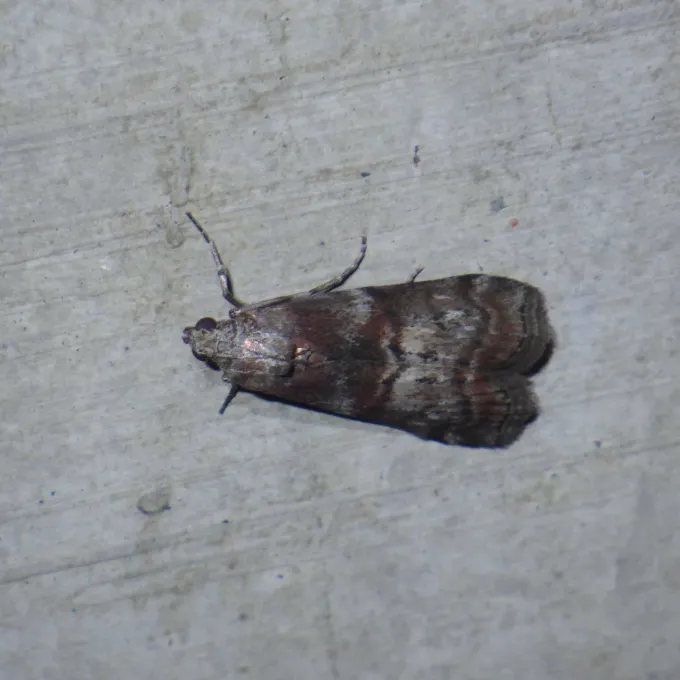
The Oak knot-horn (Phycita roborella) is a moth belonging to the family Pyralidae. The adult moth typically has a wingspan ranging between 25 and 30 mm.
The forewings are colored in mottled shades of grey and brown, featuring intricate transverse lines that provide excellent camouflage against oak bark, making them hard to spot.
The larvae, or caterpillars, reach about 20 mm in length. Their bodies are greenish-grey with a dark head and distinct pale longitudinal lines along the dorsal area.
Pupation occurs within a sturdy, silken cocoon constructed by the larvae. These cocoons are often found hidden within folded leaves or deep inside fissures in the bark.
The species overwinters as young larvae. They seek refuge in dense, silken hibernacula built in the crotches of branches or under bark scales to survive cold conditions.
What it damages
The primary host for Phycita roborella is the English oak (Quercus robur). The caterpillars cause damage by feeding on young leaves and developing buds.
During outbreaks, these larvae can cause significant defoliation, particularly in young saplings, which hampers growth and reduces the overall vigor of the trees.
While oak is the main target, the species can occasionally infest related woody plants like hazel and hornbeam when located near heavy infestations.
The feeding activity creates wounds that may serve as entry points for secondary pests, wood-boring insects, and various pathogenic fungi.
Severe infestations reduce the photosynthetic capacity of the trees, potentially leading to branch dieback and increased susceptibility to environmental stress.
When it appears
Larvae emerge from their overwintering sites in early spring, synchronized with the opening of oak buds, which they immediately start to consume.
Adult moths are typically active during the summer months, with flight peaks occurring between June and August. They are nocturnal and shy away from daylight.
The life cycle is generally univoltine, meaning there is one generation per year, although temperature fluctuations can slightly alter development times.
Eggs are laid singly or in small clusters on the underside of leaves, usually adjacent to the midrib, providing the hatching larvae with immediate access to food.
After reaching maturity in mid-summer, the larvae construct their protective cocoons to pupate, continuing their development before the next cycle begins.
Signs of infestation
The most prominent sign of an infestation is the presence of silk webbing that binds several leaves together, creating a protected feeding chamber for the caterpillars.
Early in the season, look for buds that fail to open or show ragged edges, indicating that larvae have been feeding inside the protective bracts.
- visible frass (excrement) trapped within the silk webbing;
- skeletonized leaves showing irregular, jagged feeding patterns;
- premature wilting and browning of leaf clusters due to webbing damage.
In winter, closer inspection of the tree trunk might reveal small, greyish silken cocoons tucked away in the rough texture of the bark.
Large-scale damage manifests as a scorched appearance of the tree crown, characterized by a high number of dead, webbed leaves remaining on the branches.
Control measures
Encouraging populations of insectivorous birds and predatory insects within forests is a highly effective way to naturally regulate caterpillar density.
Biological insecticides, such as those formulated with Bacillus thuringiensis, are effective tools for managing larvae without disrupting the local ecosystem.
In nurseries or high-value forest stands, professional application of systemic insecticides may be required during the peak spring emergence of the larvae.
Sanitation practices, such as removing excess dead bark from younger trees and clearing debris, can significantly reduce the number of overwintering sites.
Monitoring flight patterns using pheromone traps is recommended to predict population peaks and ensure that control measures are applied at the most vulnerable stage.
Taxonomy
- Latin name
- Phycita roborella
- Order
- Lepidoptera (butterflies)
- Family
- Pyralidae
- EPPO code
- PHYISS
Discussion
No discussions yet — be the first.