
Phycita fuscopilella
Phycita fuscopilella
Description
How to identify
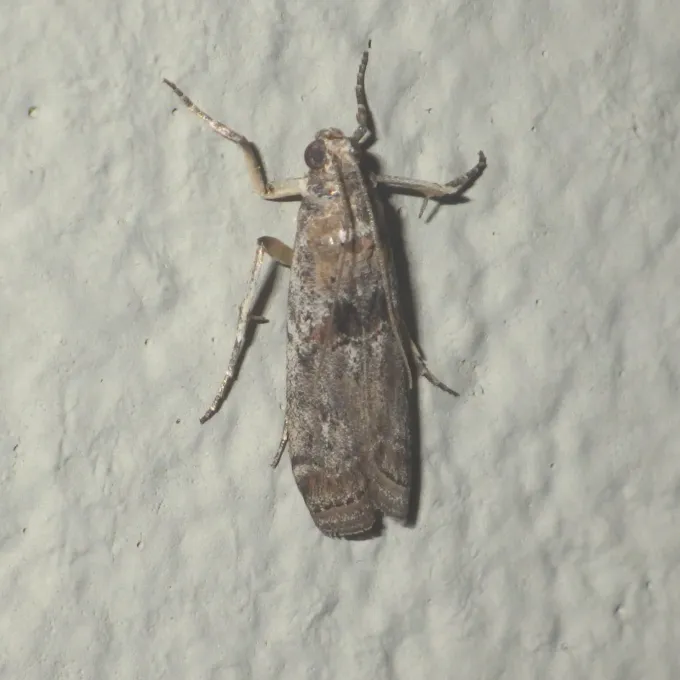
Phycita fuscopilella belongs to the family Pyralidae, order Lepidoptera. The adult is a small moth with a wingspan of approximately 20–25 millimeters, characterized by cryptic coloration.
The forewings have a dark brownish or greyish pattern, which provides excellent camouflage against tree bark during the daytime. The hindwings are generally lighter with distinct venation.
The larvae, or caterpillars, undergo several developmental stages, gradually increasing in size and transitioning from a pale yellowish to a greenish-brown coloration with distinct longitudinal stripes.
The pupa is typically dark brown and develops inside a dense cocoon, which the larva spins in protected locations such as bark crevices or among dry leaves.
This species exhibits high adaptive capacity in natural environments, allowing it to successfully overwinter in the prepupal or early larval stages within the bark cracks of host trees.
What it damages
The primary hosts for Phycita fuscopilella larvae are fruit trees, particularly members of the Rosaceae family. Apples, pears, and various stone fruit species are most frequently affected.
The pest damages the vegetative organs of the plant, including buds, young leaves, and occasionally developing fruit. During outbreaks, caterpillars can significantly reduce total leaf surface area.
The most severe damage occurs in nurseries and young orchards, where the destruction of buds and terminal shoots leads to stunted tree growth and deformation of the crown structure.
Beyond direct tissue consumption, these injuries act as entry points for fungal and bacterial pathogens, which significantly complicates the phytosanitary status of the orchard.
Economic losses are primarily driven by reduced fruit yields and the necessity for supplementary control measures, which increase overall production costs.
When it appears
Adult flight typically begins in the spring, coinciding with the bud-break period, and may extend into early summer depending on regional climatic conditions.
The moths are primarily active during dusk and nighttime hours, remaining hidden in the canopy or among dead bark during the day, which makes manual detection difficult.
The larval feeding period spans from late spring through the first half of summer, aligning with the window of active shoot growth and fruit development.
Depending on the geographic latitude, Phycita fuscopilella may complete one or two generations per season, which directly influences the intensity of the infestation.
Pupation occurs in mid-summer, leading to the emergence of the next generation, which prepares the foundation for the overwintering cycle of the pest.
Signs of infestation
The primary indicator of an infestation is the presence of silk nests that bind several young leaves or buds at the tips of the shoots.
On affected branches, one can observe larval frass (excrement) accumulating inside the silken webs, forming characteristic clumped debris.
Wilting or premature yellowing of individual young shoots is a clear sign that the larvae have damaged the vascular tissues of the stem.
- Small holes in buds and irregularly eaten margins of leaf blades.
- Curled and deformed leaves held together by fine silken threads.
- Gnawed areas of bark surrounding damaged buds during the early spring period.
With careful observation of the canopy during evening hours, one may detect the activity of adult moths, which are attracted to artificial light sources.
Control measures
The management strategy includes agrotechnical methods, such as timely pruning and the destruction of infested shoots where larvae congregate.
The use of sticky bands on tree trunks helps limit the movement of the pest and reduces the overall population density within the orchard.
Biological control involves the application of Bacillus thuringiensis-based products, which effectively target the larval stage without disrupting the local ecological balance.
Chemical control is recommended only during periods of high population density, utilizing systemic or contact-stomach insecticides during the «green tip» phenological phase.
An essential component is the promotion of entomophagous insects, such as ichneumonid wasps, which act as natural predators and limit the reproduction of the pest in the wild.
Taxonomy
- Latin name
- Phycita fuscopilella
- Order
- Lepidoptera (butterflies)
- Family
- Pyralidae
- EPPO code
- PHYIFU
Discussion
No discussions yet — be the first.