
Carob moth
Paramyelois
Description
How to identify
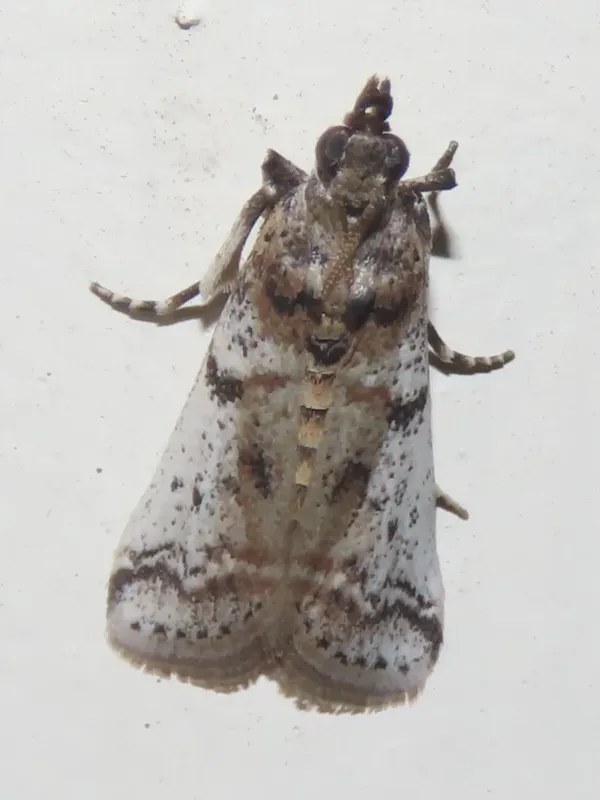
The Carob moth, scientifically known as Paramyelois transitella, is a lepidopteran insect belonging to the Pyralidae family. These moths have a wingspan typically ranging from 20 to 25 millimeters.
Adult moths exhibit a brownish-gray coloration with subtle dark bands on their forewings, which provides excellent camouflage against tree bark. Their body is slender, a characteristic trait of the Phycitinae subfamily.
The larvae, or caterpillars, undergo several developmental stages, changing color from light beige to brownish as they mature. Their head capsule is dark brown and robust, allowing them to penetrate thick fruit skins.
Identification in the field is challenging due to the larvae's cryptic habit of feeding inside fruits. Detection often occurs only when damaged fruits are opened or during harvest operations.
Eggs are minute and oval-shaped, typically deposited by females on the surface of the fruit, particularly near natural openings or the calyx end of host fruits like pomegranates.
What it damages
The primary host crops for this pest include pomegranates, walnuts, almonds, pistachios, and figs. The moth is specialized in exploiting fruits with hard shells or tough protective tissues.
Larvae bore into the fruit, creating tunnels within the pulp and seeds. In pomegranates, the caterpillars feed directly on the arils and internal partitions, rendering the fruit completely unmarketable.
Infested fruits are prone to secondary infections, including molds and bacterial rots, which spread quickly through the tunnels created by the larvae, resulting in total loss of quality.
In orchards with high pest pressure, yield losses can exceed 50 percent. This creates a significant economic impact for growers of nuts and pomegranates worldwide.
The pest often continues its life cycle in fallen fruit on the orchard floor, which serves as a reservoir for subsequent infestations if these residues are not managed properly.
When it appears
Adult activity typically begins in the spring when temperatures rise, favoring the emergence of moths from overwintering sites. The flight period can last throughout the summer.
Depending on the climatic zone, the Carob moth can complete between two and four generations per year. Peak oviposition coincides with the ripening phase of the fruits.
Larvae feed actively throughout the summer and into early autumn. They overwinter primarily as late-stage larvae within mummified fruits left on trees or on the ground.
The emergence of the spring generation of adults is often asynchronous, making the timing of insecticide applications difficult for producers who lack proper monitoring tools.
In autumn, the final generation of larvae prepares for winter by pupating in protected micro-habitats, ensuring their survival through the colder months.
Signs of infestation
The most prominent sign of infestation is the presence of small entry holes on the fruit surface, often surrounded by a mixture of larval frass and webbing.
For pomegranates, early signs include premature discoloration and wilting of the fruit, which often leads to dropping before the fruit has reached proper maturity.
Upon opening a damaged fruit, one can find internal tunnels packed with silk and dark excrement. The fruit tissue surrounding the tunnels often displays signs of rot or fungal growth.
- Presence of webbing inside the seed chambers of the fruit.
- Darkening and decay of internal seeds and pulp.
- Characteristic odor of decaying organic matter from the infested fruit.
- Premature abscission (dropping) of young developing fruits.
Damage focused around the calyx is a diagnostic indicator, as it is the most common entry point for neonate larvae seeking protection while entering the fruit.
Control measures
Effective management of the Carob moth requires an integrated approach that prioritizes sound cultural practices to minimize overwintering populations.
The most critical cultural practice is sanitation, which involves the removal and destruction of all mummified fruits from trees and the orchard floor to eliminate nesting sites.
Pheromone-based monitoring and mating disruption techniques are highly effective in managing population levels and reducing the rate of successful mating among adults.
Chemical interventions must be timed precisely with the larval hatch period, before the caterpillars have burrowed deep into the fruit where they are shielded from contact insecticides.
Biological control, including the use of Bacillus thuringiensis or releasing natural parasitoids, serves as an essential and sustainable tool for maintaining low infestation levels in commercial orchards.
Taxonomy
- Latin name
- Paramyelois
- Order
- Lepidoptera (butterflies)
- Family
- Pyralidae
- EPPO code
- PARMSP
Discussion
No discussions yet — be the first.