
European corn borer (American strain)
Ostrinia obumbratalis
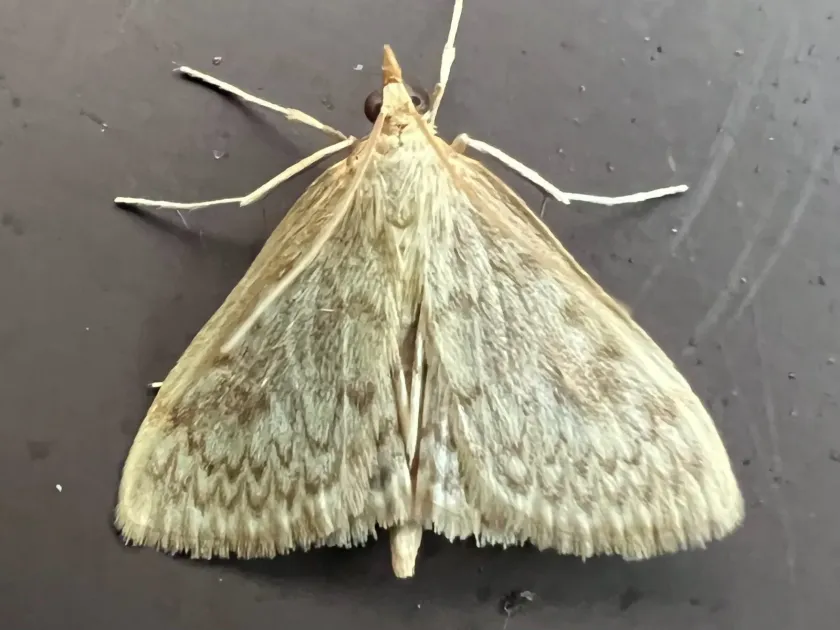
Description
How to identify
The American corn borer (Ostrinia obumbratalis) belongs to the order Lepidoptera and the family Crambidae. It is a significant agricultural pest known for its destructive impact on maize cultivation.
Adult moths have a wingspan of approximately 25-30 mm. The forewings are generally straw-colored to light brown, featuring distinct darker, zigzagged transverse bands across the surface.
Females are typically larger than males and exhibit a slightly paler overall coloration. These moths are primarily nocturnal, making them difficult to detect during daylight hours.
Eggs are deposited in masses on the underside of leaves. Each egg mass consists of overlapping, flat eggs that resemble fish scales and transition from white to a darker hue as they mature.
Larvae pass through several instars, eventually reaching 25 mm in length. Their bodies are typically greyish-brown with dark spots and a prominent longitudinal stripe along the back.
What it damages
Maize is the primary host for this species, though it can also infest various other grasses and weeds within the family Poaceae. The larvae cause the most severe economic damage.
After hatching, larvae feed briefly on leaves before boring into the plant. They create tunnels within stalks, leaf midribs, and ears, disrupting the plant's vascular system.
Internal tunneling compromises the structural integrity of the maize stalk. This leads to severe lodging, where plants break or fall over, making harvesting operations extremely difficult.
Damage to the ear shank or the ear itself significantly reduces grain yield and quality. Open wounds from the borer's tunnels often become entry points for fungal pathogens.
Widespread infestations can lead to substantial crop loss if left unmanaged, as the larvae are protected from many external environmental factors once inside the plant.
When it appears
The activity of the moths is highly dependent on regional climate and temperature. Adults typically emerge during early summer when nighttime temperatures stabilize.
Female moths exhibit a prolonged flight period, during which they select suitable host plants to lay eggs. This behavior ensures that larvae have immediate access to nutrients upon hatching.
The developmental period from egg to adult is relatively short, allowing for multiple generations in warmer climates during a single growing season.
Late-season larvae overwinter in a state of diapause inside the stalks or stems of the host plant. They remain protected within these remnants until the following spring.
Pupation occurs inside the existing tunnels. Successful emergence in spring is highly correlated with the moisture content and temperature of the plant debris left in the field.
Signs of infestation
Early infestation signs include small, shothole-like lesions on leaves, caused by young larvae feeding before they move toward the stalk.
The presence of fine, sawdust-like frass (larval excrement) at the leaf axils or near entry holes in the stalk is a definitive indicator of an active infestation.
Wilting of the tassels or the upper portion of the maize plant during the silking stage is a classic symptom, indicating that the larval tunnels have severed the main transport tissues.
Visual inspection often reveals darkened entry holes surrounded by minor discoloration, which are clear markers of larvae activity inside the plant stem.
- Stalk breakage or bending at points of larval entry.
- Premature yellowing of leaves located above the point of tunneling.
- Damage to the husk and kernels of the ear, sometimes affecting the cob core.
Control measures
Effective management begins with aggressive post-harvest crop residue management. Shredding and deep plowing incorporate the stalks, destroying the overwintering sites for the larvae.
Crop rotation remains a fundamental practice to break the life cycle of the moth by limiting the availability of host plants in consecutive seasons.
The use of genetically modified maize hybrids expressing insecticidal proteins has become the gold standard for controlling this pest in many regions of North America.
Biological control, such as the release of egg parasitoids (Trichogramma species), can be effective if timed precisely to match the moth's egg-laying periods.
In cases where chemical intervention is necessary, insecticides must be applied precisely during the window of egg hatch, before the larvae successfully penetrate the stalks.
Taxonomy
- Latin name
- Ostrinia obumbratalis
- Order
- Lepidoptera (butterflies)
- Family
- Pyralidae
- EPPO code
- PYRUAI
Discussion
No discussions yet — be the first.