
Mango leaf webber
Orthaga exvinacea
Description
How to identify
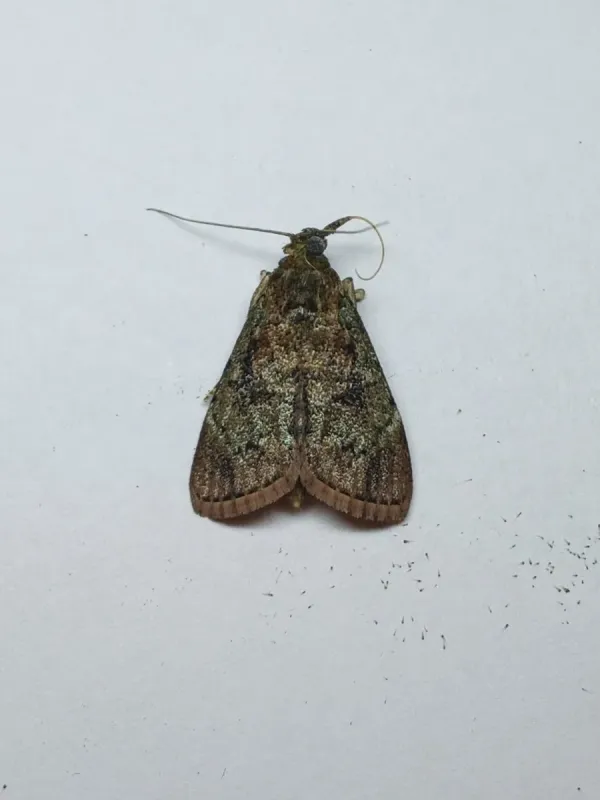
The mango leaf webber (Orthaga exvinacea) is a moth belonging to the family Crambidae. It is recognized as one of the most destructive pests affecting mango orchards worldwide.
Adult moths are relatively small, with a wingspan of 20-25 mm. They exhibit cryptic coloration, usually dark brownish-grey, which helps them blend seamlessly with the bark of mango trees.
The life cycle consists of egg, larva (caterpillar), pupa, and adult stages. Females typically deposit eggs in clusters on the undersides of tender, young leaves.
Larvae are the primary damaging stage. They grow through several instars and often have a brownish body with longitudinal stripes, which helps them remain inconspicuous while feeding.
The pest completes its life cycle in approximately 30 to 40 days, which facilitates the emergence of multiple, overlapping generations throughout the growing season.
What it damages
This pest exclusively feeds on mango leaves and soft shoots. During severe infestations, caterpillars can cause near-total defoliation of the tree canopy.
Young larvae feed on the leaf epidermis, while older caterpillars consume the entire leaf lamina, leaving only the primary veins behind, which is often referred to as skeletonization.
Constant feeding reduces the photosynthetic surface area of the tree, significantly hindering its growth and ability to produce healthy fruits.
The pest webbed leaves together, creating a protected microenvironment where they feed, which leads to leaf drying and eventual abscission.
Besides immediate leaf loss, the damage weakens the tree, making it more susceptible to secondary fungal infections and decreasing overall orchard productivity.
Signs of infestation
The most distinctive sign of a mango leaf webber infestation is the presence of webbed clusters of leaves tied together with silk threads.
Inside these webbed nests, one can often find large numbers of caterpillars hiding during the day to avoid heat and predators.
Damaged leaves show characteristic irregular holes or are completely consumed, resulting in a scorched or blighted appearance of the tree canopy.
The accumulation of dry excreta (frass) within the webbing and on the branches below the infested foliage provides strong evidence of active feeding colonies.
When inspecting the tree, you will notice that the webbing turns brownish as the leaves inside die, creating dark, unsightly patches across the canopy.
Control measures
Physical removal of the webbed nests during the early stages of infestation is a highly effective manual control method for home gardens and small orchards.
Biological control using microbial insecticides, specifically those containing Bacillus thuringiensis, is recommended to target larvae without harming beneficial insects.
Pruning and thinning the tree canopy enhances airflow and sun penetration, making the environment less favorable for the webber's nesting behavior.
Systemic insecticides should be used as a last resort in commercial plantations, ensuring they are applied during the period of peak larval activity.
Using light traps or pheromone traps can help in monitoring moth population density, allowing for precisely timed management actions before damage spreads significantly.
Taxonomy
- Latin name
- Orthaga exvinacea
- Order
- Lepidoptera (butterflies)
- Family
- Pyralidae
- EPPO code
- ORTAEX
Discussion
No discussions yet — be the first.