
African cob borer
Mussidia nigrivenella
Description
How to identify
The African cob borer (Mussidia nigrivenella) is a significant moth species belonging to the order Lepidoptera and the family Pyralidae, known for its destructive impact on tropical crops.
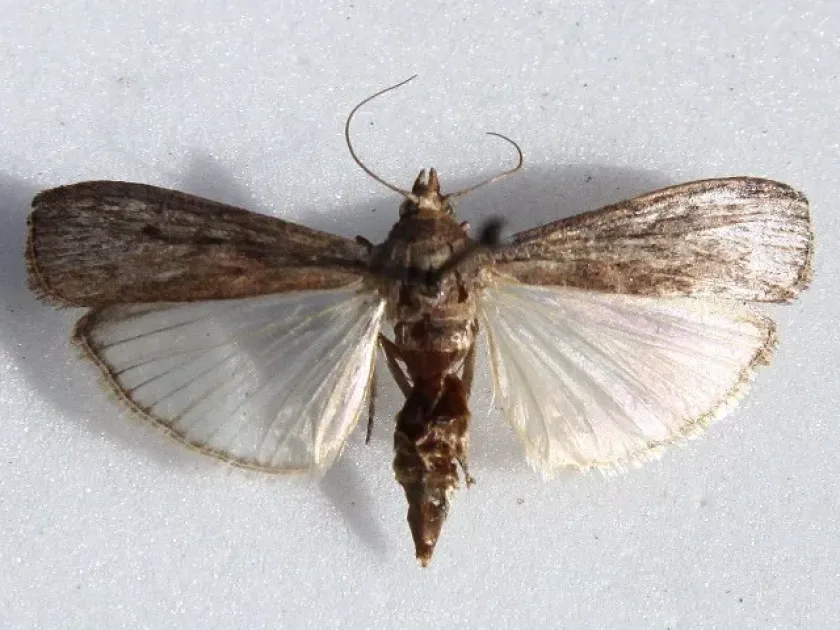
Adult moths are relatively small, with a wingspan of approximately 20 to 25 mm, and possess wings with brownish-grey patterns that serve as camouflage.
The larvae progress through several instar stages, initially appearing creamy-white and developing a reddish or pinkish hue as they mature.
Eggs are minute and typically deposited by females on the surface of developing cobs or fruit, serving as the starting point for larval feeding.
Pupation occurs within a tough, silken cocoon constructed by the mature larva in protected sites, such as inside the cob or beneath the soil surface.
What it damages
This pest is a major threat to maize production, as larvae tunnel into the cobs and consume the kernels, leading to significant yield losses and quality reduction.
Beyond maize, it is a primary pest for cocoa, where it penetrates the pods and destroys the beans, resulting in major financial losses for farmers.
The borer is highly polyphagous and also affects various other hosts, including peanuts, oil palm fruits, and cowpeas, making it a difficult pest to eradicate.
Feeding damage creates entry points for fungal pathogens, significantly increasing the risk of secondary infections and mycotoxin contamination in harvested crops.
In post-harvest scenarios, the borer can continue to develop within stored grain if moisture levels are sufficiently high, threatening food security in storage facilities.
When it appears
The lifecycle of the African cob borer is heavily influenced by local environmental conditions and the availability of preferred host plants throughout the year.
In tropical environments, the pest can undergo multiple overlapping generations, meaning it remains active and poses a threat across almost every season.
Adult moths are nocturnal, exhibiting peak activity after dusk when they navigate to suitable host plants for oviposition based on olfactory cues.
The abundance of the pest typically spikes during the silking and grain-filling stages of maize, as these offer the most nutritious and accessible food sources.
Temperature fluctuations directly impact the speed of the lifecycle; warmer temperatures facilitate faster development rates, potentially causing rapid outbreaks.
Signs of infestation
Initial signs of infestation often include the accumulation of larval frass (excrement) and silk webbing visible on the tips of the maize cobs.
Discoloration or premature wilting of the cob silks often indicates that larvae have successfully penetrated the husks and are feeding on the kernels.
Internal examination of infested cobs reveals characteristic galleries and irregular feeding patches, often accompanied by decay caused by opportunistic fungi.
On cocoa pods, small entry holes surrounded by necrotic tissue are tell-tale signs of borer infestation that can be detected during routine inspections.
The presence of abandoned cocoons or empty pupal cases attached to the crop residue is a strong indicator of past or ongoing pressure in the field.
Control measures
Field sanitation is a critical control measure, involving the removal and destruction of crop residues where larvae and pupae may seek refuge.
Selecting maize varieties with tight, long husks is a recommended cultural practice to physically prevent the borer from accessing the developing grain.
Biological control, particularly the use of natural parasitoids like Trichogramma species, has shown promise in reducing population numbers naturally.
Monitoring using pheromone traps is essential for timing interventions and determining whether chemical pesticide applications are necessary to prevent severe damage.
Integrated Pest Management (IPM) strategies emphasize planting schedules that mismatch the most vulnerable crop stages with the peak flight periods of the adult moths.
Taxonomy
- Latin name
- Mussidia nigrivenella
- Order
- Lepidoptera (butterflies)
- Family
- Pyralidae
- EPPO code
- MUSSNV
Discussion
No discussions yet — be the first.