
Mill moth
Moodna bisinuella
Description
How to identify
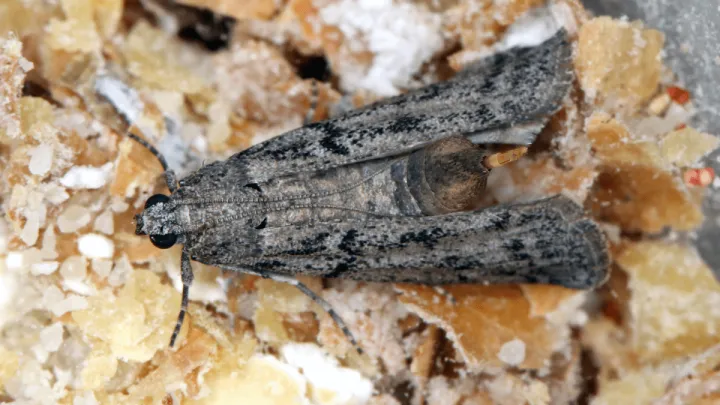
The mill moth (scientific name Moodna bisinuella) belongs to the Phycitidae family, order Lepidoptera. Adults are small moths with a wingspan of approximately 15–18 mm, characterized by greyish-brown forewings with distinct patterns.
Larvae are 12–15 mm long with a yellowish-white or greenish body and a distinct brown head capsule. They are cryptic and often remain deep within the grain or processed products.
Pupae are found within tough, silken cocoons. These cocoons are often spun in protected areas such as crevices, storage container seams, or machinery parts in milling facilities.
The life cycle is highly dependent on ambient temperature and humidity. Warm, humid environments significantly accelerate the developmental rate, allowing for multiple generations per year.
Identification often requires careful inspection of storage sites. Because they resemble other stored product moths, professional monitoring is recommended to confirm the specific species.
What it damages
The mill moth is a specialized pest of stored food products, primarily targeting grains, flour, cereals, bran, dried fruits, nuts, and various processed agricultural commodities.
Larvae feed by burrowing into the product, leaving behind extensive silk webbing that binds particles of food together into large, unsightly clumps. This makes the affected product unsellable.
The primary damage includes direct consumption of the product, particularly the grain germ, which lowers the nutritional quality and viability of stored seeds.
Contamination with excrement, larval skins, and webbing significantly degrades the quality of food, creating an environment susceptible to mold growth and additional infestation by secondary pests.
Infestations in industrial mills or elevators can cause heating within stored grain masses, leading to localized spoilage that can spread rapidly throughout the entire storage unit.
Signs of infestation
The most prominent sign of an infestation is the presence of silk webbing on the surface of stored grain or inside food packaging, which often creates mats or clumping of the product.
Consumers or managers may notice small exit holes in grain kernels or the presence of fine debris resembling sawdust, resulting from the larvae feeding and maturing inside the product.
Sighting adult moths flying near artificial light sources during evening or night hours is a clear indicator that a breeding population is established nearby.
Hidden cocoons found in the cracks of floorboards, wall junctions, or behind conveyor belts are typical indicators of established populations in industrial facilities.
A musty or rancid odor, coupled with a change in product color or texture in specific zones, often indicates that the larvae have been active in that area for an extended period.
Control measures
Strict sanitation protocols are the first line of defense. Regular cleaning of storage equipment, removal of spilled flour, and vacuuming of corners and crevices prevent population buildup.
Monitoring using pheromone-baited traps is essential for early detection. These traps provide data on moth activity levels, helping to determine the precise timing for intervention.
If an infestation reaches economic threshold levels, fumigation using phosphine-based products is the standard procedure to eliminate all developmental stages of the pest.
Managing the storage environment by maintaining low temperatures and adequate dryness can significantly inhibit the metabolic and reproductive rates of the mill moth.
Implementing a "first-in, first-out" inventory system and ensuring that all containers are properly sealed protects the product from entry and subsequent infestation by adult moths.
Taxonomy
- Latin name
- Moodna bisinuella
- Order
- Lepidoptera (butterflies)
- Family
- Pyralidae
- EPPO code
- MOODBI
Discussion
No discussions yet — be the first.