
African rice stem borer
Maliarpha
Description
How to identify
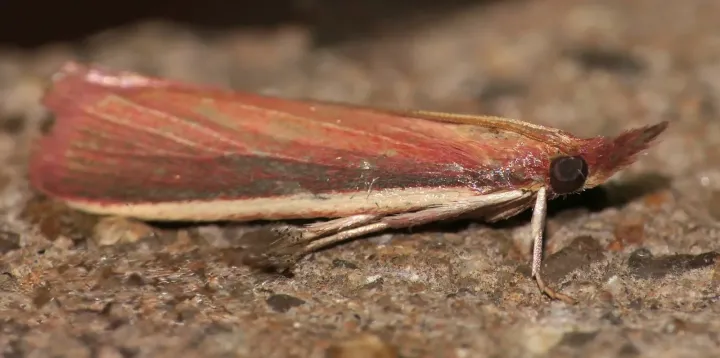
The African rice stem borer (Maliarpha separatella) is a moth belonging to the order Lepidoptera and the family Pyralidae. Adult moths have a wingspan of approximately 20–25 mm.
The forewings exhibit a grayish-brown pattern with longitudinal darker stripes, providing excellent camouflage against rice stems. The hindwings are generally paler and translucent.
Larvae, which are the primary damaging stage, reach up to 25 mm in length. They feature a smooth body ranging from creamy to pinkish, with a distinct dark brown head capsule.
Pupation occurs within the rice stem, where the pupa remains protected inside a reddish-brown cocoon formed from silk and plant tissue.
As a highly specialized pest, it is almost exclusively found in rice-growing regions, making it a critical focus for agricultural monitoring.
What it damages
The primary host for this pest is cultivated rice (Oryza sativa). Larvae feed internally on the stems, disrupting the plant's vascular system.
This internal feeding prevents water and nutrient translocation, leading to the development of dead, empty panicles commonly known as "whiteheads."
Young plants infested by the borer often show "deadheart" symptoms, where the central leaf withers and dries out, inhibiting the plant's growth.
Infested stalks become structurally weakened, significantly increasing the risk of lodging during adverse weather conditions like heavy rain or wind.
In severe infestations, crop yields can be reduced by 30% or more, resulting in substantial economic losses for rice farmers.
When it appears
The lifecycle of the borer is synchronized with the phenology of the rice plant, with one generation typically completed in 35 to 45 days.
Adult moths are nocturnal and active at night, when females lay clusters of eggs on the leaves, near the leaf sheath.
Outbreaks are most common during the warm and humid stages of the rice growing season, which provide optimal conditions for larval survival.
In tropical areas where rice is grown continuously throughout the year, the pest can persist through successive generations without a dormant period.
Stability in environmental conditions, specifically high humidity and moderate temperatures, fosters the rapid population growth of this moth.
Signs of infestation
The most visible diagnostic sign is the presence of "whiteheads" during the grain-filling stage, where the panicle turns white and fails to produce grains.
Small entry holes on the rice stems, often surrounded by larval frass (excrement), indicate that a stem borer is actively feeding inside.
At the seedling stage, the yellowing or drying of the central leaf (deadheart) is a classic indicator that the pest has penetrated the plant tissue.
By splitting the stem longitudinally, a technician can expose the galleries created by the larvae and find the larvae or pupae inside.
Uneven growth patterns and the presence of wilting tillers in an otherwise healthy field are strong signals to inspect for stem borer activity.
Control measures
Effective management begins with cultural practices, such as deep plowing of rice fields after harvest to destroy dormant pupae in crop residues.
Planting resistant or tolerant rice varieties is a primary strategy for reducing damage in regions where the pest is endemic.
Biological control, using microbial insecticides like Bacillus thuringiensis, offers a targeted approach that minimizes impact on non-target species.
Chemical control should be applied strategically, based on economic thresholds, using systemic insecticides to reach larvae hiding inside the stems.
- Crop rotation to break the pest's lifecycle.
- Water management to disrupt larval survival.
- Removal and destruction of infested rice stubble.
Taxonomy
- Latin name
- Maliarpha
- Order
- Lepidoptera (butterflies)
- Family
- Pyralidae
- EPPO code
- MALISP
Discussion
No discussions yet — be the first.