
Gold triangle
Hypsopygia costalis
Description
How to identify
The Gold Triangle moth (Hypsopygia costalis) is a member of the Pyralidae family. It is a small moth, typically measuring about 20 to 25 mm in wingspan.
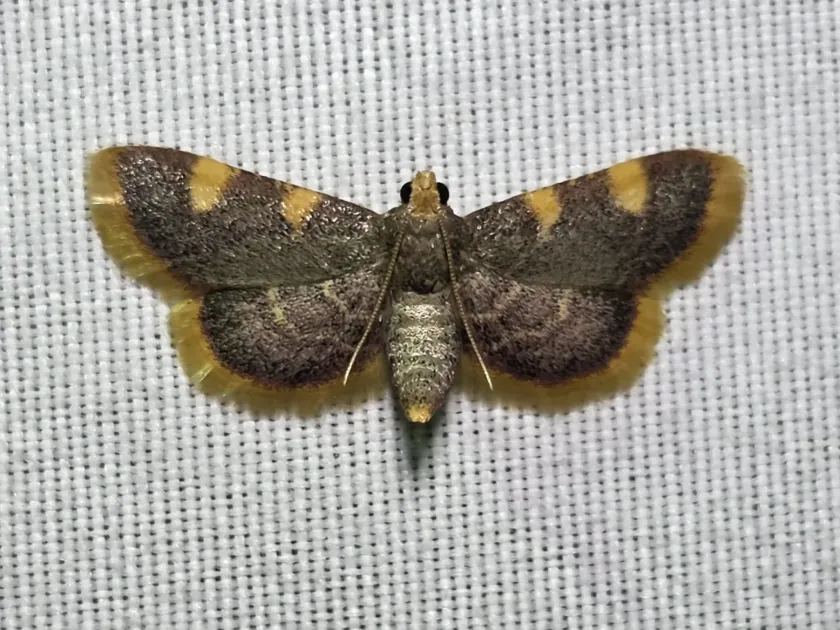
The moth is easily identified by its purplish-brown wings marked with two distinct golden-yellow transverse stripes and golden fringes along the wing margins.
The larvae are yellowish-white with a brown head and a few sparse hairs. They grow up to 20 mm in length and are known for their silk-spinning capabilities.
Pupation occurs within a tough, silken cocoon constructed from debris, waste, and food particles, often found hidden in crevices or tucked into the hay.
As a nocturnal and crepuscular insect, the adult moth spends the daylight hours in dark, sheltered corners of agricultural buildings and storage facilities.
What it damages
The primary food source for the larvae is stored hay, particularly clover and alfalfa, which makes them a significant pest in agricultural storage settings.
Larvae consume the stems and leaves, often webbing the hay together in thick, matted clumps, which significantly degrades the quality and structure of the fodder.
In addition to feeding damage, the accumulation of larval frass and webbing makes the hay unpalatable and potentially toxic for livestock due to mold growth.
Heavy infestations can lead to substantial financial losses, as large sections of baled hay become unusable and must be discarded to prevent further spread.
The pest often focuses on the outer layers of hay bales or stacks, but can penetrate deeper if the storage conditions are conducive to their development.
When it appears
Adult moths emerge in late spring and early summer. Depending on the environmental temperature, multiple generations can occur within a single growing season.
The lifecycle is highly temperature-dependent, with warmer and more humid conditions significantly accelerating the development from egg to adult.
The larvae overwinter in sheltered locations, often deep within old hay piles or in the architectural cracks of wooden barns, surviving the cold months.
Activity peaks during the warm months of June and July, when mating occurs and the next generation of larvae begins feeding on available dry plant matter.
Monitoring the moth population throughout the summer allows farmers to predict potential infestation risks before the final winter stockpiling of hay.
Signs of infestation
The most prominent sign of an infestation is the presence of extensive silk webbing that binds the hay stalks together into dense, web-filled clusters.
Frass, which appears as small dark pellets, is usually found scattered throughout the damaged areas and is a clear indicator of active larval feeding.
Tunnels lined with silk can be observed upon inspecting the interior of the hay bales, where larvae reside and feed in safety away from light.
A musty or decaying odor emanating from the stored fodder is a common symptom associated with the moisture trapped by the larval webs and waste products.
Sighting adult moths resting on the walls or rafters of the barn during the day is a definitive indicator of an established and potentially severe population.
Control measures
The most effective strategy for control is the proper storage of hay: it should be stored dry, elevated off the ground, and in well-ventilated buildings.
Sanitation is critical; all residual hay and debris must be removed from the barn before the new harvest is brought in to eliminate overwintering sites.
Using compressed bales and airtight storage covers can physically prevent the moths from accessing the hay and laying their eggs on the surface.
Biological control agents, such as specific parasitic wasps, can be introduced in some environments to naturally suppress the moth population levels.
- Maintain low humidity in storage barns.
- Inspect hay bales regularly for webbing.
- Dispose of heavily infested hay immediately by burning.
Taxonomy
- Latin name
- Hypsopygia costalis
- Order
- Lepidoptera (butterflies)
- Family
- Pyralidae
- EPPO code
- HYPSCO
Discussion
No discussions yet — be the first.