
Purple-backed moth
Hypsopygia
Description
How to identify
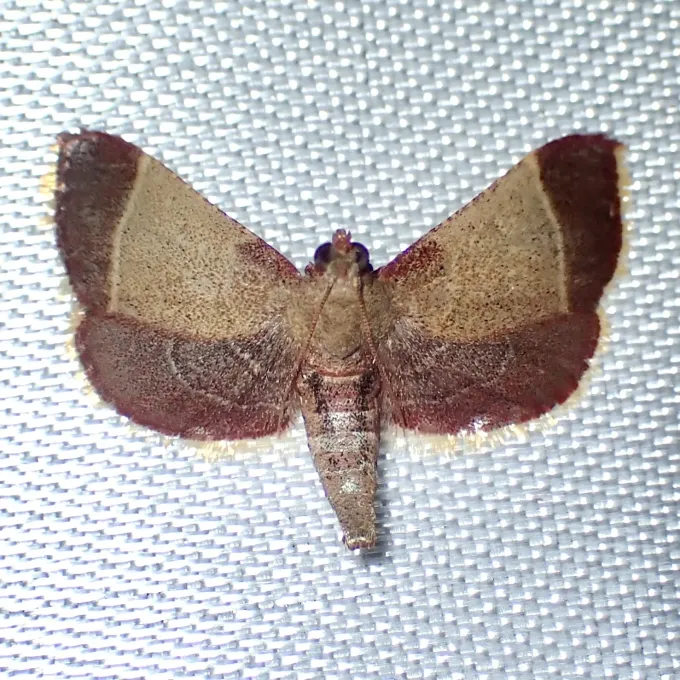
The Purple-backed moth (Hypsopygia costalis) is a member of the Pyralidae family. The adult moth is easily identified by its distinctive purple-red wings, which feature two prominent yellow spots, giving it a vibrant appearance among other pantry moths.
The larvae, or caterpillars, are typically greyish-white with a darker head capsule. They grow up to 20 mm in length and are known for their habit of spinning dense silk webs, which they use to construct protective cocoons and feeding galleries within stored materials.
This species is highly adapted to man-made environments. The life cycle consists of the egg, larva, pupa, and adult stages. Depending on climate and warehouse conditions, the moth can produce multiple overlapping generations, allowing the population to grow rapidly if left unchecked.
Adults are nocturnal and attracted to light, which aids in their dispersal throughout agricultural buildings. Females deposit eggs on available substrates, such as dried plant materials, which immediately serve as a food source for the hatching larvae.
Recognizing the biological traits of Hypsopygia costalis is essential for any integrated pest management strategy. Its ability to survive in relatively dry conditions makes it a persistent challenge in hay barns and grain storage facilities.
What it damages
The primary hosts for the Purple-backed moth are dried растительные materials, most notably hay, straw, and clover. In agricultural settings, it is a significant pest of stored fodder, where large quantities can be rendered useless by larval feeding.
The larvae are also capable of feeding on grain, cereals, and various processed plant products if moisture levels within the storage environment are not strictly controlled. They chew through the plant material, reducing its quality and volume.
Damage is not only caused by direct consumption but also by the extensive webbing left behind. This webbing contaminates the feed with fecal pellets, shed skins, and silk, creating an unhygienic environment that often leads to secondary mold growth.
In large stacks of baled hay, the presence of the moth can go unnoticed for long periods, leading to significant economic losses. The compromised feed often becomes unpalatable or unsafe for livestock consumption due to fungal toxins and bacterial contamination.
The cumulative impact includes both the loss of stored products and the labor-intensive requirements for disinfecting silos, barns, and storage sheds to remove the infestation before new stock is added.
Signs of infestation
The most visible sign of an infestation is the presence of silk webbing, which binds particles of hay or grain together. These webbed clumps are a clear indicator that larvae are actively feeding and creating protected areas for their development.
Adult moths may be observed resting on walls, ceilings, or near light sources during the evening hours. The presence of small, pellet-like frass (excrement) scattered throughout the storage area is another strong indicator of a localized population.
Infested areas often emit a musty or moldy odor. As the larvae degrade the structure of the stored material, it becomes friable and loses its integrity, often resulting in visible piles of debris or "dust" at the base of storage piles.
Damage to the exterior of storage containers, such as fraying or small holes in burlap bags, may suggest that larvae are present inside. Additionally, finding dry, empty pupal cases in cracks or corners confirms that the moth has completed a generation cycle.
Regular inspections, particularly in the lower layers of stacked material and along structural beams, are necessary to detect the early stages of infestation before it reaches critical levels.
Control measures
Sanitation is the most effective approach for managing the Purple-backed moth. Keeping warehouses clean by removing old debris, dust, and leftover hay from previous seasons is vital to eliminating potential breeding sites for the larvae.
Maintaining low humidity levels within the storage facility is crucial, as the moth thrives in conditions where moisture supports mold growth. Adequate ventilation helps keep the stored material dry and less attractive to the pest.
Chemical control measures often involve applying contact insecticides to the walls, floors, and corners of empty warehouses. This creates a barrier that prevents moths from establishing colonies when new supplies are brought in.
In severe infestations where the product itself is heavily contaminated, fumigation may be required to eradicate the pests within the bulk of the stored material. This must be carried out by certified professionals to ensure safety and efficacy.
- Thorough cleaning of storage areas.
- Monitoring of temperature and humidity.
- Application of approved insecticides.
- Professional fumigation if necessary.
Taxonomy
- Latin name
- Hypsopygia
- Order
- Lepidoptera (butterflies)
- Family
- Pyralidae
- EPPO code
- HYPSSP
Discussion
No discussions yet — be the first.