
Hypsipyla grandella
Hypsipyla grandella
Description
How to identify
Hypsipyla grandella, commonly known as the mahogany shoot borer, is a destructive moth species within the family Pyralidae, notorious for its impact on Meliaceae trees.
The adult moth exhibits cryptic coloration, typically shades of gray and brown, which serves as camouflage against tree bark, making them difficult to spot during daylight.
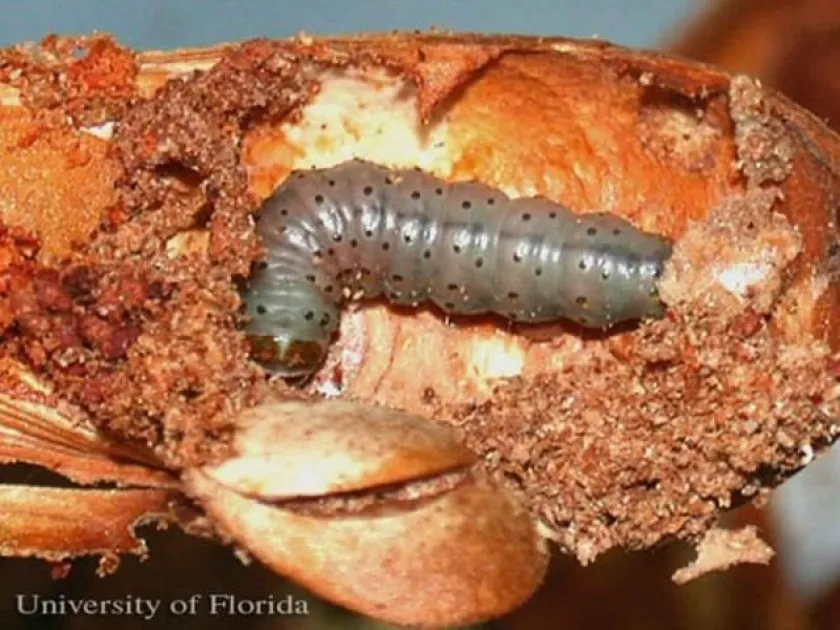
Larvae develop through several instars, with late-stage caterpillars showing a reddish-brown hue and a hardened head capsule adapted for boring into woody tissues.
The pupal stage occurs inside the plant's tunnels or in leaf litter, protected by a dense, silken cocoon that helps the insect survive unfavorable conditions.
Understanding the life cycle is crucial, as the moth's reproductive strategy is highly adapted to exploit the seasonal growth cycles of its host plants.
What it damages
Larvae are the primary cause of damage, as they bore into terminal shoots and developing fruits, effectively disrupting the plant's apical dominance.
In young mahogany and cedar trees, the destruction of the terminal bud leads to lateral branching and stem deformation, significantly reducing timber value.
Seed loss is a critical concern, as larvae often consume the entire contents of the fruit, preventing natural forest regeneration and affecting nursery production.
Heavy infestations can result in stunted growth and, in severe cases, the complete dieback of seedlings within commercial tree plantations.
The wounding caused by the borer also creates entry points for secondary pathogens, such as fungi, which further degrade the health of the tree.
When it appears
The activity of Hypsipyla grandella is largely dependent on climate, with continuous breeding cycles observed in tropical environments throughout the year.
Population surges often coincide with the beginning of the rainy season, which triggers the flush of new foliage and fruits necessary for larval development.
Temperature serves as a key regulator, with peak development occurring between 25 and 30 degrees Celsius, accelerating the transition between generations.
In subtropical regions, the emergence of adults is synchronized with the availability of preferred host plant stages, ensuring optimal survival for offspring.
Monitoring the flight patterns of adult moths during dusk is essential for predicting the timing of egg-laying and implementing timely control measures.
Signs of infestation
The presence of fine, brown, sawdust-like frass accumulating at the base of shoots or on the bark surface is a diagnostic sign of larval activity.
Gummosis, or the exudation of resin from entry holes on fruits or stems, is the tree's natural physiological reaction to the boring process.
Wilting and browning of the terminal leader or young shoots clearly indicate that the pith has been destroyed by the borer's feeding.
Finding small, exit holes on the surface of fruits or shoots suggests that a mature larva has successfully completed its development and emerged.
Webbing and silk strands found near the damage sites indicate the larvae's protective covering and their movement between different parts of the host.
Control measures
Effective management requires a holistic approach, integrating mechanical, biological, and chemical methods to suppress Hypsipyla grandella populations.
Pruning and destroying infested shoots immediately after detection is a vital mechanical practice to remove larvae before they migrate to other trees.
Biological control agents, including parasitic wasps and entomopathogenic fungi, play a significant role in keeping populations below economic damage thresholds.
- Utilizing pheromone traps for early detection of adult flight activity.
- Maintaining biodiversity within plantations to support natural predator populations.
- Applying Bacillus thuringiensis-based sprays on young foliage during peak oviposition.
Ongoing research into resistant tree varieties and sustainable forest management practices remains the most promising strategy for long-term control.
Taxonomy
- Latin name
- Hypsipyla grandella
- Order
- Lepidoptera (butterflies)
- Family
- Pyralidae
- EPPO code
- HYPYGR
Discussion
No discussions yet — be the first.