
Sugar beet crown borer
Hulstia undulatella
Description
How to identify
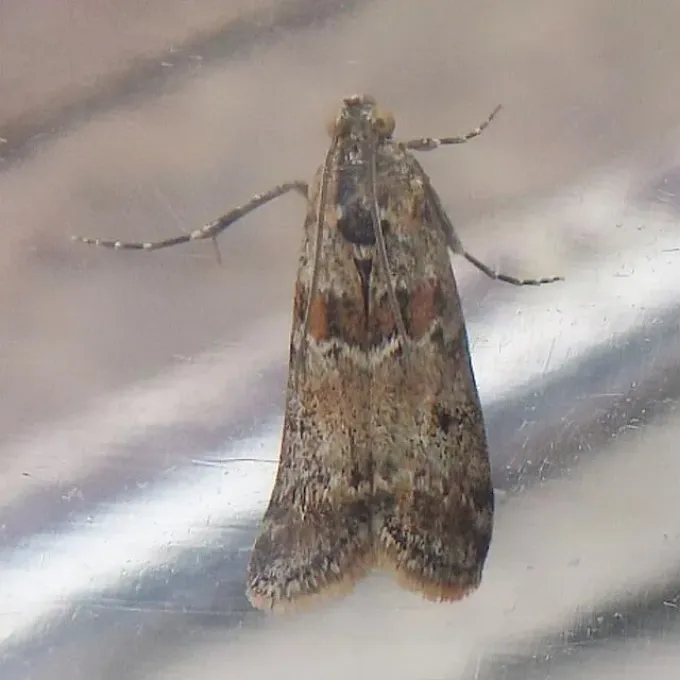
The sugar beet crown borer (Hulstia undulatella) belongs to the order Lepidoptera and the family Pyralidae. The adult moth has a wingspan of approximately 18-22 mm. Its forewings are grayish-brown with distinct wavy lines, providing excellent camouflage against soil and plant debris.
Larvae pass through several growth stages, reaching a length of about 20 mm when fully mature. Their bodies are typically dirty white or greenish with dark longitudinal stripes. A dark brown head capsule is a primary diagnostic feature used by agronomists to identify the species in the field.
Pupation occurs within the soil, where the insect constructs a tough, silk-lined cocoon. This stage is crucial for its survival, as the pupa can withstand various environmental stresses while hidden beneath the soil surface near the host plants.
Adult moths are primarily nocturnal, making them difficult to detect during daylight hours. Field monitoring often relies on pheromone traps, which attract males and provide data on flight intensity, helping to time insecticide applications effectively.
Proper identification requires careful examination of the root crown area of beets. Field scouts must look for silk webs mixed with soil and frass, which are classic indicators of larval activity in the crown region.
What it damages
Sugar beets are the primary host for this pest, as indicated by its common name. However, the larvae can also feed on other members of the Amaranthaceae family, making them a significant multi-host threat in regions where these crops are grown in close proximity.
Damage is primarily caused by larvae that feed on leaves in the early stages and later burrow into the crown or the upper part of the beet root. This feeding behavior disrupts the plant's vascular system, causing stunting and severe loss of vigor.
The internal burrowing of the larvae reduces both the total root weight and the sugar content of the beet. At high population densities, the damage can lead to widespread crop loss, directly affecting the economic output and processing quality of the yield.
The tunnels created by the larvae serve as entry points for secondary pathogens, including various bacteria and fungi that cause soft rot. Infected beets become unsuitable for storage, leading to significant post-harvest losses in processing facilities.
Economic damage is compounded by the loss of raw material quality. Beets damaged by the crown borer have lower storability, which causes mass loss and increased processing costs in the sugar production cycle.
When it appears
Adult flight activity typically begins in late spring or early summer, depending on regional temperature patterns. The pest can produce multiple generations per season if conditions remain favorable for development.
Peak larval activity generally occurs in mid-summer, which coincides with the period of rapid root expansion. Consequently, this is the most critical window for growers to protect their fields from substantial yield reduction.
Hot and dry weather conditions are highly conducive to the development of the sugar beet crown borer. These conditions accelerate the life cycle of the larvae and contribute to rapid population explosions across large areas of farmland.
As autumn approaches, activity declines as the final generation of larvae prepares for diapause. They retreat into the soil to overwinter within their cocoons, remaining dormant until the return of warmer temperatures in the following spring.
Effective monitoring involves the use of light traps and field observations to track the timing of egg-laying. Forecasting models based on degree-days are often used to predict when the first instar larvae will emerge and begin feeding.
Signs of infestation
Early symptoms of an infestation include small, window-like holes in the leaves caused by young larvae. As the larvae grow, they move to the crown area, where their presence is indicated by silk webbing and frass accumulations.
Wilting of foliage during daylight, even when soil moisture is adequate, is a strong signal that the root crown has been bored into. Upon closer inspection, growers will find characteristic tunnels filled with excrement within the crown tissue.
Patches of chlorotic or stunted plants in the field often indicate concentrated zones of pest activity. In these areas, the roots may show external damage and internal tunneling, making the plant's growth significantly inferior to surrounding healthy beets.
Silk-lined chambers found at the base of the petiole or near the soil line are diagnostic signs of the larvae's presence. If these structures are found during a field survey, immediate intervention is usually required to prevent further spread.
Field scouts should carefully brush away surface soil around the crown to inspect for burrowing activity. The presence of larvae or their distinct feeding tunnels within the root tissue confirms an active infestation of the sugar beet crown borer.
Control measures
Cultural control strategies include strict crop rotation, which is essential to prevent the buildup of pest populations. Deep autumn plowing is a highly effective method to disrupt overwintering sites by burying or exposing larvae to predators and environmental stress.
Sanitation efforts must focus on eliminating weed hosts from the family Amaranthaceae, such as lambsquarter, which can support the pest population between beet crops. Keeping fields weed-free reduces the availability of secondary food sources.
Chemical control focuses on the use of insecticides targeting the early larval stages. Systemic products are often preferred, as they are absorbed by the plant and can reach larvae inside the crown where contact sprays are ineffective.
Timing is critical for successful control; applications should coincide with the peak hatching period. Applying treatments in the evening is recommended to coincide with the nocturnal activity of the adult moths and larvae.
Integrated Pest Management (IPM) incorporates biological controls, such as beneficial insects or microbial-based products, to suppress populations without heavy reliance on synthetic chemicals. Constant monitoring remains the backbone of an effective control strategy.
Taxonomy
- Latin name
- Hulstia undulatella
- Order
- Lepidoptera (butterflies)
- Family
- Pyralidae
- EPPO code
- HULSUN
Discussion
No discussions yet — be the first.