
Ash bark moth
Euzophera pinguis
Description
How to identify
The Ash bark moth (Euzophera pinguis) belongs to the Pyralidae family and is a significant pest primarily affecting ash trees (Fraxinus spp.).
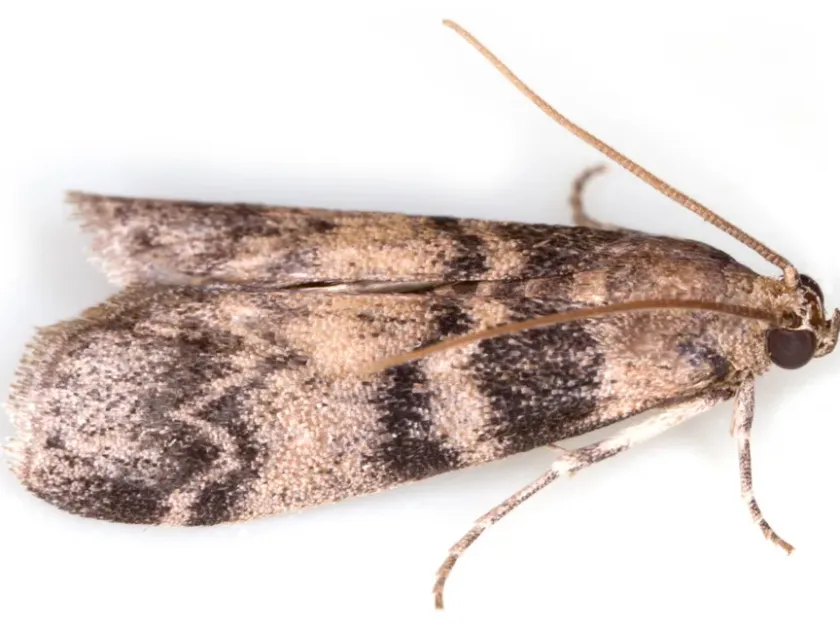
The adult moth has a wingspan of approximately 20–25 mm, with brownish-gray forewings featuring intricate, darker wavy patterns for camouflage.
The larvae are approximately 25 mm long, with a body that appears pinkish or dirty white, characterized by a distinct dark-brown head capsule.
Being a concealed feeder, the moth spends most of its larval life cycle under the bark, making it difficult to detect before visible symptoms occur.
Pupation takes place inside the tunnels created by the larvae, often protected by silk cocoons blended with wood frass and bark debris.
What it damages
The larvae primarily target the bark and cambium layer, creating irregular galleries that disrupt the vascular flow within the tree.
By consuming the phloem and cambium, the pests effectively girdle branches or even the main stem if the infestation is severe enough.
Trees that are already stressed due to drought, mechanical injury, or poor site conditions are the most susceptible to successful colonization.
Heavy infestations lead to the gradual decline of the tree, manifesting in canopy thinning and localized branch dieback.
In nursery settings, the moth can cause substantial economic losses by ruining the structural integrity and aesthetic value of young trees.
When it appears
The adult moths usually emerge in late spring or early summer, following temperature cues that dictate the start of the breeding season.
Females are selective, often depositing eggs in existing bark fissures or areas where the bark has been wounded by mechanical damage.
After hatching, the neonate larvae immediately bore into the bark to reach the succulent tissues beneath, staying hidden throughout their development.
Feeding activity is highest during mid-to-late summer, as larvae grow rapidly to reach their final instar before the onset of autumn.
Depending on the latitude and climate, the species may complete one generation per year, though development can sometimes be prolonged over multiple seasons.
Signs of infestation
A tell-tale sign of activity is the presence of brownish frass, which the larvae push out of their galleries and onto the bark surface.
Wounded areas often exhibit sap bleeding, as the tree attempts to defend itself against the burrowing activity of the larvae.
The bark above the tunnels may eventually crack, become brittle, or peel away, revealing the underlying galleries constructed by the moth.
Presence of fine webbing within cracks in the bark can also indicate that the larvae are active or have recently pupated in the area.
- Yellowing of foliage on specific branches.
- Dieback of the tree crown.
- Visible entry holes in the bark.
- Bark detachment in patches.
Control measures
Sanitation is the most critical control measure: infected branches and severely infested trees should be removed and destroyed before adult emergence.
Mechanical protection of the trunk is vital to prevent wounds that serve as entry points for egg-laying females.
When infestation is localized, carefully scraping away damaged bark down to healthy tissue and applying professional tree wound paint can facilitate healing.
Insecticide treatments are most effective if applied during the adult flight period, targeting the moths before they successfully oviposit.
Promoting a healthy environment for insectivorous birds can serve as a long-term, low-impact strategy to suppress pest population spikes.
Taxonomy
- Latin name
- Euzophera pinguis
- Order
- Lepidoptera (butterflies)
- Family
- Pyralidae
- EPPO code
- EUZOPI
Discussion
No discussions yet — be the first.