
Eggplant stem borer
Euzophera perticella
Description
How to identify
The eggplant stem borer (Euzophera perticella) is a moth belonging to the family Pyralidae. The adult moth is relatively small, with a wingspan of about 20–25 mm, featuring a greyish-brown color pattern with distinct dark bands across its forewings.
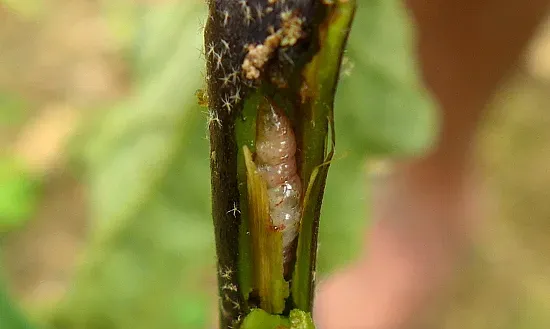
The larvae are typically creamy-white or yellowish with a brown head capsule. As they mature, they grow up to 20 mm in length and possess sclerotized plates on their body segments, which are adapted for tunneling through plant tissues.
The life cycle encompasses a complete metamorphosis: egg, larva, pupa, and adult. They typically overwinter as mature larvae or pupae within the soil or in sheltered debris, waiting for optimal spring temperatures to emerge.
Female moths lay their eggs on the stems or near the root collar of host plants. A single female can produce several hundred eggs, allowing for rapid population growth under favorable warm and humid conditions.
Depending on the climatic zone, the species can produce multiple generations annually. The most significant damage usually occurs during the hot summer months, which accelerates their developmental cycle.
What it damages
The eggplant (aubergine) is the primary target for this pest, though it also infests tomatoes, peppers, and various wild Solanaceous weeds, making it a persistent threat to diverse vegetable crops.
Damage is exclusively caused by the larvae, which bore into the stems. Once inside, they feed on internal pith tissues, effectively destroying the plant's vascular system and interrupting the flow of nutrients.
This internal tunneling weakens the structural integrity of the plant, often resulting in broken stems or lodging. Secondary infections from soil-borne fungi and bacteria frequently enter through the boring sites, exacerbating the damage.
Visually, affected plants show stunted growth, leaf chlorosis, and reduced yield. In severe infestations, the plant wilts and dies completely, leading to significant economic losses for commercial growers.
As the larvae reach their final stage, they often pupate within the stem or move down to the soil near the roots to form a cocoon, continuing the infestation cycle for the next generation.
Signs of infestation
The most prominent sign of infestation is sudden wilting of the plant tops during the hottest part of the day, which often persists even after regular irrigation cycles.
Closer inspection of the stem base usually reveals small entry holes surrounded by frass, which looks like fine brown sawdust, indicating the presence of a feeding larva inside.
The stem may appear discolored, swollen, or hollowed out. If the stem is pressed gently, it may feel soft or empty due to the extensive tunneling performed by the borer.
When an infested stem is cut open longitudinally, one can observe distinct galleries or tunnels filled with excrement and plant debris, often containing the larva itself.
Plants at the advanced stages of infestation are characterized by a lack of vigor, yellowing leaves, and a failure to set or develop healthy fruit compared to neighboring uninfested plants.
Control measures
Integrated pest management (IPM) is essential for controlling this borer, focusing on a combination of cultural practices, biological methods, and targeted chemical applications.
Strict crop rotation is the most effective preventative measure; avoid planting any Solanaceous crops in the same area for at least three to four years to break the pest's life cycle.
Deep plowing or soil cultivation after harvest helps expose overwintering pupae to predators and environmental conditions, significantly reducing the pest density for the following season.
- Regular weeding to remove alternative host plants like wild Solanaceae from the field edges.
- Prompt disposal of infested plant material by burning or deep burial to eliminate larvae and pupae.
- Utilization of biological control agents and biopesticides where applicable.
When populations exceed the economic threshold, the application of systemic insecticides is recommended to reach the larvae hidden deep within the plant stem tissues.
Taxonomy
- Latin name
- Euzophera perticella
- Order
- Lepidoptera (butterflies)
- Family
- Pyralidae
- EPPO code
- EUZOPE
Discussion
No discussions yet — be the first.