
Tobacco seed moth
Euzophera osseatella
Description
How to identify
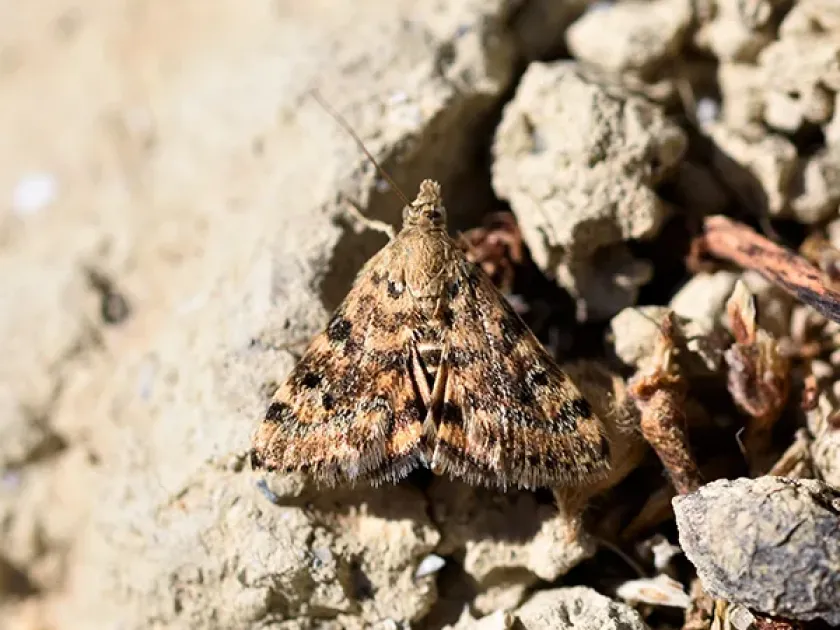
The tobacco seed moth (Euzophera osseatella) belongs to the order Lepidoptera and the family Pyralidae. The adult moth has a wingspan of approximately 20–25 mm.
The forewings are generally greyish-brown or brownish, featuring a distinct pattern of darker transverse bands and spots. The hindwings are lighter with a pearly sheen.
Larvae are typically 18–20 mm long, with a smooth body ranging from greyish-white to yellowish-green, often marked with small dark spots on the segments.
Pupation occurs within a tough, white silk cocoon. The pupae are usually located inside the plant tissues where the larvae have been feeding.
The developmental cycle is highly dependent on ambient temperature, allowing the moth to complete multiple generations per season in warmer climates.
What it damages
The primary host for this pest is tobacco (Nicotiana tabacum). It is capable of destroying both wild tobacco varieties and cultivated crops.
Beyond tobacco, the moth poses a significant risk to other Solanaceae species, particularly eggplant, tomatoes, and potatoes in field conditions.
Larvae act as stem borers, excavating galleries within the stems of the plants, which disrupts water and nutrient transport throughout the vascular system.
In storage facilities, the larvae may infest dried tobacco leaves and vegetables, causing severe degradation of quality and rendering the produce unmarketable.
Significant infestations lead to weakened stems, reduced plant vigor, and ultimately lower yields, especially in cases of early-season attacks.
Signs of infestation
The most common sign of infestation is the presence of small entry holes on the stems, accompanied by larval frass (excrement) visible around the openings.
Wilting of the plant tops and premature yellowing of leaves are classic symptoms, indicating that the larvae are disrupting the internal structure of the stem.
Webbing is often observed around the entry points or among the foliage, as larvae utilize silk threads to stabilize their habitat during the feeding process.
Stems damaged by the tobacco seed moth become structurally compromised, often snapping or breaking easily under wind pressure or mechanical stress.
Close inspection of the stem often reveals hollowed-out tissue and the presence of larvae inside, confirming the diagnosis of the pest infestation.
Control measures
Deep plowing following the harvest is essential to destroy pupae and larvae overwintering in crop residues or the top layer of the soil.
Rigorous crop rotation practices are highly recommended to disrupt the life cycle of the pest, especially when dealing with recurring Solanaceae crops.
Chemical control using systemic insecticides is often necessary when larval populations reach economic injury levels during the active growing season.
Pheromone traps should be employed for monitoring purposes, allowing farmers to track the flight patterns of adult moths and time pesticide applications precisely.
Proper sanitation, including the removal and destruction of infested plant stalks, significantly reduces the overwintering population for the subsequent planting cycle.
Taxonomy
- Latin name
- Euzophera osseatella
- Order
- Lepidoptera (butterflies)
- Family
- Pyralidae
- EPPO code
- EUZOOS
Discussion
No discussions yet — be the first.