
Mugwort borer
Euzophera cinerosella
Description
How to identify
The mugwort borer (Euzophera cinerosella) is a moth belonging to the family Pyralidae (snout moths) within the order Lepidoptera.
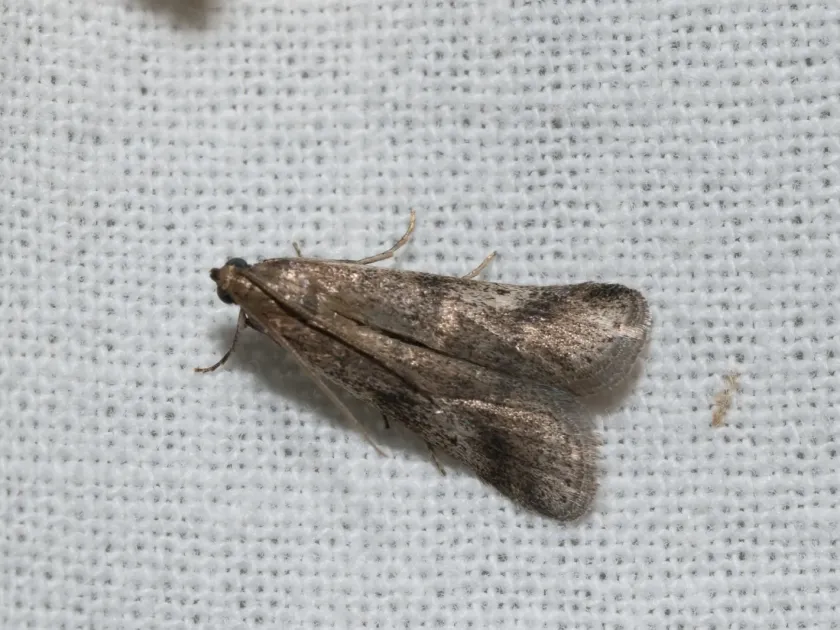
Adult moths have a wingspan ranging from 20 to 25 mm, with ashy-grey forewings adorned with dark, intricate cross-lines that provide camouflage.
The larvae, or caterpillars, reach lengths of up to 20 mm and are characterized by a pale body and a distinctively dark brown head capsule.
Pupation occurs within the host plant, usually inside a tough silk cocoon constructed within the galleries bored into the root or stem.
This species is well-adapted to the temperate climate, typically completing one generation per year, though environmental factors may influence the timing.
What it damages
The primary host for this pest is mugwort (Artemisia species), where larvae feed internally, focusing on the root system and stem bases.
As larvae bore into the tissues, they create long tunnels that disrupt the plant's vascular system, hindering the transport of water and nutrients.
This physiological stress leads to stunted growth, yellowing foliage, and structural weakness, often causing the stems to snap under wind or pressure.
External injuries and tunneling often invite secondary bacterial or fungal infections, leading to the rapid decay of the plant's basal tissues.
Significant infestations can lead to high plant mortality, which is particularly detrimental in field-scale cultivation of Artemisia for medicinal use.
When it appears
Adult moths typically emerge in late spring to early summer, with peak flight activity occurring between May and July depending on regional weather.
Females deposit eggs at the base of host plants, and larvae hatch after about a week to begin their internal feeding cycle immediately.
The larval stage is prolonged throughout the summer months, during which they feed continuously and grow within their protected plant galleries.
As temperatures drop in autumn, fully developed larvae prepare for overwintering, remaining hidden deep within the root structures of the host.
Pupation happens during the following spring, completing the cycle as the moths emerge to start the new generation.
Signs of infestation
A key indicator of an infestation is the presence of brown, sawdust-like frass (excrement) accumulation around the base of the plant stem.
Visible wilting of the plant, especially during hot, dry periods, is often a sign of damage to the root system and impaired fluid transport.
Careful inspection may reveal localized swellings or necrotic patches at the stem base, indicating where the larvae have entered or are feeding.
Dissecting the stem base or roots reveals internal galleries filled with debris, often revealing the larvae themselves if checked during the summer.
Plants severely weakened by the borer often exhibit poor root anchorage, making them easy to dislodge from the soil by hand.
Control measures
Cultural control involves removing and destroying infested plant material immediately after harvest to reduce the local overwintering population.
Deep cultivation of the soil in late autumn is highly effective at exposing and destroying the hibernating larvae within their root chambers.
Maintaining a distance from wild Artemisia stands helps prevent the spread of the moth into managed production plots or gardens.
Chemical control via systemic insecticides is most effective when applied during the egg-hatching window before larvae tunnel deep into the stem.
Biological control, such as the application of entomopathogenic nematodes or Bacillus thuringiensis, provides an eco-friendly option for larvae management.
Taxonomy
- Latin name
- Euzophera cinerosella
- Order
- Lepidoptera (butterflies)
- Family
- Pyralidae
- EPPO code
- EUZOCI
Discussion
No discussions yet — be the first.