
Fruit moth
Euzophera bigella
Description
How to identify
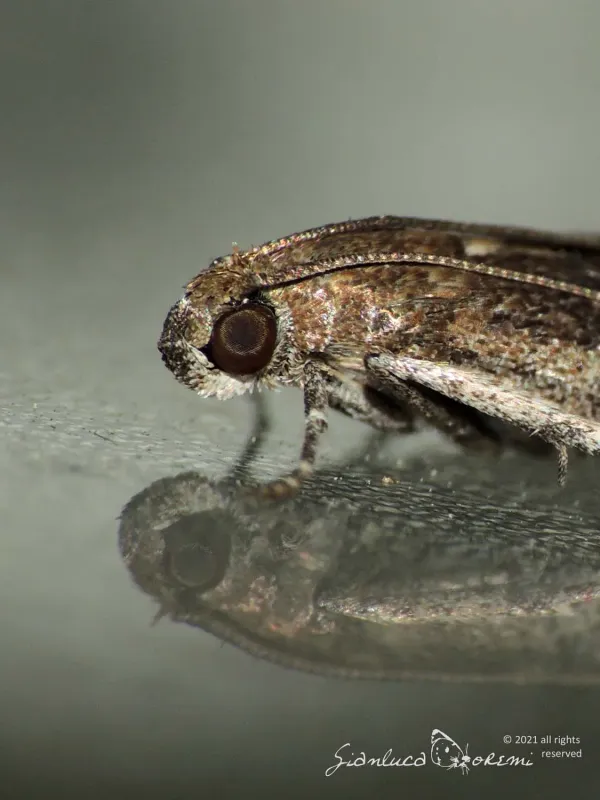
The fruit moth (Euzophera bigella) is a destructive pest belonging to the order Lepidoptera and the family Pyralidae. The adult moth typically has a wingspan of 20 to 22 mm.
The forewings are greyish-brown with a distinct pattern of darker transverse lines and wavy bands. The hindwings are noticeably lighter, often pale grey with a darker outer margin.
The larvae, or caterpillars, grow up to 15–18 mm in length. They are characterized by a yellowish-white or pinkish body and a distinct brown head capsule, which is a key diagnostic feature.
Pupation usually occurs within the infested fruit or beneath the bark of the host tree. The pupae are brown and are protected by thick, white silken cocoons spun by the larvae.
This species is highly adaptable and can establish populations across various temperate climates, making it a persistent challenge for commercial fruit growers.
What it damages
The fruit moth is a polyphagous pest, meaning it attacks a wide range of fruit crops. Its primary hosts include apples, pears, plums, quinces, peaches, apricots, and walnuts.
The primary damage is caused by the larvae boring into the fruit. This feeding creates internal tunnels, which lead to rapid decay, loss of market value, and premature fruit drop.
In addition to fruit, larvae often feed on the bark of trees. They tend to colonize areas with existing wounds, cracks, or frost damage, which can lead to local branch dieback.
Heavy infestations can result in significant yield losses, often exceeding 30-50% in orchards where effective pest management programs are not strictly followed.
Because the larvae can also survive on tree bark, the pest remains a threat even during off-seasons when fruit is not available for development.
When it appears
The flight of the first generation of adults typically begins in late spring, coinciding with the flowering period of major pome and stone fruit trees.
Depending on local weather conditions, the moth can complete two to three generations per year, creating a continuous cycle of infestation throughout the growing season.
The pest overwinters as mature larvae inside cocoons located within cracks in the bark, in pruning scars, or inside mummified fruit that remains on the tree or ground.
As spring temperatures rise above 10–12 degrees Celsius, the larvae finish their development and pupate, leading to the emergence of the spring flight of moths.
The peak period for fruit damage occurs during the second half of summer, as the larvae of the subsequent generations bore into maturing fruits.
Signs of infestation
The most common sign of infestation is the presence of entry holes in the fruit, often marked by the extrusion of frass (larval excrement) mixed with fruit juices or sap.
Infested fruit often displays dark, sunken patches of rot. In many cases, affected fruit will turn color prematurely and drop from the tree before reaching maturity.
On the trunk and main branches, one can often find piles of brownish frass ejected from larval feeding sites, indicating that the caterpillars are active under the bark.
In the case of walnuts, the green husk turns black around the entry point, and the fruit may crack, allowing secondary pathogens to enter and ruin the nut meat.
- premature fruit drop and rot;
- visible entry holes with frass accumulation;
- sap or gumming on the bark of tree trunks;
- internal tunneling within the fruit pulp.
Control measures
Effective control relies heavily on sanitation practices, such as removing and destroying mummified fruit and scraping off dead, loose bark to eliminate overwintering sites.
Pruning out infested or damaged branches is crucial to prevent the pest from spreading throughout the orchard and to promote better tree health.
Biological control, including the use of Bacillus thuringiensis, can be applied during the window of egg hatching to suppress the larval population.
Chemical control involving timely insecticide applications targeting the adult flight phase is essential to reduce egg-laying and minimize damage to the developing crop.
Monitoring using pheromone traps is highly recommended to determine the start of moth activity and to time protective sprays for maximum efficiency.
Taxonomy
- Latin name
- Euzophera bigella
- Order
- Lepidoptera (butterflies)
- Family
- Pyralidae
- EPPO code
- EUZOBI
Discussion
No discussions yet — be the first.