
Warehouse moth
Ephestia elutella
Description
How to identify
The warehouse moth (Ephestia elutella) is a significant moth species belonging to the Pyralidae family, commonly known as a pest of stored food products.
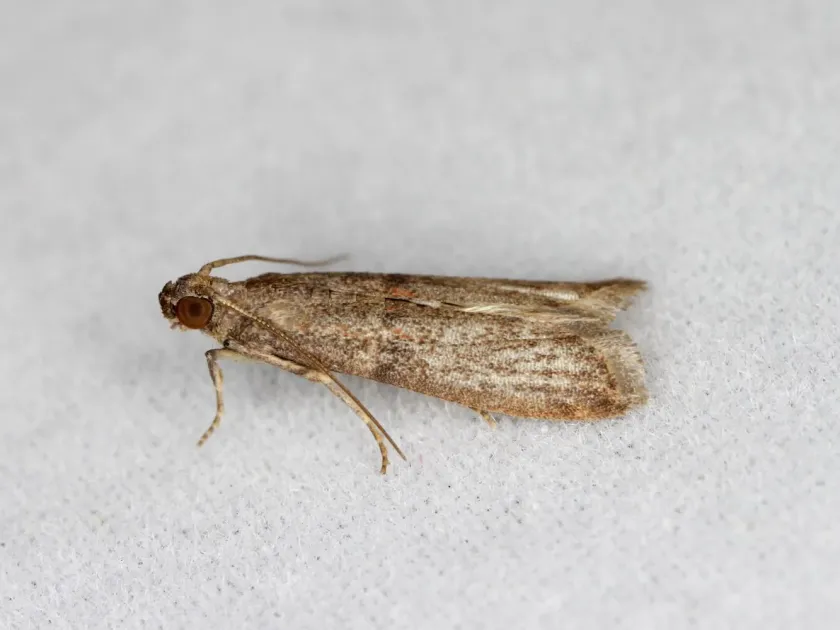
The adult moth has a wingspan of approximately 14 to 17 mm. Its forewings are typically grayish-brown, marked with two distinct pale wavy transverse bands.
The larvae are small, usually about 12–15 mm in length. They exhibit a whitish or yellowish body with a light brown head and visible, sparse body hairs.
Pupation occurs within a tough, silken cocoon constructed by the mature larva. These cocoons are often cleverly hidden in crevices, packaging, or deep inside the food source.
Eggs are minute, oval, and whitish. They are usually laid by females directly onto or in the immediate vicinity of a suitable food substrate.
What it damages
As a notorious polyphagous pest, the warehouse moth infests a wide range of dry stored products, causing substantial economic losses in the food industry.
Common commodities affected include cocoa beans, chocolate, dried fruits, nuts, grains, processed cereals, tobacco products, and various dried herbs or spices.
Larvae feed internally on seeds and products, creating tunnel systems that hollow out the material and leave behind frass, significantly reducing product quality.
A distinctive characteristic of this pest is the heavy production of silk webbing, which binds food particles together into large, spoiled masses or clumps.
Severe infestations result in complete spoilage, rendering the stock unsuitable for sale or human consumption due to contamination with larvae and waste.
When it appears
The warehouse moth is an indoor pest that thrives in controlled environments, often maintaining continuous development throughout the year in heated warehouses.
Under optimal temperature ranges of +20°C to +25°C, the moth completes its life cycle in about two to three months, allowing for multiple generations annually.
In unheated areas or during winter, the larvae can enter a state of diapause, residing in structural cracks or hidden areas until environmental conditions improve.
While adult activity can occur throughout the year, peak flights are often observed in warmer months, though indoor climate regulation often masks natural seasonal patterns.
The moths are nocturnal and are most active during the night, at which time they mate and deposit eggs onto available food supplies to continue the cycle.
Signs of infestation
The most immediate sign of an infestation is the presence of silk webbing and trails covering the surface of stored goods or packaging material.
Adult moths may be spotted resting on walls or flying around storage areas, which is a clear indicator that a breeding population is already established nearby.
Clumped food particles or debris held together by fine, sticky silk threads are definitive signs of larval activity and should be inspected immediately.
An unpleasant, musty odor often develops as the larvae consume the product and excrete waste, signalling advanced stages of a storage infestation.
Frequent visual checks may reveal shed larval skins or discarded pupal cases within product residue found in floor cracks or along shelving units.
Control measures
The most effective strategy involves rigorous sanitation, ensuring that warehouses are kept clean, dust-free, and clear of spilled food residues at all times.
Implementing airtight packaging and storage in sealed containers is crucial to prevent the adult moths from accessing food and laying their eggs.
Pheromone-based traps are highly recommended for monitoring the presence of adult males, providing early detection to prevent significant population buildup.
In cases of major infestations, professional fumigation of the premises is required to effectively eliminate all life stages of the moth within the facility.
- Maintain low temperatures (below +10°C) to inhibit larval growth and moth activity within the warehouse.
- Perform regular inspections of all incoming raw materials to prevent the introduction of new pests.
- Ensure proper rotation of stocks using the First-In, First-Out (FIFO) method to minimize long-term exposure risks.
Taxonomy
- Latin name
- Ephestia elutella
- Order
- Lepidoptera (butterflies)
- Family
- Pyralidae
- EPPO code
- EPHEEL
Discussion
No discussions yet — be the first.