
Lesser cornstalk borer
Elasmopalpus
Description
How to identify
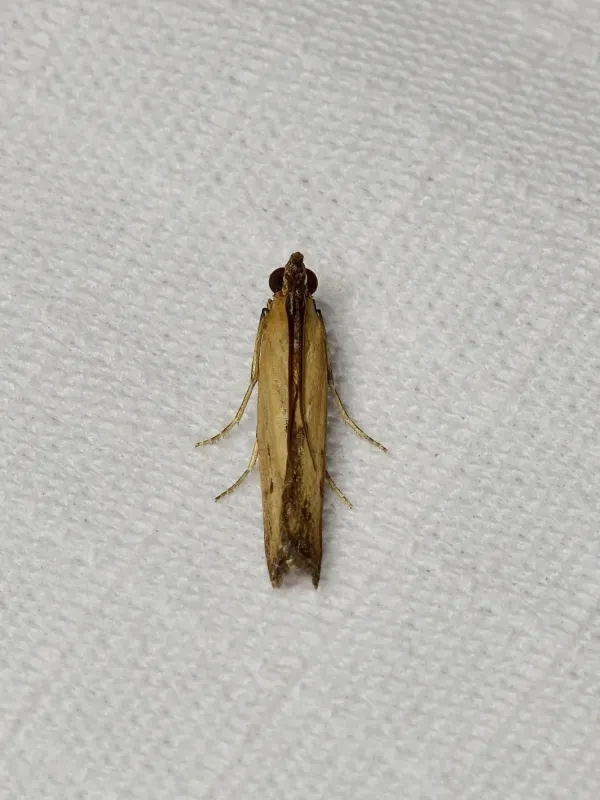
The Lesser cornstalk borer (Elasmopalpus lignosellus) belongs to the order Lepidoptera and the family Pyralidae. The adult is a small moth with a wingspan of approximately 20–25 mm.
The coloration of the forewings in males varies from light brown to yellow, while females are darker, exhibiting a brownish-grey hue with characteristic dark markings.
The larvae of this species are noted for their high mobility. Their bodies exhibit a distinct coloration ranging from bluish-green to brown with prominent dark longitudinal stripes along the back.
The larva has a hard, dark-colored head, allowing it to easily bore into the dense tissues of young plant stems. Throughout its development, the larva undergoes several instars, reaching a length of 15–20 mm.
Pupae are typically hidden in the soil or within silken cocoons among plant debris, which makes detecting them during field inspections significantly challenging.
What it damages
This pest is a polyphage and causes serious damage to numerous agricultural crops. It most frequently affects maize, sorghum, peanuts, beans, and various grasses.
It poses a particular threat to young seedlings, as larvae burrow into the base of the stem, severing the plant's vascular system.
In regions with arid climates, the damage caused by the borer increases, as stressed plants become more susceptible to mechanical injury.
Larvae often construct characteristic silken tubes covered with soil particles, which extend from the base of the stem to the soil surface, allowing them to remain hidden from predators.
Mass infestations lead to thin stands, lodging of crops, and significant yield losses during the early stages of plant growth.
When it appears
The activity of the Lesser cornstalk borer is directly dependent on weather conditions. Periods characterized by high temperatures and moisture deficits are the most favorable for the pest's development.
In southern regions, between three and five generations can develop in a single season, making continuous summer control an extremely difficult task for agronomists.
The first moths emerge at the beginning of the warm season, and their activity persists until the onset of stable autumn cooling.
The period of maximum larval damage often coincides with the germination phase and the appearance of the first true leaves in cultivated plants.
During drought years, generation turnover occurs faster, sparking population outbreaks capable of destroying a significant portion of the crops in a very short time.
Signs of infestation
The first and most noticeable sign of infestation is the wilting of the central leaf of a young plant, which gradually yellows and dies.
Upon inspecting the base of the stem, one can often find entry holes created by the larvae, frequently surrounded by insect frass.
The presence of silken tubes leading from the stem base into the soil is a nearly 100% diagnostic sign of the presence of Elasmopalpus lignosellus in a field.
Damaged young plants often separate easily from the roots when pulled, as the inner part of the stem has been completely hollowed out by the larva.
- Wilting of the growth point (central leaf).
- Presence of silken tubes at the stem base.
- Entry holes in the lower stem.
- Seedling mortality under high pest pressure.
Control measures
Effective protection starts with agrotechnical practices. Crop rotation and the thorough destruction of crop residues where pupae overwinter are highly recommended.
Irrigation during drought periods plays a critical role: moist soil not only strengthens the plants but also hinders the movement of larvae across the soil surface.
The application of insecticides is effective only when pest population monitoring, using pheromone traps, is strictly implemented to determine optimal treatment timing.
Chemical control must target larvae before they bore into the stem, as the pest becomes nearly inaccessible to contact insecticides once inside the plant tissue.
In some cases, the use of insecticide-treated seeds is justified, providing essential early-stage protection for seedlings during the most critical development phase.
Taxonomy
- Latin name
- Elasmopalpus
- Order
- Lepidoptera (butterflies)
- Family
- Pyralidae
- EPPO code
- ELASSP
Discussion
No discussions yet — be the first.