
Green rice moth
Doloessa viridis
Description
How to identify
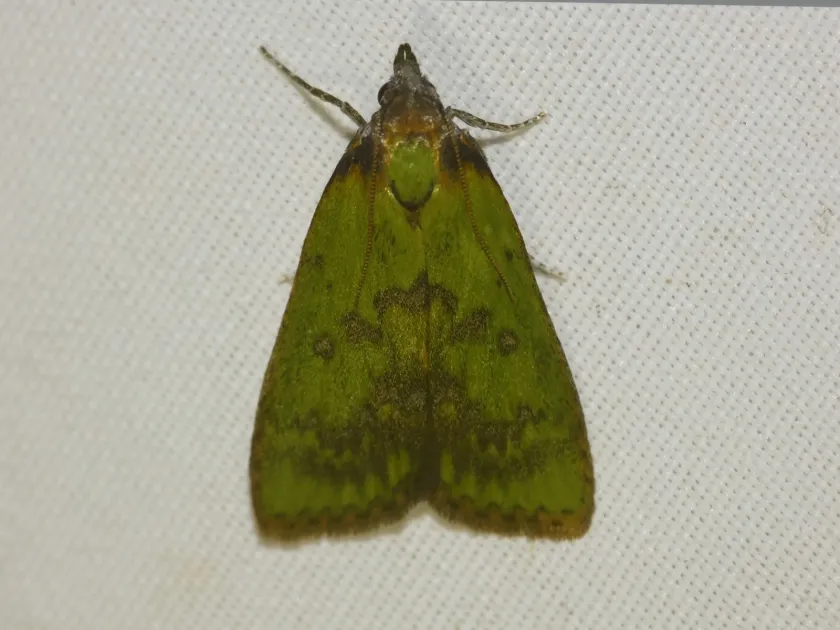
The green rice moth (Doloessa viridis) is a member of the order Lepidoptera and the family Pyralidae. The adult moth features a distinct greenish coloration, providing effective camouflage within rice fields.
The life cycle consists of four stages: egg, larva, pupa, and adult. The larvae are the primary damaging stage, actively feeding on plant tissues and often hiding inside the stems to avoid predators and environmental stress.
Agronomists identify the presence of this pest through periodic field inspections, looking for characteristic damage patterns and using light traps to monitor the population density of adult moths.
The environmental factors, specifically high humidity and temperature, significantly influence the population dynamics of Doloessa viridis, often leading to rapid increases in number under favorable conditions.
Understanding the biology of this pest is crucial for precise timing of integrated pest management (IPM) measures, ensuring maximum efficiency and reducing the risk of environmental impact.
What it damages
The green rice moth primarily infests rice plants (Oryza sativa). Larvae feed on leaves and bore into the stems, disrupting the vascular system and preventing the transport of nutrients.
The damage caused by these larvae leads to a physiological decline in plant health, resulting in reduced grain yield and lower quality of the harvest. In severe cases, the entire tiller may wilt and die.
When the pest attacks the reproductive stages of the plant, it causes empty panicles (whiteheads), which are a significant factor in total production losses across infested fields.
In addition to direct tissue destruction, the larvae create entry points for secondary infections, including fungal and bacterial pathogens, which further weaken the crop.
The economic impact is assessed based on the density of larvae per unit area. Once the economic threshold is reached, immediate remedial actions are necessary to prevent further crop degradation.
When it appears
The pest appears during the active growing season of the rice crop. Development is closely linked to the climatic patterns of the region, typically peaking during the warmer months.
Early-season infestation can affect seedlings, while late-season activity focuses on the ripening stages of the rice plant. Monitoring should cover the entire duration of the growth cycle.
Multiple generations can occur within a single season if environmental conditions remain favorable, making continuous surveillance essential for early detection.
The overwintering period occurs as larvae settle in plant debris or stubble, waiting for the return of warmer conditions to complete their life cycle.
Adjusting planting schedules to avoid peak moth activity is a strategic approach to minimize the potential for large-scale infestation.
Signs of infestation
One of the most noticeable signs of infestation is the development of "whiteheads," where the panicles or central leaves turn white due to nutrient flow being severed at the base.
Fecal matter (frass) found at the base of leaf sheaths is a primary indicator of larval feeding activity within the stem, helping farmers locate affected areas before symptoms become widespread.
Initial leaf damage, appearing as longitudinal stripes or windows, reveals where larvae have grazed before boring into the stems.
Adult moth activity in the evening hours, detectable through visual observation or light traps, serves as a warning for impending egg-laying cycles.
Dissecting a suspected damaged stem reveals the interior damage, including tunnels and the presence of larvae or pupae, providing definitive confirmation of the pest's presence.
Control measures
Effective control requires an integrated approach that includes cultural, biological, and chemical methods to disrupt the pest's life cycle at various stages.
Cultural practices such as crop rotation and weed management are essential for removing secondary food sources that might sustain the population between seasons.
Biological control, including the use of egg parasitoids like Trichogramma, is highly effective in reducing the next generation of the moth by destroying eggs before they hatch.
Chemical control should be limited to instances where the economic threshold is exceeded, utilizing systemic insecticides that can reach larvae inside the rice stems.
- Flooding fields to drown larvae and pupae within stems.
- Using pheromone traps for monitoring and population suppression.
- Selecting pest-resistant rice varieties when available.
- Deep plowing after harvest to destroy overwintering sites.
Taxonomy
- Latin name
- Doloessa viridis
- Order
- Lepidoptera (butterflies)
- Family
- Pyralidae
- EPPO code
- DLOEVI
Discussion
No discussions yet — be the first.