
Southern coneworm moth
Dioryctria amatella
Description
How to identify
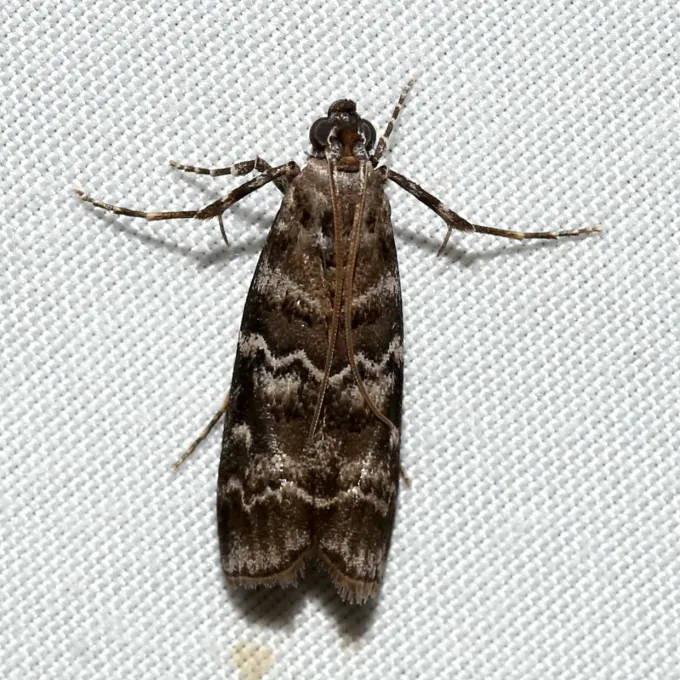
The Southern coneworm moth (Dioryctria amatella) belongs to the Pyralidae family. The adult moth features a wingspan of approximately 25–30 mm, with grayish-brown forewings adorned with intricate white zig-zag lines that provide excellent camouflage against pine bark.
The life cycle involves complete metamorphosis. Larvae undergo several instars, changing color as they grow, which is a key identifying factor. The caterpillars typically have a distinct head capsule and move through different tissues of the host plant.
The insect's biology is highly specialized, focusing on the reproductive structures of pine species. Female moths prefer to lay eggs on young cones or near fresh wounds on the tree bark, ensuring immediate access to food for the emerging larvae.
Diapause occurs at the larval stage, often inside abandoned cones or within the host tree's bark. This protective behavior allows the species to survive harsh winter conditions and makes early-season detection a significant challenge for foresters.
Depending on the latitude and climate, this species can produce one or two generations per year, with population density fluctuating based on the availability of preferred host species like longleaf or loblolly pine.
What it damages
The primary economic damage is caused to pine cones, as the larvae consume the developing seeds. This leads to substantial losses in seed orchards, directly impacting reforestation and nursery operations that rely on high-quality seed production.
Beyond cones, the larvae frequently attack shoots and the main stem of young saplings. By tunneling into the cambium layer, they disrupt nutrient flow, causing stunted growth, stem malformation, and occasionally tree mortality.
Entry wounds created by the larvae serve as infection courts for various pathogens, including pitch canker and other fungal diseases. This secondary damage can be more lethal to the tree than the primary larval feeding.
Infestations in plantations often cause significant economic losses by reducing timber quality. Distorted stems or multiple leaders resulting from larval damage lower the commercial value of the wood at harvest time.
Heavily infested cones often drop prematurely, further complicating seed collection efforts and resulting in lower germination rates for the remaining seeds that have been subjected to larval feeding.
Signs of infestation
A primary indicator of infestation is the presence of frass (larval excrement) mixed with silk webbing on the surface of cones. These accumulations are distinct and can be easily spotted during ground surveys of the forest floor or canopy.
Resin flow, known as "pitching," is a classic sign of larval boring into stems or shoots. Hardened resin masses on the bark indicate where larvae have penetrated the tissue, which is a major diagnostic feature for forest health technicians.
Flagging, or the browning and wilting of needles on specific branches, signifies internal larval damage that has interrupted the vascular supply to the branch. This visual cue often points to where the insect activity is currently localized.
Using light traps or pheromone baits during the flight season allows for precise monitoring of moth populations. This data is critical for determining the timing of control interventions to ensure the highest success rate.
During the off-season, close inspection of the ground beneath pines can reveal abandoned cones with telltale circular exit holes, confirming that the larvae have completed their development and successfully emerged.
Control measures
Sanitation is the most effective cultural practice; collecting and destroying infested cones prevents larvae from completing their life cycle and reduces the population for the following year in seed orchards.
Biological control, including the application of Bacillus thuringiensis, is effective when targeted at early-instar larvae. This method is preferred in environmentally sensitive areas as it has minimal impact on non-target species.
Chemical control using systemic insecticides is generally reserved for high-value seed production areas. Timing is crucial, and applications must coincide with the peak egg-hatching period to be effective.
Maintaining a healthy, diverse forest ecosystem helps sustain natural populations of parasitic wasps and other predators that help regulate the coneworm moth population naturally without human intervention.
- Use pheromone-baited traps for population monitoring.
- Implement strict sanitation measures in seed orchards.
- Promote natural predator habitat to improve biological control.
- Apply targeted biorational pesticides during peak larval emergence.
Taxonomy
- Latin name
- Dioryctria amatella
- Order
- Lepidoptera (butterflies)
- Family
- Pyralidae
- EPPO code
- DIORAM
Discussion
No discussions yet — be the first.