
Dioryctria moth
Dioryctria
Description
How to identify
The genus Dioryctria, commonly known as cone moths or coneworms, belongs to the family Pyralidae. These moths are notorious pests that specialize in feeding on the reproductive structures of various conifer species.
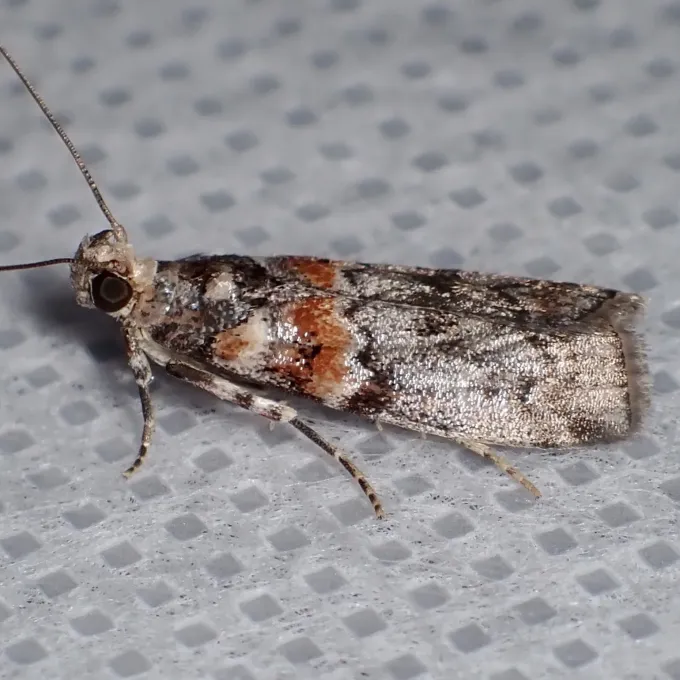
Adult moths are typically medium-sized with a wingspan ranging from 20 to 35 mm. Their forewings feature complex, mottled patterns of gray, brown, and black, providing excellent camouflage against tree bark.
The larvae, or caterpillars, vary in color from pale yellow to dark reddish-brown depending on the host species and their developmental stage. They possess robust mouthparts designed for boring into woody tissue.
Taxonomically, they are categorized within the subfamily Phycitinae. Their lifecycle is synchronized with the development of the cones, making them highly efficient at exploiting this resource.
These insects are significant in forest ecosystems as they can cause substantial losses in seed production, which has direct implications for reforestation efforts and commercial forestry.
What it damages
Dioryctria larvae primarily damage the cones of pines, spruces, larches, and firs. By tunneling into the cones, they destroy developing seeds and compromise the integrity of the cone structure.
Infected cones typically stop growing, become deformed, and often turn brown and fall prematurely. This results in significant seed crop losses, especially in seed orchards managed for forest regeneration.
In addition to cones, some species within the genus are known to attack young shoots and tree trunks, leading to stunted growth or the formation of resinous cankers on branches and stems.
The feeding activity often induces heavy resin flow as the tree attempts to defend itself. This resinous pitch often mixes with larval frass, creating unsightly, hardened deposits on the exterior of the cone.
Weakened trees are more susceptible to other forest pests and diseases, creating a negative feedback loop that can lead to long-term health decline of the affected stand.
When it appears
The flight activity of adult moths usually coincides with the conelet development phase of their host trees. This timing ensures that females can deposit eggs in optimal locations for their offspring.
Winter is typically spent in the larval stage. The caterpillars create silken cocoons in protected areas such as bark crevices, forest litter, or within hollowed-out cones that have fallen to the ground.
Spring temperatures trigger the pupation process, which is finely tuned to the host tree's phenology. Adult emergence follows, initiating the cycle for the upcoming season.
Depending on the climatic zone, some species produce one or two generations per year. Multiple generations can significantly escalate damage levels during the peak growing season.
As autumn approaches, the larvae enter a period of diapause. This adaptation allows them to survive extreme winter conditions, ensuring the survival of the population through the dormant season.
Signs of infestation
The most prominent sign of an infestation is the presence of frass (larval excrement) and boring dust at the base of the cone or near entrance holes, often glued together by resin.
Heavy resinosis on the surface of the cones is a definitive indicator of Dioryctria activity. The tree's attempt to seal the boring sites results in visible, glistening pitch droplets.
Prematurely browning or withered cones on a healthy branch are strong visual indicators. These cones are usually smaller than average and may be misshapen due to internal tunneling.
Inspection of the ground beneath infested trees may reveal fallen cones with exit holes, indicating that the larvae have completed their development and successfully emerged.
- Silken webs visible between cone scales.
- Distorted, stunted cone development.
- Visible tunneling marks when cones are bisected.
Control measures
Chemical control involving systemic or contact insecticides is often applied in seed orchards. Timing is critical, as applications must occur before the larvae penetrate the cone scales.
Silvicultural management includes the systematic collection and destruction of infested cones to reduce local population pressure for subsequent seasons.
Pheromone-based monitoring is highly effective for detecting moth presence and timing intervention strategies. This approach minimizes pesticide use and targets the pest population accurately.
Encouraging biological control agents, such as parasitoid wasps and birds, provides a sustainable way to keep population densities below the economic threshold in natural forest environments.
In nursery settings, maintaining rigorous hygiene and avoiding high-density plantings can prevent the rapid spread of infestations between individual seedlings and saplings.
Taxonomy
- Latin name
- Dioryctria
- Order
- Lepidoptera (butterflies)
- Family
- Pyralidae
- EPPO code
- DIORSP
Discussion
No discussions yet — be the first.