
Cactus moth
Cactoblastis cactorum
Description
How to identify
The Cactus moth (Cactoblastis cactorum) is a member of the Pyralidae family in the order Lepidoptera. The adult is a relatively small moth with a wingspan of 30–40 mm, featuring light gray or brown forewings with subtle darker markings.
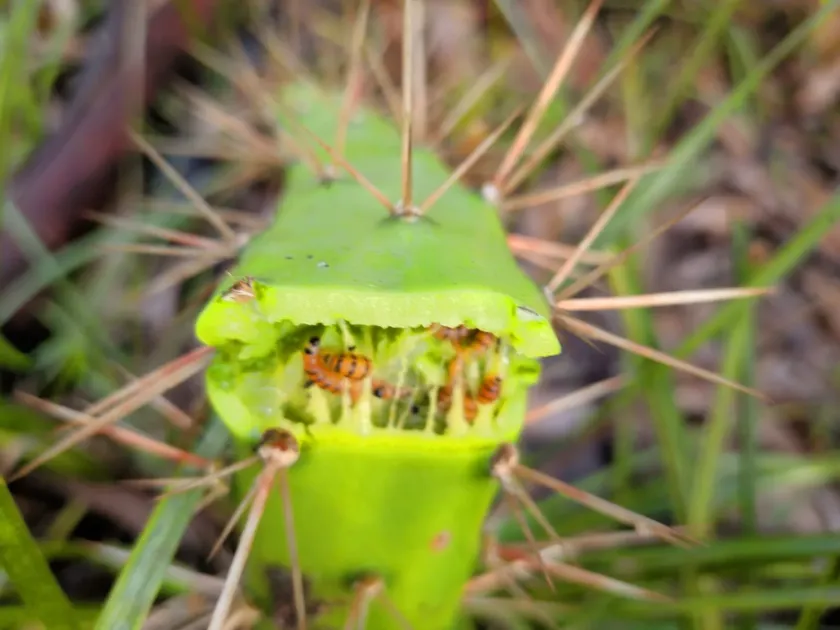
The larvae are bright orange with distinct dark transverse bands or spots, making them relatively easy to identify once they are exposed outside the host plant.
The lifecycle follows complete metamorphosis: egg, larva, pupa, and adult. Females lay eggs in distinctive chains that resemble the spines or small fruits of an Opuntia plant.
This species is highly invasive and was deliberately introduced in some regions as a biological control agent to manage weeds, but it poses a severe threat to commercial cactus nurseries.
Identifying the moth in its early stages is difficult, as the larvae spend almost their entire lives boring deep into the cactus tissue.
What it damages
The primary host for Cactoblastis cactorum is the genus Opuntia (prickly pear), but it can infest various other succulent species under certain conditions.
Larvae feed gregariously, tunneling into the fleshy pads of the cactus. Their feeding consumes the internal structure of the plant, causing rapid destruction.
The feeding tunnels create internal cavities that weaken the structural integrity of the plant, often leading to total collapse.
Secondary infections from bacteria and fungi typically follow the larval feeding, causing the cactus to rot and liquefy within a short period.
In cases of severe infestation, an entire colony of cacti can be decimated as the larvae move from pad to pad within the plant architecture.
When it appears
The activity of the Cactus moth is highly dependent on temperature, with adults emerging for mating during warmer months.
In tropical and subtropical regions, the pest can produce multiple generations per year, ensuring continuous pressure on plant populations.
The winter period is usually spent in the pupal stage, with the insects wrapped in silken cocoons located in debris or the topsoil near the host plant.
Spring and early summer are peak periods for infestation, coinciding with the rapid growth of host cacti, which provides abundant food for young larvae.
Environmental conditions, particularly humidity and warmth, are critical factors that influence the survival rate of eggs and newly hatched larvae.
Signs of infestation
The most reliable sign of an infestation is the presence of frass (larval excrement) appearing as small dark pellets on the surface of the cactus pads or the ground below.
Plants often exhibit localized yellowing or sagging, which indicates internal tissue destruction and potential rot caused by the larvae.
Holes in the cactus surface, where larvae have bored into or exited the tissue, are also key indicators of an active colony.
Upon closer inspection, the characteristic egg chains, which look like tiny beaded necklaces, can be found attached to the spines or edges of the pads.
- Dark frass pellets on or around the plant.
- Visible entry/exit holes in the succulent pads.
- Yellowing and decay of specific plant segments.
- Hollowed-out pads that collapse under pressure.
- Egg sticks found on host plant spines.
Control measures
The most effective mechanical control is the physical removal and destruction of infested plant parts before the larvae can complete their development.
Chemical control using systemic insecticides can be applied, although success is limited due to the larvae residing inside the protected cactus tissue.
Strict quarantine protocols are essential when introducing new cactus material into a collection to prevent the accidental arrival of the pest.
Monitoring using pheromone traps is highly recommended for commercial nurseries to detect adult moth activity early in the season.
Good sanitation practices, such as removing fallen pads and keeping the area around the base of the plants clear, help reduce overwintering sites for the pupae.
Taxonomy
- Latin name
- Cactoblastis cactorum
- Order
- Lepidoptera (butterflies)
- Family
- Pyralidae
- EPPO code
- CACTCA
Discussion
No discussions yet — be the first.