
Assara albicostalis
Assara albicostalis
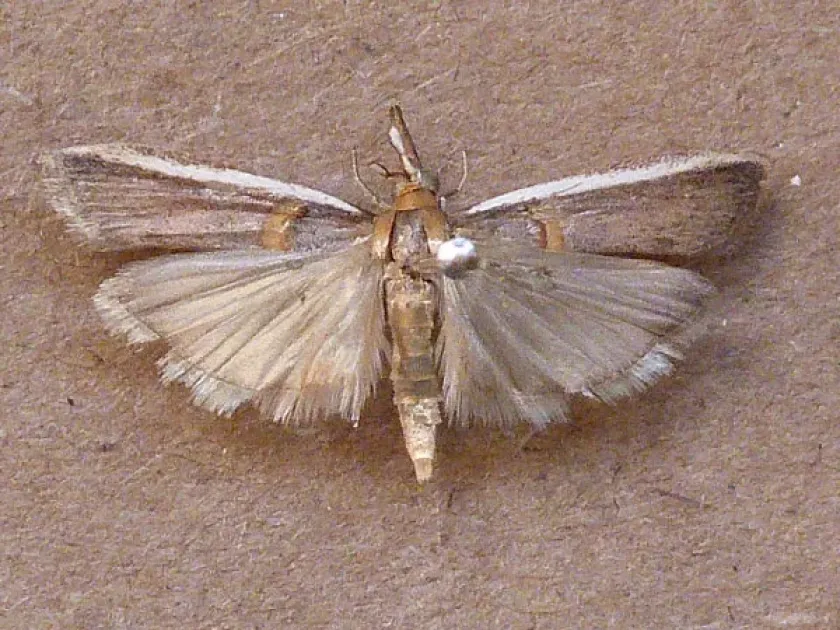
Description
How to identify
Assara albicostalis belongs to the order Lepidoptera and the family Pyralidae (snout moths). This insect is recognized by its distinct white stripes along the costal margin of its forewings, which serve as a primary diagnostic feature for identification.
As nocturnal insects, adult moths are rarely seen during the day. Their cryptic coloration allows them to blend in with foliage, making it difficult for field scouts to detect their presence without proper monitoring equipment.
The life cycle of the moth consists of four distinct stages: egg, larva, pupa, and adult. The larval stage is the primary cause of damage, as the caterpillars possess chewing mouthparts designed to feed on various plant tissues.
The larvae are typical in structure for the Pyralidae family, featuring a segmented body and prolegs that allow for efficient movement within host plants. Their size and coloration can vary depending on their maturity and the specific host tissue they consume.
Detection often relies on the use of pheromone traps, which attract male moths, providing data on population levels and allowing for the precise timing of necessary agricultural interventions.
What it damages
This pest is known to affect various plants within the Asteraceae family. In agricultural settings, it is primarily recognized as a pest of sunflowers, where it targets the generative organs of the plant.
Larvae bore into the sunflower heads, damaging developing seeds and the receptacle. This feeding activity disrupts seed set and development, directly resulting in significant yield losses for the grower.
In addition to direct tissue consumption, the damage caused by larvae facilitates the entry of secondary pathogens. Holes created by the pest often become epicenters for various fungal and bacterial rots, further degrading crop quality.
The economic impact of Assara albicostalis can be severe, especially during seasons with favorable climatic conditions that allow for multiple generations to develop throughout the growing period.
Beyond cultivated crops, wild host plants in the surrounding area can serve as reservoirs, maintaining pest populations even when commercial sunflower fields are not present.
When it appears
The adult flight period typically begins as temperatures rise in late spring or early summer, synchronized with the budding and flowering phases of host crops. The exact timing is highly climate-dependent.
Larval activity peaks during the period of head formation and seed filling. This stage represents the window of greatest vulnerability for the crop, as larvae are at their most voracious stage of development.
Depending on the region, the moth can complete multiple generations per season. This multivoltine nature means that overlapping generations may be present, complicating management and requiring ongoing vigilance.
Winter is usually spent in a state of diapause, either as pupae or mature larvae. They overwinter in sheltered locations, such as crop residues, leaf litter, or just below the soil surface, protected from extreme winter temperatures.
Proper monitoring of the growing season allows for the prediction of peak emergence times, which is critical for making informed decisions regarding the timing of integrated pest management practices.
Signs of infestation
One of the earliest signs of infestation is the presence of frass (larval excrement) on the surface of sunflower heads, often mixed with silk webbing created by the larvae as they feed.
Entry holes, often webbed over, indicate where larvae have successfully bored into the plant tissues. These holes are characteristic indicators of moth larvae activity and can be found on stems or floral disks.
Premature wilting or discoloration of specific sections of the plant head often indicates internal feeding activity. If the infestation is severe, entire sections of the head may fail to develop properly.
Dissecting damaged plant organs will often reveal the presence of larvae or their shed skins, confirming the identity of the pest and the severity of the internal damage being inflicted.
During the harvest phase, the presence of hollowed-out seeds or missing grains within the head provides clear evidence of previous pest damage that occurred during the reproductive growth stages.
Control measures
Cultural control measures are the first line of defense. Deep plowing of fields after harvest helps to bury crop residues, effectively killing overwintering pupae and larvae and reducing future population pressure.
Crop rotation is essential for breaking the life cycle of the pest. By moving host crops to fields distant from previous years' infestation sites, farmers can significantly limit the migration and colonization of the moth.
Biological control, such as the release of Trichogramma wasps, can be highly effective in parasitizing the eggs of the moth, providing a sustainable way to keep populations below the economic threshold.
Chemical control should be implemented only when monitoring data indicates that the pest population has reached the economic injury level, ensuring that insecticides are applied during the most vulnerable larval stages.
- Rigorous weed management to remove alternative host plants.
- Monitoring with pheromone-baited traps for early detection.
- Selection of sunflower hybrids with tighter floral heads.
- Timely harvesting to minimize the duration of crop exposure.
- Strategic application of targeted, biorational insecticides.
Taxonomy
- Latin name
- Assara albicostalis
- Order
- Lepidoptera (butterflies)
- Family
- Pyralidae
- EPPO code
- ASSAAL
Discussion
No discussions yet — be the first.