
Navel orangeworm
Amyelois transitella
Description
How to identify
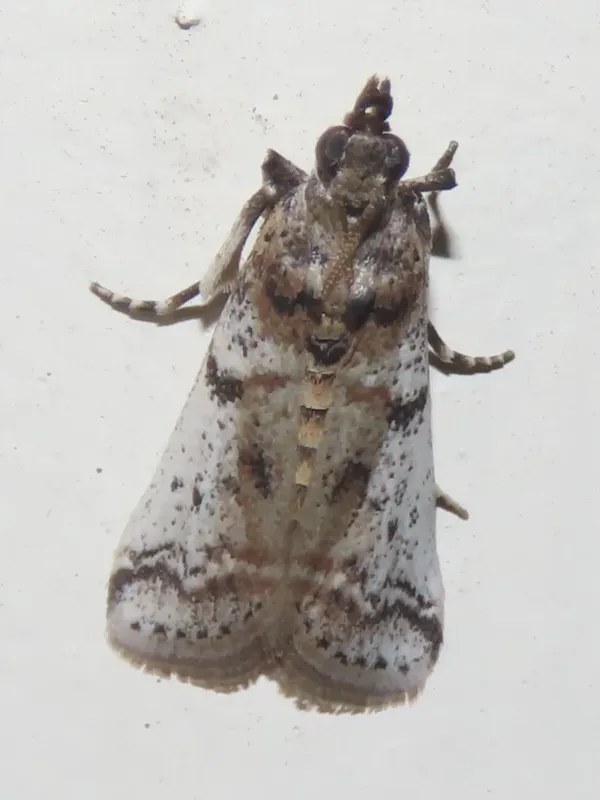
The Navel orangeworm (Amyelois transitella) is a moth species belonging to the Pyralidae family. It is a significant agricultural pest known for its destructive impact on various nut and fruit crops.
Adult moths have a wingspan ranging from 15 to 25 mm. Their wings are typically grayish-brown with distinct dark zigzag patterns, providing excellent camouflage against tree bark.
Eggs are oval-shaped and start as a creamy white color, eventually turning a reddish-orange hue as they approach hatching. They are usually laid singly on the surfaces of developing fruits.
Larvae pass through several growth stages, reaching up to 20 mm in length. They are characterized by a light-colored body and a distinctively dark, sclerotized head capsule.
Pupae are formed inside the infested fruits or within protected areas like crevices in the bark or crop debris, where they remain safe from environmental stressors.
What it damages
This pest primarily attacks almonds, pistachios, walnuts, citrus, figs, and apples. It is highly notorious for the direct economic losses it causes in nut production industries.
Larvae tunnel directly into the nut kernel or fruit flesh. This feeding behavior destroys the edible portion of the crop, making it unfit for commercial sale or human consumption.
Beyond physical damage, the tunneling activity exposes the fruit to pathogens, particularly Aspergillus fungi, which can produce dangerous levels of aflatoxins.
Once the protective hull or skin is breached by the larvae, the fruit becomes highly susceptible to secondary invaders, including other insects and various decay-causing organisms.
In cases of severe infestation, the cumulative loss can reach substantial portions of the harvest, requiring costly sorting and cleaning processes to salvage the remaining crop.
When it appears
The life cycle of the Navel orangeworm is highly dependent on ambient temperatures and the availability of suitable host plant material throughout the growing season.
Overwintering occurs primarily in the larval stage, residing within "mummy" nuts—fruits that were not harvested and remain attached to the trees or on the orchard floor.
As temperatures rise in spring, the overwintered larvae pupate. The emergence of the first generation of adults coincides with the development of the new season's fruit set.
Peak activity and oviposition often align with the maturation phase of the fruits, when the physical barriers of the fruit hulls begin to soften or open.
Multiple overlapping generations can occur in a single season, creating a constant pressure on the orchards until the final harvest is completed and cleanup begins.
Signs of infestation
One of the earliest signs of infestation is the appearance of frass (larval waste) on the surface of the fruit or near the point of attachment to the stem.
Silken webbing around the entry holes or fruit clusters is a strong indicator of larval activity, serving as a defensive structure while the larva feeds internally.
Premature color changes, wilting, or unusual fruit drop patterns are key visual alerts for orchard managers to investigate the crop more closely for potential pest damage.
Internal inspection of fallen or damaged nuts reveals extensive tunneling and the accumulation of brown, sawdust-like frass mixed with fungal growth.
Pheromone-baited traps are standard tools for detection, providing critical data on the timing of moth flights to predict when eggs are likely being laid.
Control measures
Sanitation is the cornerstone of control; removing and destroying mummy nuts from the trees and orchard floor significantly reduces the overwintering population.
Timing insecticide applications based on pheromone trap monitoring is essential to ensure efficacy, targeting the larvae before they bore deep into the fruit.
Biological control methods, such as the release of parasitic wasps, play a vital role in natural population management within sustainable orchard systems.
- Early and efficient harvesting to minimize the duration of vulnerability on trees.
- Proper storage conditions, including cool temperatures, to prevent post-harvest development.
- Regular orchard monitoring and prompt removal of infested fruit during the season.
Integrated Pest Management (IPM) programs combine these cultural, biological, and chemical strategies to maintain population levels below the economic threshold.
Taxonomy
- Latin name
- Amyelois transitella
- Order
- Lepidoptera (butterflies)
- Family
- Pyralidae
- EPPO code
- PARMTR
Discussion
No discussions yet — be the first.