
Grease moth
Aglossa pinguinalis
Description
How to identify
The Grease moth (Aglossa pinguinalis) is a moth belonging to the family Pyralidae, commonly found in storage facilities and barns.
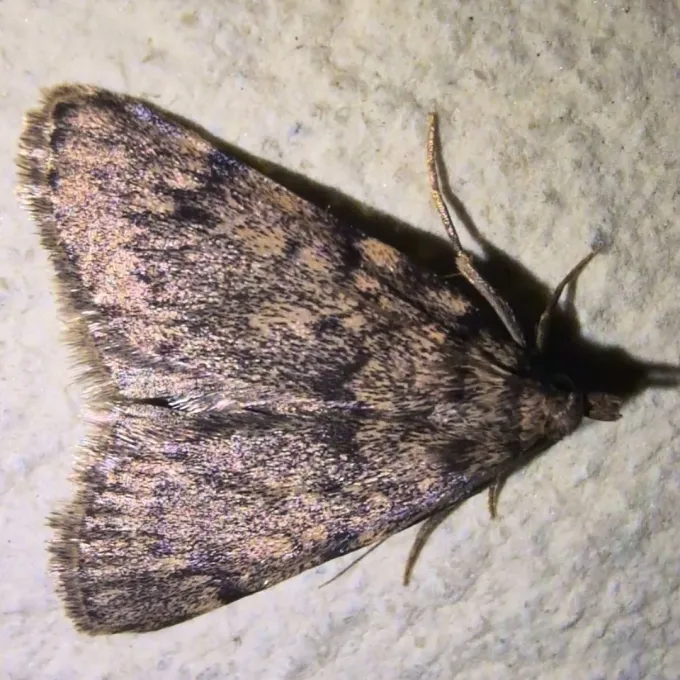
The adult moth has a wingspan of 20–30 mm, with dark, greasy-looking forewings that give it a distinctive, shiny appearance.
The larvae are approximately 25 mm long, greyish-brown in color, and have a dark, well-defined head capsule.
Pupation occurs within a sturdy silken cocoon, which is often coated with bits of debris or food particles from its environment.
These moths are nocturnal and are usually found resting in dark, sheltered areas of buildings during daylight hours.
What it damages
This species is a typical pest of stored products, particularly in environments with high humidity or poor sanitation.
Larvae feed on a wide range of dry plant products, including cereals, flour, bran, dry vegetables, and animal feed.
They are particularly attracted to decaying or damp materials, often causing significant damage to products that are beginning to rot.
The main economic impact is caused by the larvae webbing the product together, contaminating it with feces, and rendering it unsalable.
Large populations in warehouses can lead to massive spoilage of stored stocks, especially when ventilation is inadequate.
When it appears
The flight period for adult Grease moths typically occurs during the summer months, spanning from June through August.
In temperature-controlled storage facilities, the life cycle may continue throughout the year with overlapping generations.
The larvae of the final instar usually overwinter in cracks, wall crevices, or under storage pallets, showing high cold resistance.
Pupation takes place in the spring as temperatures rise, signaling the emergence of a new cycle of adult moths.
The rate of development is heavily influenced by the nutritional value of the food source and the moisture levels of the storage area.
Signs of infestation
The most evident sign of infestation is the presence of silk webbing, which binds food particles into clumps within the stored material.
A musty or rancid odor is often associated with the presence of larvae and the subsequent mold growth in damaged goods.
Adult moths can often be seen resting on walls, rafters, or bags in the dark corners of the storage facility during the day.
The loss of free-flowing properties in grain or flour, caused by extensive larval webbing, is a classic symptom of infestation.
Finding empty cocoons attached to storage containers or warehouse walls confirms that the infestation is well-established.
Control measures
Sanitation is the most effective prevention strategy, requiring the removal of spilled grain and debris from the warehouse floor.
Maintaining low humidity levels within the storage area is crucial to prevent the development of larvae, as they thrive in damp conditions.
Regular inspection and the use of approved insecticides on surfaces can help reduce population densities in heavily infested areas.
Storing products in sealed, airtight containers prevents female moths from laying eggs, effectively protecting the stored goods.
Pheromone traps should be used for monitoring to detect early activity and apply targeted control measures before significant damage occurs.
Taxonomy
- Latin name
- Aglossa pinguinalis
- Order
- Lepidoptera (butterflies)
- Family
- Pyralidae
- EPPO code
- AGLOPI
Discussion
No discussions yet — be the first.